
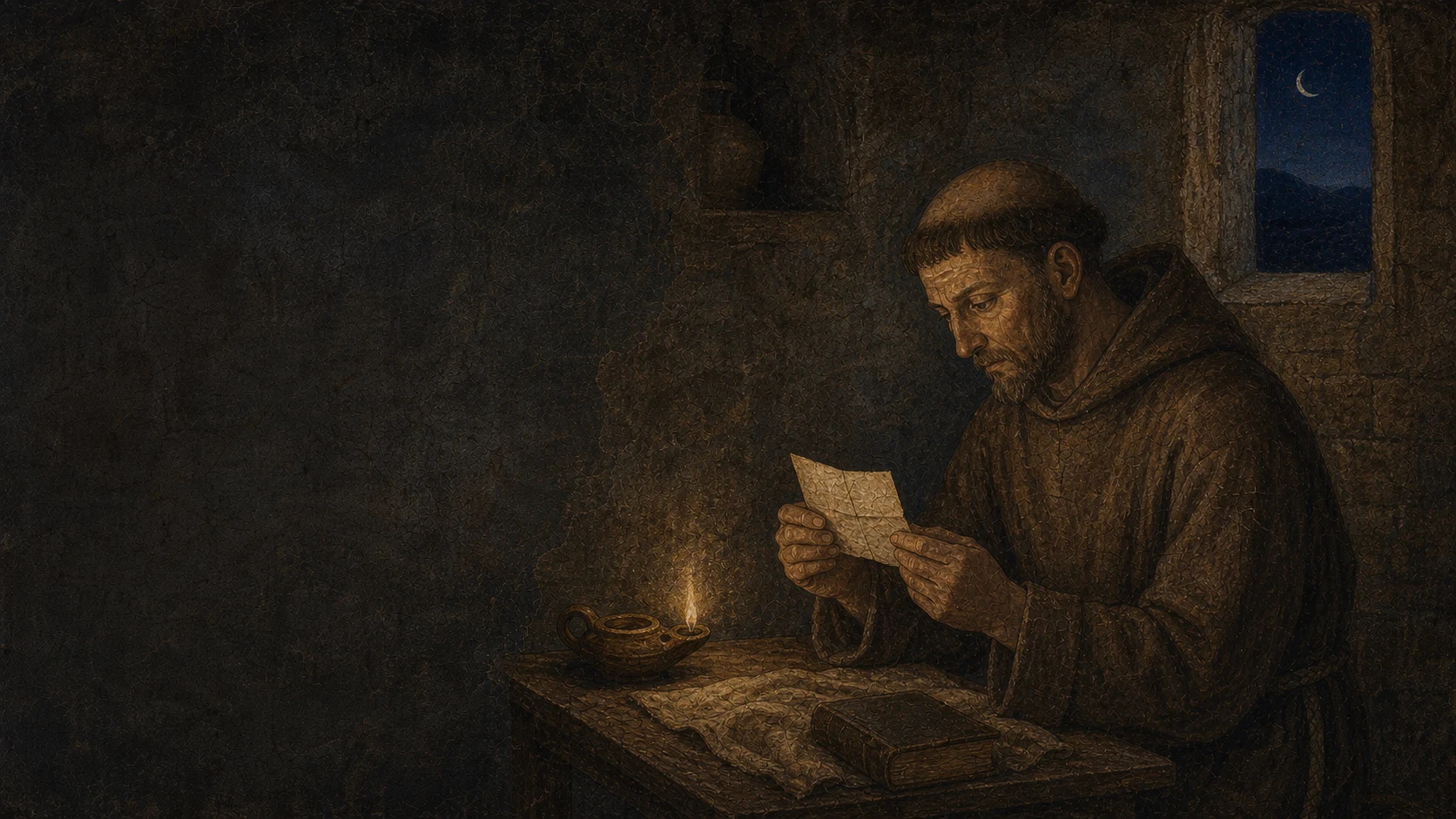
Imagine a stone cell after the night bell has rung. The wind passes through the cracks. An oil lamp makes a small shadow tremble on the wall. On a table lies a sheet of parchment smaller than a book, marked by folds, time and the hands that carried it.
A friar holds it carefully. His name is Leo.
He is not looking at a copy made by a scribe. On that sheet, he recognises the awkward strokes of his friend Francis’s hand. On one side are the Praises of God Most High. On the other, a blessing that ends by calling Leo by name.
The parchment still exists today. It is one of those rare occasions when we can stand not only before a story about Francis, but before something he actually touched and wrote. The sheet is small. What it holds is immense.
The man almost hidden behind the saint
We do not know when Leo was born. Nor do we know exactly when he entered the fraternity. The most reliable sources place him among Francis’s close companions during the final years of his life. He served as a companion and confidant and, according to early tradition, as secretary and confessor.
At that time, being a “secretary” meant helping to write, preserving messages, accompanying journeys and remembering decisions. Francis’s health became fragile, and the brothers closest to him had to listen carefully.
Leo lived close to the voice before he lived close to the papers.
In the Middle Ages, memory did not reside only in libraries. It also remained in people. A companion remembered how Francis pronounced a phrase or what advice he had given on a road. As these brothers grew old, their memories became precious—and difficult to verify. To remember is to preserve, but every human memory changes a little with time.
That is why, when we speak of Leo, we must hold two things together: tenderness and historical care.
The small sheet from La Verna
In 1224, Francis spent a period in prayer on Mount La Verna. It was there, near the end of his life, that tradition places his reception of the stigmata. Leo was among the companions associated with that retreat.
The so-called Chartula of Assisi is a small fragment of parchment, about ten by thirteen centimetres. On one side, Francis wrote the Praises of God Most High: a prayer that repeats “You are” and contemplates God as strength, beauty, humility, protection, hope and peace. On the other side, he wrote a blessing inspired by the biblical Book of Numbers:
May the Lord bless you and keep you.
May he show his face to you and have mercy on you.
May he turn his countenance toward you and give you peace.
May the Lord bless you, Brother Leo.
Francis also drew the sign of the Tau, the form of the cross that he loved. Leo’s name appears beside that sign.
Most extraordinary of all, specialists recognize the main text as an autograph by Francis: it was written in his own hand. Leo added brief notes to explain and identify the gift. In one, he states that Francis wrote the blessing for him; in another, he identifies the Tau made by Francis’s hand. The sheet thus preserves two presences: the hand that blessed and the hand that refused to let the blessing go unwitnessed.
The parchment is now preserved in the Sacred Convent in Assisi. It was folded and probably carried for a long time. It did not reach us smooth, like a piece fresh from a workshop. It reached us wounded by care.
What we know—and what the narrative added
Thomas of Celano wrote around 1246–1247 that one of Francis’s companions was suffering from a severe inner temptation and wished to receive some words of God written by the saint’s hand. According to Celano, the companion did not speak of this desire. Francis, however, asked for parchment and ink, wrote the praises and added the blessing. The anguish then departed.
Celano does not name this companion as Leo in that passage. The sheet itself, with Leo’s notes and his name in the blessing, allows us to make the connection. It is a rare union between an early narrative and a surviving object.
It is worth noticing the layers. The existence of the parchment, Francis’s handwriting and Leo’s annotations are material evidence. The inner suffering and unspoken desire come from Celano, writing a little more than twenty years later. It is close testimony, but it is already a religious narrative.
Centuries later, other versions made the scene more detailed and wondrous. We may receive them as devotional tradition without pretending that every detail carries the same weight as the surviving sheet.
Perhaps Leo kept the parchment because the temptation passed. Perhaps he kept it because it bore the trace of a friendship. Perhaps both are true. The object does not let us hear everything that happened in the cell at La Verna. It simply allows us to come very close.
When Francis was no longer there
Francis died on the night of 3 October 1226. For those who had accompanied him, it was not only a founder who disappeared. They lost a familiar voice, a way of looking and a presence able to correct and console.
After Francis’s death, the Order grew rapidly. Houses, schools, churches and tensions emerged. How could poverty be lived when thousands of friars needed shelter? Sincere brothers could answer in different ways.
Leo became associated with the demanding memory of the earliest poverty. Later texts portray him in conflict with decisions made by Brother Elias and with the construction of the great basilica in Assisi. Some accounts say that he knocked down a box intended for donations to the building works and was punished. These episodes, however, came through later traditions and do not have the same documentary solidity as the Chartula. They reveal how later generations saw Leo: the guardian who preferred a poor stone to a splendid monument.
We need not turn Leo into the hero of a faction. He recalled that a work built in honor of Francis could forget what Francis had loved. The question remains: is it possible to speak grandly of poverty and lose simplicity?
Three companions send a remembrance
In 1244, the minister general Crescentius of Jesi asked the friars to send information about Francis’s life. Two years later, at Greccio, Leo, Rufino and Angelo signed a letter. They said that they had gathered memories as well as testimony received from other close brothers, including Bernard and Giles.
This letter, dated 11 August 1246, is an important piece of evidence. It proves that Leo participated in a deliberate effort to preserve memories. Yet the text we now call the Legend of the Three Companions has a complicated history. Scholars debate how much of the work in its present form corresponds to the material originally sent by the three friars. The letter is early; the book’s final form may have undergone selection and reorganisation.
Something similar applies to the Mirror of Perfection. For a time, some argued that Leo had written the entire work. Today, that claim is treated with great caution. The book appears to be a later compilation and may preserve material from Leo and other companions, but it should not simply be presented as “the book written by Brother Leo”.
This uncertainty shows how medieval memory was constructed. A recollection could be noted on a sheet, told in the refectory, gathered by another friar and finally incorporated into an anonymous manuscript.
Early reports speak of rolls and sheets attributed to Leo and deposited with the sisters of Saint Clare. Those materials did not survive as an identifiable collection. Perhaps fragments of them passed into later compilations. We do not know. The door remains ajar, but we must not claim to see the whole room.
Preserving is not freezing
Leo lived for decades after Francis and died, according to tradition, in 1271. He saw the fraternity spread and people who had never known Francis debate what he had wanted. Perhaps he felt the pain of hearing someone tell differently what he himself had witnessed.
But no one can preserve an entire life alone. Leo held a privileged position, not a perfect point of view. Clare, Rufino, Angelo, Giles and Bernard also knew Francis. Each testimony illuminates one part and leaves others in shadow.
Perhaps Leo’s most beautiful gesture was to preserve small signs: a folded sheet, an identifying note, episodes offered for examination. He left traces through which we still ask: where did this account come from? Who was there? How long afterwards was it written?
These questions do not destroy the wonder. They clean the glass of the oil lamp.
The guardian also needed to be guarded
When we look at the Chartula, it is easy to think only of Leo as the protector of a relic. But the sheet came into being because he himself needed protection. The guardian of the memories was a troubled man. The blessing that crossed the centuries was first a word addressed to someone who was suffering.
That changes everything. Leo did not preserve Francis as someone locks a jewel in a box. He preserved a relationship in which he could be vulnerable. His friend’s voice did not say, “Be strong on your own.” It said, “May the Lord bless you and keep you.”
The parchment continues to speak because it fits in the hands and bears folds and worn areas. It resembles human memory: precious, incomplete and vulnerable.
In the cold stone of the friaries, many books disappeared. Rolls were lost. Names were forgotten. But that small sheet remained.
Leo kept it. Then others preserved what Leo had preserved. And now, when we see it, we find not only Francis’s handwriting. We also find the quiet fidelity of a brother who understood that certain fragile things cross time only when someone decides not to let them go.
Touchstones
Sources for this story
- Franciscan Sources — Franciscan Province of the Immaculate Conception of BrazilBrings together in Portuguese Francis’s writings, the note to Brother Leo, the biographies by Thomas of Celano, the Legend of the Three Companions, the Legend of Perugia and the Mirror of Perfection.
- “The autograph of Brother Francis and Brother Leo” — Sapienza University of RomeA codicological and palaeographical study of the Chartula di Assisi, with attention to the relationship between text, image and blessing.
- The Medieval Review: The Writings of Francis of AssisiAn academic review that describes the two autograph texts on the Chartula and presents modern discussions of their historical interpretation.
- Leo of Assisi — Biographical Dictionary of the Italians, TreccaniA reference entry with documentation and critical bibliography on Leo, the writings attributed to him and the earliest Franciscan sources.
- Letter and Legend of the Three Companions — Custody of Saint Francis of AssisiThe text of the letter signed in 1246 by Leo, Rufino and Angelo, and of the biographical tradition transmitted under the three companions’ name.
How we read the sources: the Chartula, Francis’s handwriting and Leo’s notes are material documents from the 13th century. Celano’s account is early and close to the events, but it already has a hagiographical form. Episodes preserved only in later compilations are presented here as tradition, not as equally proven fact.