
The dawn without Francis’s voice
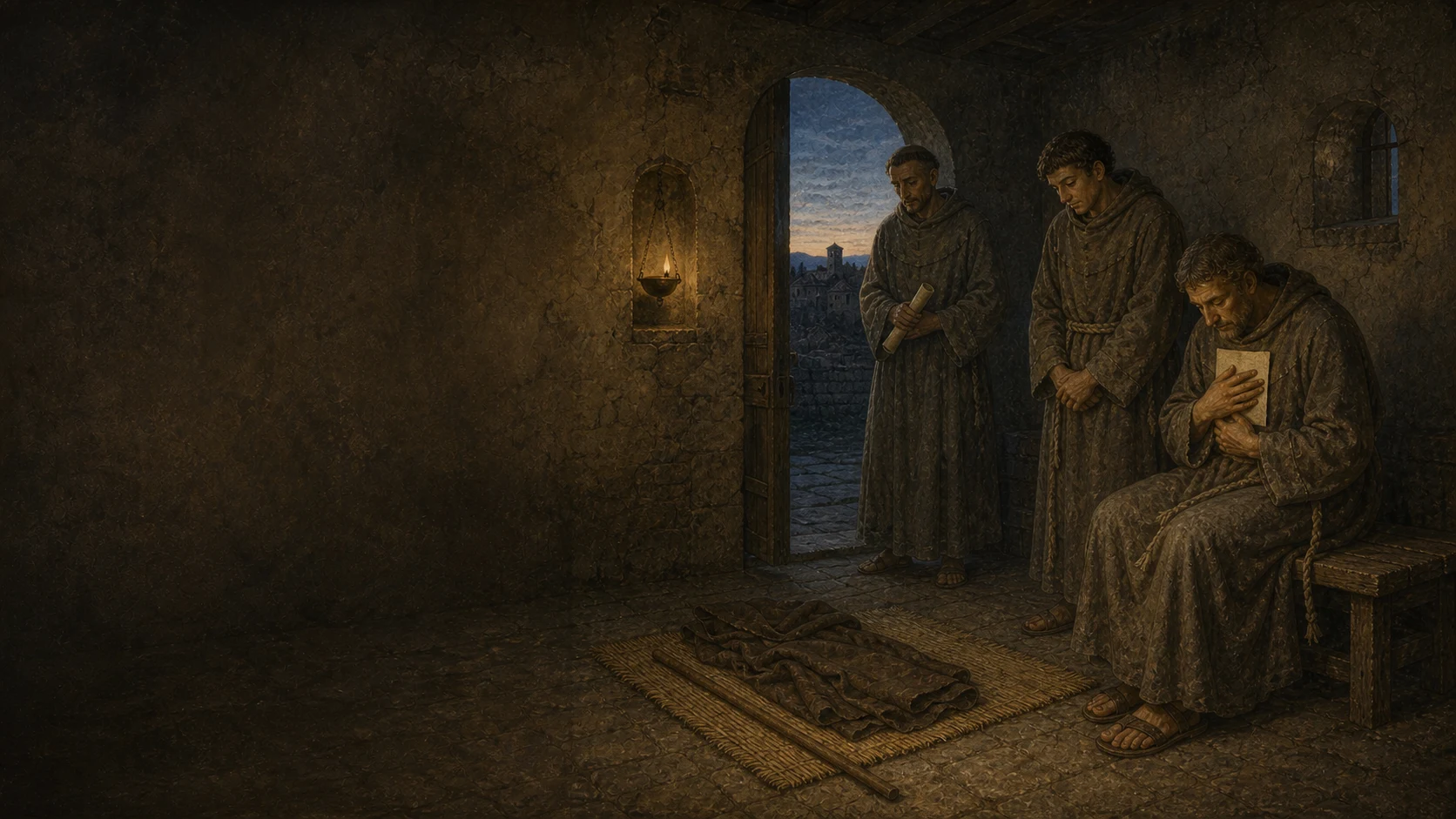
Night fell over the Portiuncula. The little church still stood, surrounded by poor huts and dark fields. Wind moved through the trees. Inside a nearby house, several men looked toward the place where Francis had been.
He had died in the evening of 3 October 1226. The brothers could still recognize his patched tunic and recall his weakened voice. But they could no longer ask, “Francis, what should we do now?”
This is one of the most human scenes in Franciscan history. A fraternity that had reached distant regions was losing the person who had given it a face. There was a Rule approved by the Church, along with ministers, chapters and missions. Even so, no sheet of parchment could replace the presence of someone they loved.
We do not know the names of everyone who spent that dawn near the Portiuncula. The early narratives do not record every hour. We know what matters: the brothers remained. Remaining would be harder than remembering.
A body, a town and many tears
Thomas of Celano, author of the first official biography of Francis, says that a crowd accompanied the body. The procession passed San Damiano, where Clare and the sisters could say goodbye, and continued to the church of San Giorgio inside Assisi. Francis was temporarily buried there.
Celano completed his work around 1228 or 1229 at the request of Pope Gregory IX. It is an indispensable source, but a medieval saint’s life sought both to preserve facts and to reveal their spiritual meaning. Celano did not write like a reporter standing before a camera.
The brothers believed that the marks of Christ’s Passion were present on Francis’s body. The tradition of Elias’s letter is among the earliest testimony to that conviction. For believers, they were the stigmata; their supernatural meaning belongs to faith and cannot be measured like a stone wall.
Francis’s death ceased to be an event belonging only to the small fraternity. Assisi, too, sensed that something precious belonged to it.
The short Testament
Shortly before his death, Francis dictated a text he called his Testament. He recalled his encounter with people affected by leprosy, his faith in churches, the arrival of the brothers and the discovery of a way of life according to the Gospel.
In one short sentence, he summed up the beginning of everything: “The Lord gave me brothers.” At the end, he asked that the Rule and Testament be understood without explanations that emptied them of their force. He also wanted the friars not to seek privileges to make their path safer.
The text was both memory and warning. The fraternity was already very different from the little group at Rivo Torto. There were scholars, preachers, priests and distant provinces. Growth brought new choices: could the brothers own books? What kind of houses were acceptable? Who would answer to the authorities?
The Testament offered no detailed answer to all these questions. It preserved a direction: do not forget poverty, simplicity, work, obedience and the condition of being lesser brothers.
What truly remained
Not a formula, but a direction
Francis left the Rule of 1223, his writings and a living fraternity. He did not leave a complete plan for the centuries ahead. The brothers would have to decide how an intuition born among people with leprosy, chapels and roads could continue in cities, schools and lands Francis had never visited.
Who would fill the empty place?
The Rule itself showed the way. When there was no minister general, the provincial ministers and custodians were to elect a successor at the Pentecost Chapter. Francis had not built a family that would depend forever on his personal command.
Brother Elias remained in charge as vicar during the following months. At the chapter of 1227, however, the electors chose Brother John Parenti, who had worked in the province of Spain. The choice reminds us that the fraternity was already international. The successor was not simply the best-known companion in Assisi.
We know little about John Parenti. The Middle Ages resembles a corridor in which some doors survived and others vanished. He led the Order at a decisive moment, but his voice reaches us only faintly.
Elias, by contrast, would remain highly visible. He was given responsibility for the construction of the great church intended to receive Francis’s remains. He later became minister general and one of the most disputed figures in Franciscan history. Some sources accuse him severely; others remember his organisational ability. The texts were written amid conflict, so historians must avoid both turning him into a perfect villain and declaring him innocent of every criticism.
A basilica for the poor brother
On 16 July 1228, less than two years after the death, Gregory IX proclaimed Francis a saint in Assisi. A new basilica began to rise on the hillside. Masons, pack animals, scaffolding and blocks of stone filled the landscape.
The building held a contradiction that still makes us think. How could a grand structure honor the man who had chosen small, poor houses? For the pope and many friars, the basilica would honor Francis, welcome pilgrims and protect his body. To other brothers, so much magnificence looked dangerous.
Later sources turned these tensions into stories with heroes and traitors. Reality was more confused. One brother could love Francis and imagine a magnificent church; another could oppose the project out of sincere loyalty to poverty. Conviction, fear, ambition and affection could mingle.
In May 1230, Francis’s body was transferred to the new basilica. The quick and private manner of the final burial caused controversy. The tomb would remain hidden for centuries, deepening the mystery. We do not need to invent secret passages or conspiracies to make the history fascinating. The documents already confront us with questions that have no complete answer.
When the words needed interpretation
That same year, 1230, the leaders of the Order presented practical questions about the Rule to the pope. Gregory IX replied in a document called Quo elongati. Among other decisions, he declared that Francis’s Testament was not legally binding as a second Rule.
For some friars, this helped an enormous community function. For others, it opened a door leading away from the founder’s wishes. The argument did not end. It would become a long fracture within the Franciscan family.
It is tempting to want a simpler history: on one side, the good people who preserved everything; on the other, the bad people who destroyed everything. Real people rarely fit such a clean design. The brothers inherited simple words and new circumstances. They had to interpret even when they said they did not want to interpret.
The smell of ink on the Rule, the cold stone of the basilica and the memory of the Portiuncula began to live together. The union was not always peaceful.
The keepers of the little stories
As the years passed, another danger emerged: Francis might become only a distant image surrounded by miracles while his human gestures were forgotten.
In 1244, Minister General Crescentius of Jesi asked the brothers to send in memories that had not yet been recorded. On 11 August 1246, Leo, Rufino and Angelo wrote from Greccio, saying that they had gathered episodes which they had witnessed or heard from trustworthy brothers.
This letter is precious. It shows that the memory of Francis did not appear ready-made. It was gathered: a conversation remembered beside the fire, a gesture seen on a road, a correction someone never forgot. The three companions compared memories and offered their material like people gathering a few flowers from a much larger field.
Scholars dispute the exact fate of everything they sent. For a long time, the work known as the Legend of the Three Companions was attributed directly to them. Today the relationship between the letter and the text is recognized as more complicated. The Greccio letter is firmly connected with the three men; the final form of the Legend, however, passed through a process of composition and transmission that we cannot reconstruct in full.
That does not make the old stories useless. It teaches us to read them attentively. A memory recorded by someone who lived with Francis carries one kind of weight. A narrative that emerged many decades later carries another. Both may preserve beauty; they do not have the same proximity.
Remaining was also a way of traveling
The brothers who remained did not stand still. Some crossed mountains. Others preached in towns. Some cared for the sick, studied or copied pages. Leo kept small writings safe. At San Damiano, Clare protected the form of poverty she had received. Ministers organized a family growing faster than anyone had expected.
They also disagreed. Some decisions caused pain. Certain memories were emphasised, while others remained in shadow. Franciscan history after Francis’s death does not begin as a flawless stained-glass window. It begins as a house full of grieving brothers, each trying to recognize the same voice amid unfamiliar sounds.
Perhaps this is the lesson left by that dawn: faithfulness is not preserving a person as one preserves a stone. It is allowing that person’s life to go on asking questions.
Francis was no longer before them. But someone with leprosy still awaited care, a Gospel still had to be lived, a difficult brother still had to be loved and a road still lay beyond the door.
Documentary stones
Sources for this chapter
- Testament of Saint Francis — Order of Friars MinorDirect source, 1226. The memory of the beginning, the phrase “the Lord gave me brothers” and Francis's final exhortations.
- Rule of 1223 — Order of Friars MinorDirect, normative source. It explains the election of the minister general and the structure that continued after Francis's death.
- Circular letter attributed to Brother Elias on the death of FrancisTradition of a document from 1226. Early sources attest that the letter was sent, but its surviving form is late and its authenticity disputed.
- Thomas of Celano — First Life of Saint FrancisContemporary biography, completed around 1228–1229. The principal early narrative of the death, procession and farewell.
- Vatican News — Francis's canonisation in 1228Context for the proclamation of sainthood by Gregory IX and the beginning of the Assisi basilica.
- University of Naples — Greccio letter and the tradition of the Three CompanionsThe companions' memory, 1246. It explains the gathering of recollections by Leo, Rufino and Angelo and the problems in the text's transmission.
- Noel Muscat — History of the Franciscan Movement, vol. 1Modern historical synthesis. It discusses John Parenti, Elias, the basilica, the 1230 transfer and the tensions of the first decades.
How to read this chapter: dates, documents and institutional decisions are based on the sources listed. The night-time opening is a respectful literary reconstruction. We do not know which brothers remained at every moment or their private words. Early hagiographic accounts are identified as such; later traditions are not presented as direct testimony.