
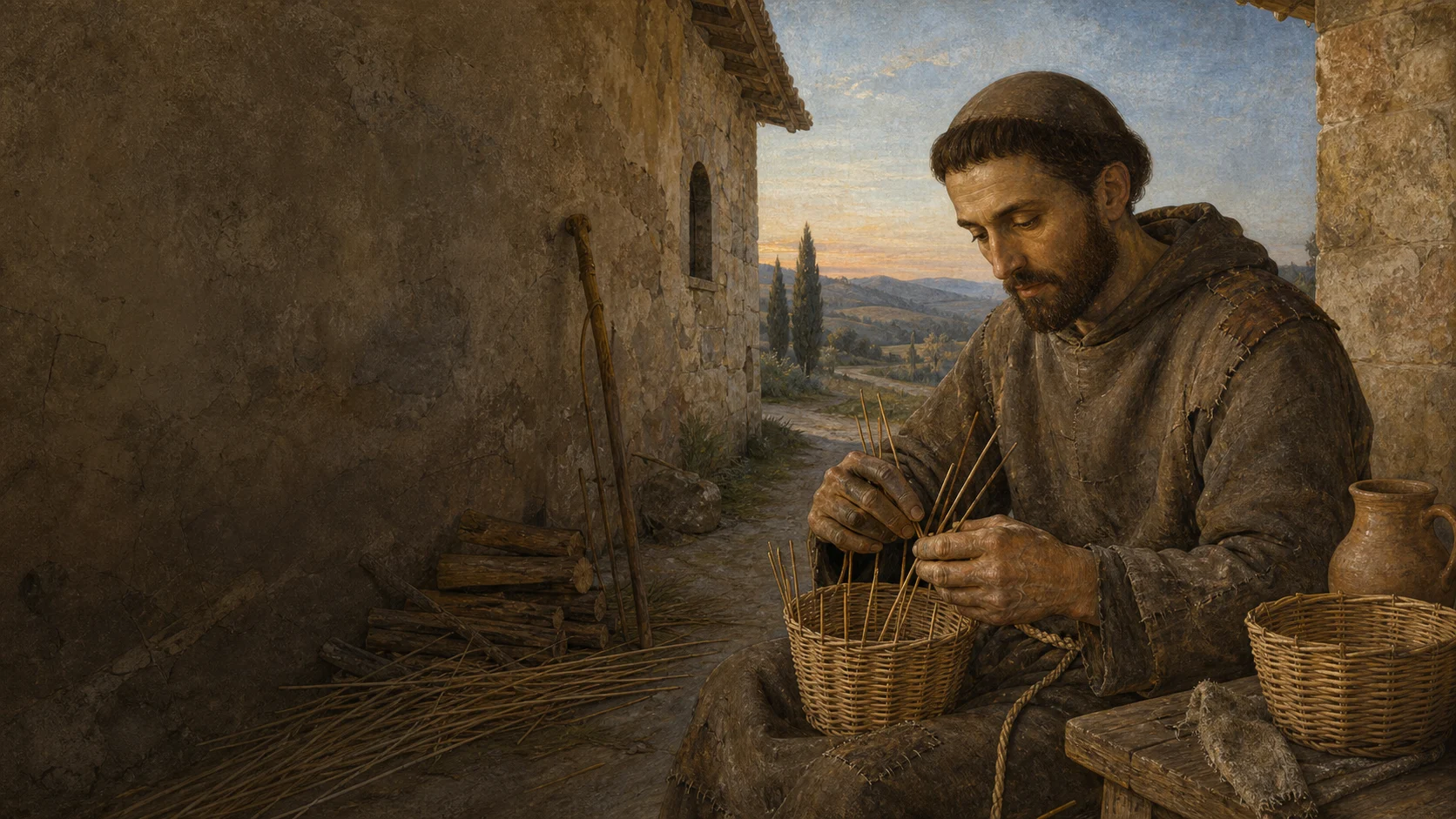
The day is only beginning when Giles sits before a stone wall. The morning air is cold. Reeds lie scattered on the ground, with an earthenware jar and a half-finished basket on his knees.
He chooses one fibre and passes it beneath another. His fingers bear old cuts, earth in their lines, and the calluses of someone who has held axes, ropes, and buckets.
At some point, the bell will call him to prayer. Until it rings, the only sound is dry reed brushing dry reed.
For Giles, that work does not interrupt the spiritual life. It is part of it.
A Man Who Arrived Fourth
We know almost nothing about Giles’s childhood or family. Tradition presents him as a peasant, but the sources do not allow us to treat that as certain. We know that he was from Assisi and probably had no formal education.
On 23 April 1209, he sought Francis.
Bernard of Quintavalle and Peter Catani had already left their possessions to live the poverty of the Gospel. Giles also wanted to share that life.
He found a handful of men near the Portiuncula, a tiny chapel on the plain. Could they live as brothers and proclaim peace without making money the center of everything?
Francis welcomed Giles joyfully. The early sources place him among the first companions, traditionally as the fourth to arrive.
It was Saint George’s Day, the knight remembered for facing a dragon. Giles received neither sword nor horse. He received a poor tunic and a road.
Two Brothers Walking
Soon afterwards, Francis and Giles set out toward the March of Ancona, on Italy’s eastern side. The first friars traveled two by two. They had no carriage loaded with provisions. They walked.
After many hours came dust, thirst, and the weight of the sun. Medieval roads had no clear signs or night lighting. travelers depended on springs, villages, and strangers.
Francis spoke simply to people. Giles was not yet a preacher. The early narrative says he affirmed his companion’s words and invited listeners to believe them.
His first sermon may have been the way he walked.
When someone offered food, he gave thanks. When work was available, he joined in. Francis taught that friars able to work should do so honestly.
Giles took this very seriously.
Bread Should Not Arrive Without a Face
On his journeys, Giles tried to earn food with his own hands. Early biographies and later expansions collect many examples: making baskets, carrying water, cutting wood, helping with harvests, cleaning a house, and tending to tasks no one considered important.
Not every episode has the same historical security. The exact order of his journeys is also difficult to reconstruct. Even so, the different traditions agree on one point: manual work was a genuine hallmark of his life.
In Ancona, he is said to have made reed baskets. In Rome, he supposedly cut wood, gathered walnuts, and helped tread grapes in the winepress. In other cities, he carried water and accepted humble work in exchange for bread or shelter.
For Giles, bread had a history: someone sowed, harvested, milled, and carried it to the oven. Working kept that effort from becoming invisible.
His hands learned gratitude.
The Road Grew Longer and Longer
Giles did not remain near Assisi. With Bernard, he traveled to Santiago de Compostela, in the northwest of present-day Spain. He also visited Italian shrines and journeyed east, reaching the region of Acre in the Holy Land.
The dates of some journeys are debated. Researchers agree more readily on the places than on their exact sequence.
He was not always welcomed. Friars could look like vagrants or strange people. But work crossed differences: a field needed clearing in any language. Anyone who saw Giles helping could understand his message before understanding his words.
Yet work was not merely a strategy for acceptance.
It was a school against pride.
The Danger of Choosing Only Beautiful Tasks
It is easy to enjoy a task when it brings praise. It is harder to sweep a floor that will become dusty again, knowing no one will remember our name.
When Giles stayed in the household of Cardinal Nicholas, bishop of Tusculum, between 1225 and 1226, he continued seeking humble tasks. Tradition shows him sweeping and cleaning utensils even in a house where he might have been treated as an honored guest.
He distrusted idleness disguised as religion. A friar should not speak to others and leave every heavy effort to less admired people.
The “Sayings” attributed to Giles repeatedly unite word and action. Instead of copying a sentence as though it were an exact recording of his voice, we can summarise it this way:
A good word points out the road; a good deed begins to walk it.
This applies to a twelve-year-old too. We can talk about helping but never put away what we use; defend generosity but never share; say we respect everyone but despise the person who cleans our school.
Our hands reveal whether our mouth is telling the truth.
Work Is Not a Punishment
His story does not justify exploitation. Every worker deserves rest, safety, and fair pay. Children need to study, play, and be protected. Dignity does not depend on how much anyone produces.
Giles resisted the desire to receive everything without contributing to the common good.
Work meant offering strength to the world: the basket carried food, water quenched thirst, and wood warmed a house. None of this was small when done in love.
One tradition says happiness lay in working for love of God without demanding any reward less than heaven. This does not condemn wages: it says a good deed cannot be contained in coins.
When the Hands Stopped
Around 1215, Giles’s life began to change. His travels became less frequent and he spent more time in hermitages, secluded places devoted to prayer.
This change did not erase the worker. It taught him another rhythm.
There is a time to lift the bucket and a time to set it down. Without prayer, work can become agitation. Without work, prayer can become an escape from those who need us.
Giles sought both.
The sources describe ecstasies in which Giles seemed to lose awareness of the world around him. Such accounts belong to the medieval way of recognising holiness and cannot be tested like a date. We can say that his contemporaries regarded him as an extraordinary man of prayer.
The uneducated friar became a teacher of learned people.
Not because he had read more books than they had, but because for years he had observed the movements of his own heart.
Words Gathered by His Companions
Giles did not sit down to write a book called The Sayings of Brother Giles. He taught orally. Companions and visitors remembered or noted his phrases, and different collections emerged.
This detail changes how they should be read.
The Sayings passed through the hands of people who listened, selected, arranged, and copied. The main collection, Gratiae Dei et virtutes, gathers themes such as humility, patience, prayer, work, and perseverance. Other collections differ.
Manuscripts survive from the late thirteenth century; some groups are preserved in fourteenth- and fifteenth-century copies. A critical study calls two smaller collections “Pseudo-Giles” because of their complex authorship.
This does not make the texts useless. It makes our reading more honest.
They are not literal transcripts. They are seeds passed from hand to hand: some close to the original voice, others marked by the community that cultivated them.
Monteripido: The Final Workshop
From about 1234, Giles lived at the hermitage of Monteripido, outside Perugia. He remained there until his death.
Ordinary people, friars, scholars, and authorities sought his counsel. Tradition records visits from popes and kings, some more plausible than others. Giles replied with images from daily life and questions.
Those expecting complicated answers found an intelligence scented with wood, earth, and smoke.
He knew the haste of roads, the silence of hermitages, the dependence of receiving bread, and the responsibility of earning it through work.
His ageing hands continued to teach even when still.
The Brother Who Remained for Another Thirty-Five Years
Giles was at the Portiuncula when Francis died in October 1226. After that night, he lived for more than three decades.
He saw the fraternity grow, establish schools, and build large friaries. In 1230, tradition presents him as uncomfortable with the luxury beginning to surround the memory of the poor brother.
His response was to remain connected with the simplicity of the beginnings.
Giles died on 23 April 1262, fifty-three years after his traditional entry into the fraternity. In 1777, the Church recognized his cult; he is therefore called Blessed, not a canonised saint.
His legacy fits into one simple image: hands that know how to open in prayer because they also learned to close around a tool.
To Keep in Your Heart
You do not need to pretend every task is pleasant. Some work is tiring, repetitive, and difficult. Giles does not ask us to pretend the weight is weightless.
He invites us to ask:
- Who will be helped by what I am doing?
- Can I do this task without humiliating those who work with me?
- Do I know how to be grateful for the hidden effort within the things I receive?
- Does my prayer make me more available, or merely more distracted from the world?
Perhaps today your hands can wash a plate, repair something simple with guidance, organize a shared space, care for a plant, or set the table.
Do it slowly enough to notice the person who will receive the gesture.
Then, when your hands stop, let silence complete the prayer.
Sources and paths for further reading
How We Know Brother Giles
- Dizionario Biografico degli Italiani — Egidio di AssisiSilvana Vecchio's study of his biography, journeys, work, Monteripido, and the complex transmission of the Life and Sayings.
- The Golden Sayings of the Blessed Brother Giles of AssisiPaschal Robinson's edition and translation, published in 1907, with an introduction, the main collection, and appendices of sayings.
- Franciscan Sources — Life and Sayings of Brother GilesAn index of early Franciscan sources, including the Life of Brother Giles and the Sayings.
- Collectanea Franciscana 90 — study of the smaller collectionsAn academic discussion of Stefano Brufani's critical edition: manuscripts, transmission, and caution concerning the authorship of the smaller collections.
The Life of Brother Giles exists in short, intermediate, and long versions. Attribution of the short form to Brother Leo is possible, not undisputed. The Sayings arose from oral teaching recorded by companions; collections were already circulating in the late thirteenth century, but they should not be read as literal recordings of Giles's voice.
Historical note: dates such as 23 April 1209 and 23 April 1262 belong to the traditional chronology and are widely accepted. The precise sequence of certain journeys and many details of his work vary among the biographical versions; the text marks those differences instead of hiding them.