
Before a very small light
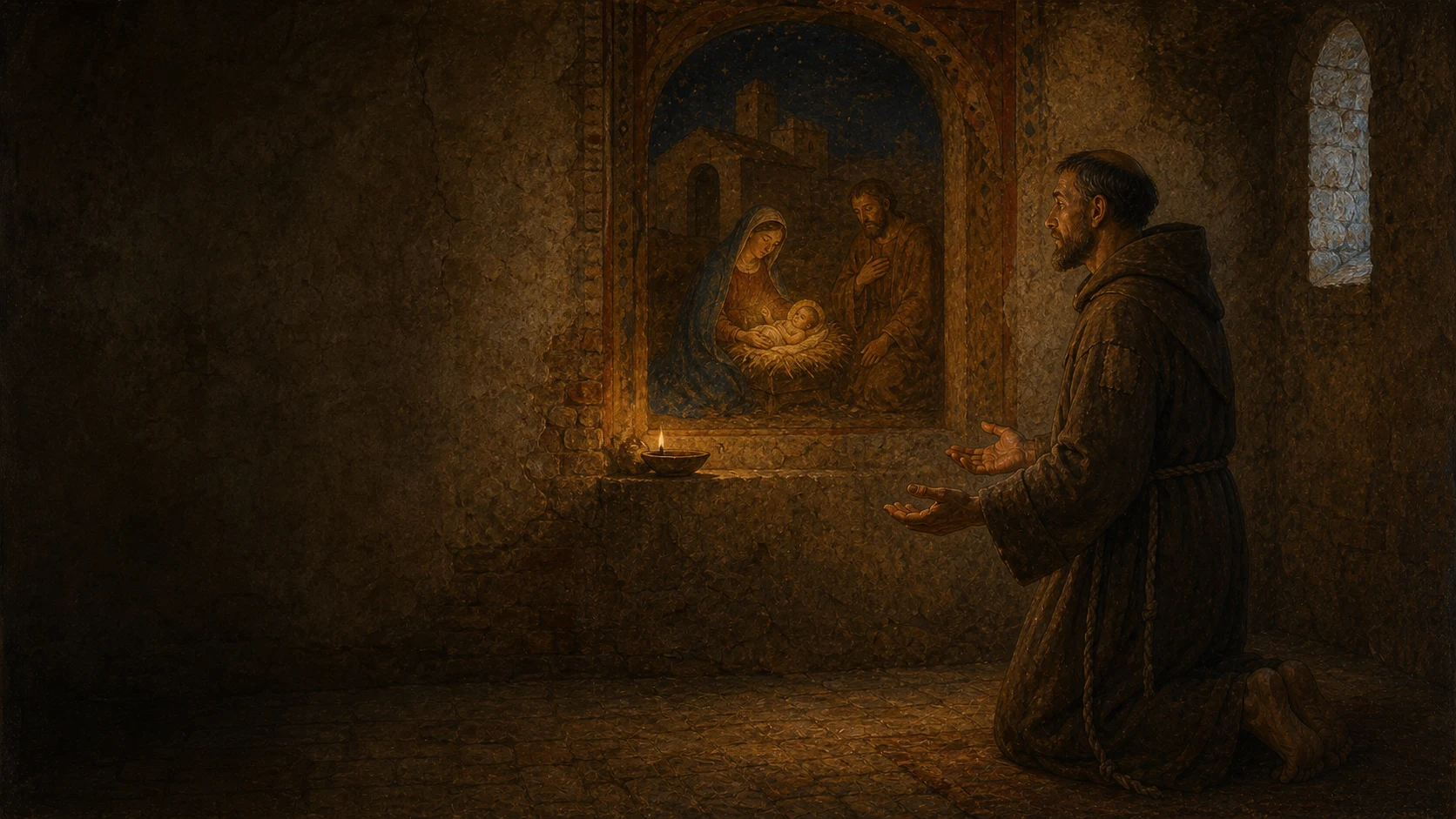
Imagine a chapel of old stone in Umbria. Night has entered through the narrow window. A lamp can barely push back the shadows. On the worn wall, a painting shows Mary, Joseph, and a newborn lying close to the ground.
Francis kneels before it. He brings no coins, expensive flowers, or festive clothes. His hands are open and empty. He looks at the Child like someone who has found what he had long been seeking.
This scene is a contemplation, not a record of a known event in his life. Yet it shows a truth that appears powerfully in Francis’s writings: he marveled that the eternal Son of God had received from Mary our humanity and our frailty.
The Creator of all things accepted the need to be held. The one who sustains the universe was wrapped in bands of cloth. The God whom no one can possess allowed himself to be carried by a young mother.
Francis did not see defeat in this. He saw God’s way of overcoming: coming so close that no one needed to be afraid to approach.
The Word fit into human arms
John’s Gospel begins differently from Luke’s account. It does not speak first of the journey to Bethlehem, the shepherds, or the manger. It goes back to the beginning of everything and calls Jesus the Word of God.
Through this Word, John says, all things were made. In him was life. He was the light that shines in the darkness. Then comes the sentence at the heart of Christian faith: the Word became flesh and came to live among us.
“Flesh” does not mean merely that Jesus appeared human on the outside. The Church teaches that the Son of God truly assumed human nature. Jesus had a body, felt hunger and weariness, grew, learned, rejoiced, suffered, and loved with a human heart. He is truly God and truly human.
Francis expressed this wonder in a letter to the faithful. He recalled that the Word of the Father descended into Mary’s womb and received from her the flesh of our humanity and frailty. He did not write like someone solving a distant problem. He wrote like someone bending down to contemplate a mystery full of tenderness.
God did not merely send a message from far away. He came in person. He entered our history and began to walk within it.
The sign no one expected
Luke tells us that Mary gave birth, wrapped Jesus in bands of cloth, and laid him in a manger because there was no room for them in the lodging place. A manger held food for animals. It was not the cradle prepared for the son of a powerful family.
At that time, the Roman emperor could issue commands that set whole populations in motion. His name was associated with power. Jesus, however, was born almost hidden. He commanded no soldiers. He could not even hold up his own head.
And this very baby was proclaimed Savior and Lord.
This changes our idea of greatness. We often think being great means giving orders, being seen, possessing things, or being the most admired person in the room. In Bethlehem, God shows another greatness: drawing near without crushing, offering himself without forcing, and becoming small in order to lift up those who have fallen.
The first guests were shepherds spending the night in the fields. They did not belong to the rich and famous. The announcement came to ordinary workers. God’s glory appeared in the sky, but its sign was below, in a child lying in a manger.
To find the Most High, they had to lower their eyes.
What filled Francis with wonder
Francis loved to call God the Most High. In his prayers, he acknowledged God’s majesty, goodness, and beauty. He did not believe in a God who was small or weak in the sense of being unable to save. His amazement lay precisely in the contrast: the Most High chose humility.
In the Letter to the Faithful, Francis recalled that Christ, though rich above all things, chose poverty in this world with Mary, his mother. In the Office of the Passion, a prayer he arranged from verses of the Psalms and other biblical passages, he joyfully celebrated the holy Child given to us, born along the way and laid in a manger.
These texts show that Bethlehem was not, for Francis, a decorated story only for December. It was a window through which to see the character of God.
The God of Bethlehem does not keep his distance to appear important. He is not ashamed of human frailty. He does not consider straw, simple work, tired hands, or a poor home unworthy. He enters the real world.
This is why Francis wished to live as a lesser brother: not above others but among them, not sheltered by privilege but available to serve. Franciscan minority does not arise from self-contempt. It arises from contemplating Jesus, who came close to us by the path of humility.
Poverty is not abandonment
It is very important to understand this: loving the poor Christ does not mean calling good the destitution that harms children and families.
Hunger, homelessness, exploitation, and abandonment are not gifts from God. They are forms of suffering to which Christians cannot close their eyes. If a person is in need, the answer is not to say that they should enjoy being poor. The answer is to share, defend their dignity, and work so that they do not lack what is necessary.
The poverty chosen by Jesus reveals that he did not come clinging to wealth, comfort, or prestige. His freedom allowed him to draw near to everyone, especially those whom the world places last.
Francis sought to follow this freedom. He wanted to possess less so that he could call every person sister or brother. He knew that things can be good and useful; the danger begins when they occupy the center of the heart, when our worth depends on what we own, or when we accumulate while someone beside us has no bread.
Bethlehem does not tell us to romanticize a cold home. Bethlehem asks why we still allow someone to find no room.
Empty hands are not useless hands
In the art for this chapter, Francis appears with open hands. They are empty, but they are not idle.
Closed hands can hold many things. They can also keep anything from being shared. Open hands seem to possess nothing, but they can receive a child, lift someone who has fallen, offer food, dress a wound, and build peace.
Jesus came into the world with small, open hands. Before teaching crowds, he accepted being cared for. Mary fed him. Joseph protected him. Other people prepared food, clothing, and shelter. God entered a network of human care.
This gives great value to gestures that almost no one applauds. Setting the table, listening to someone who is sad, caring for a sick person, welcoming a child, working honestly, and sharing what we have may seem like small actions. Yet the Child of Bethlehem teaches that small is not the same as unimportant.
If God’s love fit into a baby, it can also pass through our hands.
Glory hidden in littleness
John says that the Word came to live among us and that the disciples saw his glory. Luke shows that glory hidden in bands of cloth. The two Gospels do not conflict. Together they say something surprising: God’s glory can be present where hurried eyes see only simplicity.
Francis trained his heart to recognize this presence. He looked for it in Jesus poor, crucified, and given in the Eucharist. In the first Admonition, he contemplated the same movement of humility: Christ offers himself every day under a lowly appearance, without ceasing to be the Lord.
A line connects the manger, the Eucharistic table, and a life of service: God gives himself. He does not use his greatness to keep others far away; he turns his greatness into gift.
This is why Christian humility is not pretending we have no gifts. It is recognizing that everything we have received can become a gift to someone else. An intelligent person can teach without humiliating. A strong person can protect without dominating. Someone in authority can serve without thinking themselves superior.
In Bethlehem, strength learned to speak softly.
When Bethlehem enters our home
The Incarnation happened uniquely in Jesus Christ. We do not repeat this mystery. But we can allow it to change the way we see everyday life.
Bethlehem enters our home when someone important interrupts what they are doing to listen to a child. It enters a school when the student who was left out finds a place in the circle. It enters a community when the poorest person receives not only leftovers, but respect, friendship, and a voice.
It also enters us when we stop constructing a perfect character for ourselves. Jesus did not save the world by staying far from frailty. He came close to it. We can present our truth to God: our fears, questions, failures, and even the parts of us that still need to grow.
Francis was fascinated because in the littleness of Jesus he discovered that God was greater and better than he had imagined. A God who allows himself to be found. A God who does not despise the body or human history. A God who, being rich, chooses neither to buy nor dominate us, but to love us.
Perhaps the first response before this mystery is the same as that of empty hands: do not try to possess the light. Simply receive it—and then share it.
To keep in your heart
God was not afraid to be small.
The greatness of Jesus does not push people away; it draws near. In the manger, the Most High allows ordinary people to find him and turns frailty into a place of encounter.
A gesture for today
Give importance to someone who is hardly noticed.
Choose a person who is often left out—at home, school, work, or in the neighborhood. Call them by name, listen without looking at your phone, and offer practical help. Do not do it to be seen. Do it to make room.
Prayer in silence
Lord of the manger
Jesus, eternal Word who chose human hands,
teach me to recognize your greatness in littleness.
Free my heart from the desire to seem superior.
Give me open hands to receive and share,
attentive eyes for those no one sees,
and courage to make room where doors are closed.
May your humility be not only a beautiful story,
but the path of my steps.
Amen.
For those who want to go deeper
Sources for this chapter
- Vatican — Catechesis on Christmas and John 1:14Presents the Incarnation as the heart of Christmas faith and contemplates Jesus as humble, poor, and defenseless.
- Vatican — The birth of Jesus according to LukeExplains the sign of the manger, the place of the shepherds, and the quiet path of humility.
- Commission on the Franciscan Intellectual-Spiritual Tradition — Christmas: A Special Feast for FranciscansCollects passages from the Letter to the Faithful and early sources about Francis’s wonder before the Incarnation.
- Order of Friars Minor — HistorySummarizes the Franciscan tradition concerning the humility of God and the poverty of Bethlehem.
- William J. Short, OFM — Francis as Vernacular TheologianA Franciscan study of the coherence of Francis’s vision of God, including the Incarnation, humility, and the Eucharist.
The scene of Francis before a painting of the Nativity was created for this chapter’s art as a contemplative image; it is not presented as a documented historical episode. References to Francis’s writings have been paraphrased to keep the reading clear and avoid attributing words to him that he did not write.