The first light appeared far away on the mountain path. Then came another. And another.
Seen from the cave, they looked like stars descending to earth. They were torches carried by families from nearby homes and by friars arriving from different places. On the narrow trail, each person could see the steps of the one ahead and shelter the flame of the one behind.
It was Christmas night in 1223. In the region of Greccio, Francis had prepared a different kind of remembrance of Jesus’ birth. Inside the cave were a manger with straw, an ox, and a donkey. No child represented Jesus. No actors were dressed as Mary and Joseph. The place had not been turned into a stage.
There was, however, an altar. There was a priest. The people had gathered for Mass.
Perhaps the most beautiful part of Greccio is what Francis helped form around the cave: a whole community drawing near to the mystery of Jesus.
A memory that takes bodily form
Fifteen days before Christmas, Francis called a local man named John. He asked him to prepare what was needed for a celebration: he wanted to remember the Child born in Bethlehem and see with his own eyes the hardships Jesus faced when he was laid on the straw of a manger.
John welcomed the request. He prepared the place, gathered what was needed, and helped notify the people. When night came, friars and families walked to the cave carrying their lights. Thomas of Celano, Francis’s first biographer, wrote that the forest echoed with voices and that the night was filled with light.
This was not an attempt to travel through time or pretend that Umbria had become Judea. In the Church’s prayer, to remember is to recall a work of God in a way that illuminates the present and transforms those who celebrate.
At every Christmas, the Church does not claim that Jesus is born again. She celebrates that unique birth, listens to the Gospel, and receives the grace of Christ today.
Francis understood that the body takes part in this remembrance. The feet that climbed, the eyes that saw the straw, and the ears that heard the Gospel helped the heart pay attention.
An empty manger full of meaning
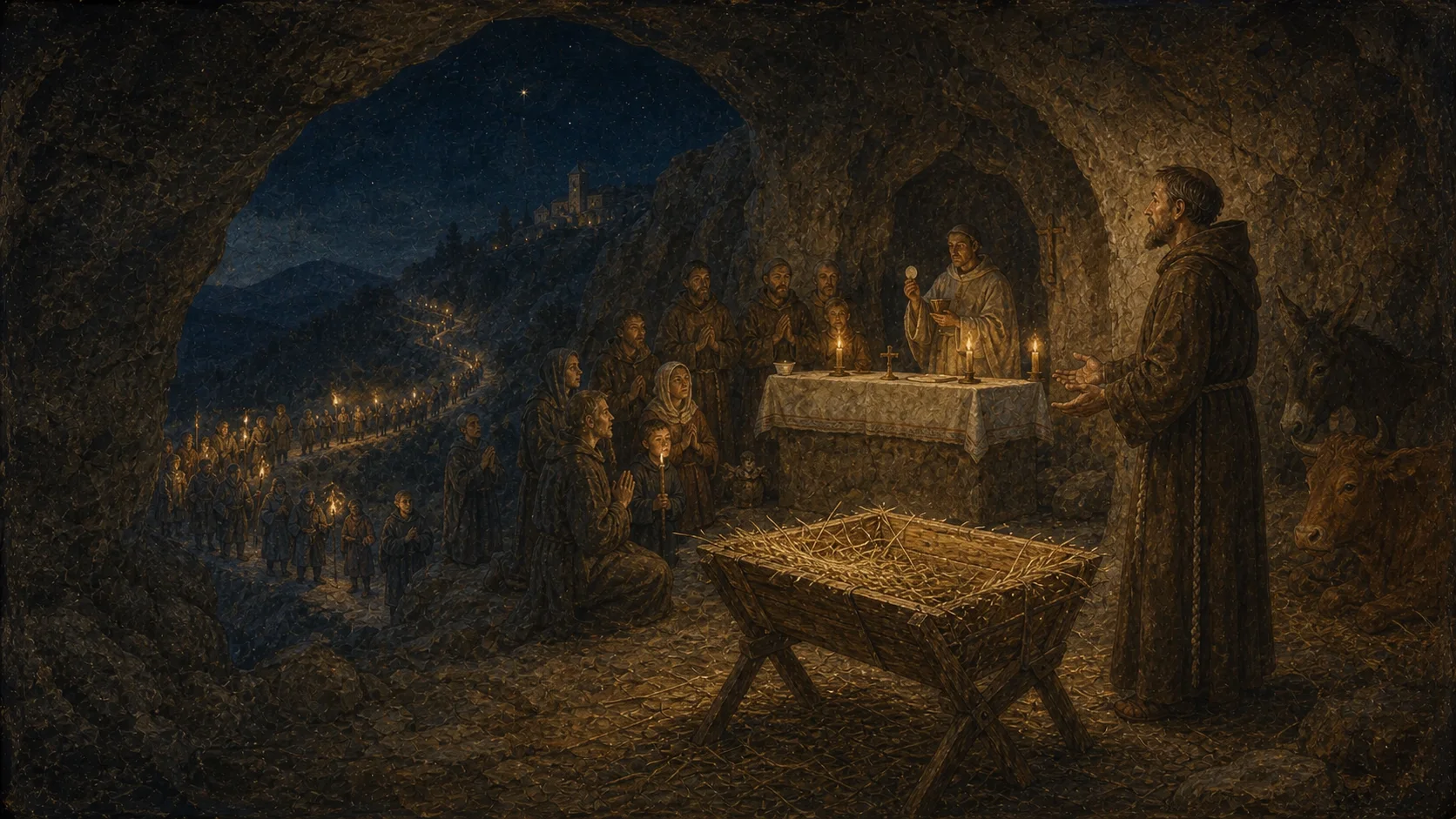
In the art for this chapter, the manger occupies the foreground. It is full of straw and completely empty. This is not an overlooked detail; it is a historical and spiritual choice.
The early sources do not describe an image of the Child placed there. Nor do they mention people portraying the Holy Family. The ox, donkey, hay, and manger recalled the simple conditions of the birth. Those present were not watching actors; they themselves formed the worshipping assembly.
The empty manger did not say that Jesus was absent. It pointed to a presence that did not need to be invented. The Gospel proclaimed the birth, the community responded, and at the center the Eucharist was celebrated.
The straw did not confine the mystery. It served as a sign through which to recognize Christ, proclaimed in the Word and received in the sacrament.
Greccio teaches that a simple space can guide the gaze. The manger did not compete with the altar. It pointed toward it.
Bethlehem beside the altar
Thomas of Celano says that the priest celebrated Mass over the manger. This detail is the heart of the night.
For Catholics, the Eucharist is not merely a remembrance. At Mass, through the action of the Holy Spirit and the words of Christ spoken by the priest, the bread and wine become the Body and Blood of Jesus. Christ is truly and really present.
Francis had immense reverence for this mystery. In one of his Admonitions, he taught that Jesus comes down to us every day in humble appearance. The Lord encountered in the frailty of a child gives himself to the Church under simple signs.
That is why the night in the cave did not end in a display. It ended—and began—in a celebration. The people came to listen, respond, give thanks, and receive.
The word Eucharist means thanksgiving. In that poor place, the community gave thanks for Jesus, who gives himself. No decoration, torch, or person—not even Francis—occupied the center that belonged to Christ.
The village was not an audience
When we watch a performance, some people work and many merely watch. Greccio was different. John prepared the place. Friars arrived from different regions. Families brought lights. A priest celebrated. Francis proclaimed and preached. The people responded.
Each person offered their presence. The accounts do not give every name or describe every task. We may imagine small scenes from the climb, provided we do not confuse them with documented facts.
What we know is enough: the joy was communal. The tradition was born not from the solitary genius of an artist, but from a village that agreed to walk and celebrate together.
This helps us understand the Church. She is not a performance staged by specialists. In the liturgy, every person is called to listen, respond, be silent, offer their own life, and join the prayer of all. There are different roles but one assembly.
A child who responds “Amen” and an elderly person who prays in silence are not unnecessary. The community is more genuine when no one becomes decoration.
The awakened child
Celano records that a virtuous man had a vision that night: he seemed to see a child asleep in the manger, and Francis approached to wake him. The biographer himself explains the image’s meaning: the memory of the Child Jesus had become almost forgotten in many hearts and, through Francis, was awakened again.
This episode is an account of a vision, not the physical appearance of a child before the village. Historical care does not destroy its beauty; it helps us see that beauty in the right place.
It was not Jesus who was asleep. It was the people’s attention.
We can know Christmas and still hurry past it. We can sing about peace and feed a quarrel, build a beautiful manger and leave no room for the person who is alone, go to Mass in body while leaving our heart far away.
To awaken the memory of Jesus is to let the celebration reach our life. After Greccio, people returned to the same homes and problems, but like Luke’s shepherds: praising God for what they had heard and seen.
The procession continues
The torchlit path is one of Greccio’s most powerful images. One flame gave little light. Many flames, cared for together, traced a road through the darkness.
Even today, a community brings Bethlehem near when it celebrates with reverence and welcome; when the reading can be understood; when no one is despised; when the Eucharist continues in care for those who are hungry.
We do not need to rebuild the cave of 1223 to receive its lesson. We need to walk together toward Jesus and allow his presence to gather us.
Francis did not take the village away from life. He helped it return with renewed vision. Greccio was a school for inhabiting the world differently.
Perhaps you feel like a small flame. Alone, you cannot light the whole mountain. But that is not your mission. Care for the light you have received, draw near to others, and take the next step. In God’s procession, one flame helps another arrive.
To keep in your heart
Jesus gathers people before gathering decorations.
At Greccio, the manger was simple, but no one needed to walk alone. The Word, the Eucharist, and the community transformed a cave into a house of prayer.
A gesture for today
Help someone take part.
At the next meal, class, game, or celebration, notice who has been left at the edge. Make room, explain what is happening, and invite that person to make a real contribution. Do not treat them as an audience member: help them feel that their presence completes the circle.
Prayer in silence
Jesus, center of our night
Jesus, Word proclaimed in the cave,
living Bread shared at the altar,
gather my steps with those of your brothers and sisters.
Teach me to celebrate without seeking appearances,
to listen without leaving my heart far away,
and to return home carrying your peace.
When my attention falls asleep,
awaken in me the joy of the Gospel.
Make my small light a help along the way,
and our community a place where no one is unnecessary.
Amen.
For those who want to go deeper
Sources for this chapter
- Gospel according to Luke, chapter 2 — USCCBThe Catholic biblical text of Jesus’ birth, the announcement to the shepherds, and their return praising God for what they heard and saw.
- Thomas of Celano — First Life of Saint Francis, chapters 30–31A translation of the early account of the preparations, the Mass, Francis’s preaching, the people’s joy, and the vision of the awakened child.
- Pope Francis — Apostolic Letter Admirabile signumPresents the Greccio tradition, clarifies that there were no figurines, and emphasizes the link between the Incarnation and the Eucharist.
- Vatican — Greccio, a school of simplicity and joyA catechesis published for the eighth centenary, centered on Francis’s intention and the people’s participation.
- Order of Friars Minor — Celebrating Christmas at GreccioConnects Celano’s account, the Eucharistic celebration, and Franciscan contemplation of Christ’s humility.
The sources confirm the manger with straw, the ox and donkey, the gathering of the people, the Mass, and Francis’s ministry as a deacon. The opening narrative imagines the procession’s movement to bring the reader close to the night, without presenting individual participants’ thoughts or actions as documented. The artwork keeps the manger free of an image of the Child, in keeping with the historical account.