
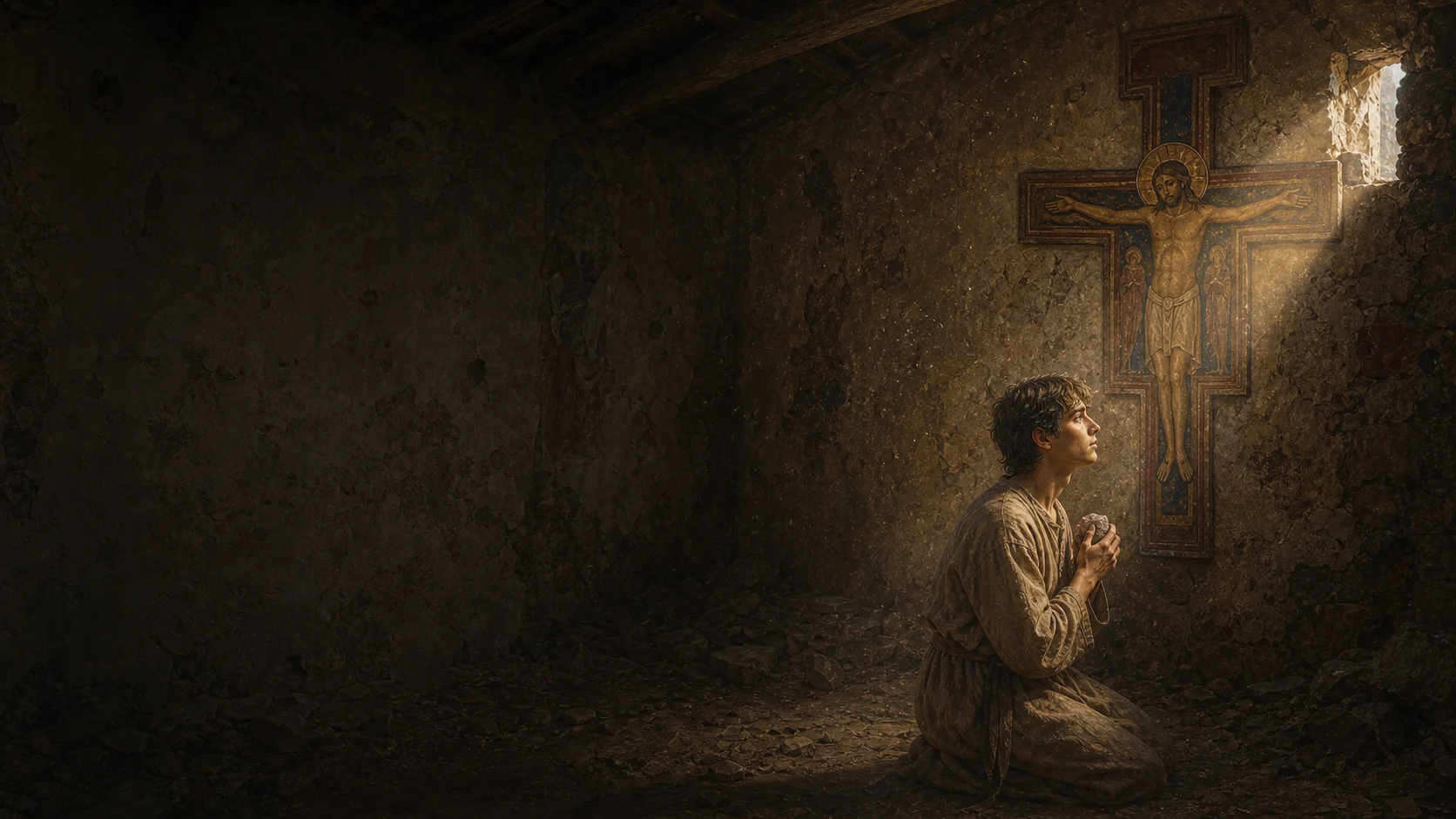
A stone held close to the heart
The little church stood outside the walls of Assisi, down the slope among olive trees. It was called San Damiano. It had neither the splendor of a palace nor the bustle of the streets where merchants advertised their cloth. There were cracks in the plaster, loose stones, and a silence that seemed to be keeping something safe.
Francis entered while still a young man, without a friar’s habit and without imagining that one day his name would cross continents. His conversion did not happen in a single afternoon. He had been through war, imprisonment, and illness. By drawing near to people with leprosy, he had already discovered that what once seemed bitter to him could be changed into sweetness. Even so, he was still searching for his path.
In the nearly abandoned chapel was a crucifix painted in the icon tradition. Jesus appeared with open eyes. His body bore the marks of the cross, yet the image did not speak only of defeat: Christ was alive, surrounded by witnesses and signs of the Resurrection.
Francis stood before him. Perhaps his hands were empty. Perhaps the floor still held dust from the broken walls. What we know is that this encounter became one of the great memories of the Franciscan tradition.
A voice preserved in memory
According to Thomas of Celano, who wrote about Francis a few decades after the events, the young man heard the Crucified Christ call him by name and ask him to repair his house, for it was falling into ruin. The wording varies slightly among translations, but its heart remains: “Francis, go and repair my house.”
It is important to tell this honestly. Francis himself did not recount in his Testament that an image spoke to him. This scene comes to us through the early Franciscan biographies, especially Thomas of Celano’s Second Life, and has been received for centuries by the Franciscan family and the Church. It is therefore neither a recording nor a diary written that day; it is a memory handed down by the community that knew his life and sought to understand his conversion.
That does not make the episode empty. It teaches us to receive tradition without inventing details. San Damiano profoundly marked his path, and he began to restore poor churches with his own hands.
He began with the walls
Francis looked around and understood the request in the most concrete way: that building needed help. He did not answer, “Surely this is a metaphor for an immense spiritual reform.” He saw stone, wood, and neglect. So he began there.
This response can seem small to someone who knows the rest of the story. Francis would help rekindle the Gospel in many hearts; he would inspire fraternities and meet the pope. At that moment, however, his mission was the size of a wounded chapel.
There is humility in that. He did not wait to understand everything before doing the first good he could see.
There were also mistakes and learning. Carried away by enthusiasm, Francis sold cloth from his father’s business to raise money. His intention was to repair San Damiano, but the goods were not his alone. His father reacted harshly, and the chapel’s priest was afraid to accept the money. Following a vocation does not automatically make every decision perfect. Francis had to mature, let go, and learn to serve without calling an imprudent act holy.
Then he worked. He asked for stones, endured mockery, and rebuilt not only San Damiano but other small churches as well. Prayer acquired weight, dust, and weariness. Hands that had touched fine cloth began to carry rough materials.
The Crucified Christ who is alive
On the San Damiano Crucifix, Jesus does not appear alone. The image gathers witnesses to his Passion and points to God’s victory. The Crucified One is the living Christ: his love passed through death.
This changes the meaning of rebuilding. It is not a matter of covering cracks to pretend nothing happened. The Resurrection does not erase the cross; it turns the wound into a passage toward new life.
A Christian community can also have cracks: when the strong humiliate the small, when religion becomes appearances, when truth is used as a weapon, when poor people are left outside, or when no one listens to anyone else. Repairing this house requires more than paint. It requires a return to Jesus.
Francis did not renew the Church by placing himself above it. In time he sought the bishop, presented his form of life to the pope, and remained in communion. His freedom was courageous, but it was not a project of vanity. He did not want to build a private church bearing his own name. He wanted to live the Gospel within the people of God.
From the stone church to the living Church
In the Bible, the word “church” does not primarily mean a building. It speaks of the assembly, the people called by God. The building is precious because it welcomes this people, the Word, prayer, and the Eucharist. But the living house is made of people.
Francis discovered this step by step. First came the chapels. Then very different brothers were given to him. In his Testament, he does not say, “I found the perfect companions.” He says the Lord gave him brothers. A brother is not a stone we can place wherever we want. He has a will, limits, gifts, and wounds. Building fraternity takes longer than raising a wall.
The Testament itself shows how the two dimensions remained united. Francis recalls the faith God gave him in churches, his reverence for the Body of Christ, and his respect for priests; immediately afterward, he recalls the gift of the brothers and the pattern of the Holy Gospel. For him, loving Jesus, caring for churches, and living as a brother were not separate tasks.
A true restoration begins within the heart, passes through the hands, and reaches relationships. If it ends only inside the person who prays, it is still incomplete. If it cares for walls and forgets those who suffer, it has lost its center. If it wants to change everyone else but refuses personal conversion, it adds noise to the ruin.
Rebuilding means serving communion
Communion does not mean that everyone must think the same way about every subject. It means belonging to one another in Christ, seeking truth without contempt, and treating no one as disposable material.
Imagine a group in which two people have quarreled. It is easy to spread messages and widen the crack. Repair may begin when someone stops the humiliation, listens, and seeks responsible help. This creates a place where truth can be spoken without turning the other person into an absolute enemy.
There are cracks we cannot repair alone. Violence, abuse, depression, prejudice, and serious conflicts require protection and trained people. Seeking a safe family member, teacher, health professional, or authority is not a lack of faith. It too can be a way of setting the first stone in the right place.
Jesus did not tell Francis to become the savior of the Church. The Savior was already before him on the cross. Francis was given the task of cooperating. That difference protects the heart: we do our part courageously, but we do not have to carry the world as though everything depended on us.
The work that continues
San Damiano does not offer a formula for hearing voices. It offers a school of attention. Francis stopped in a forgotten place, before Jesus, and allowed a need to cease being scenery and become a call.
Perhaps near us there is a “house” that needs care: a friendship with no conversation, a newcomer who always eats alone, a tired community, a room where no one helps, or an unjust word we have not yet corrected. Not every crack is our responsibility. But some have been placed before our eyes.
The first gesture may seem small: apologize without making excuses; put the phone away and listen; return something; help without posting about it; respectfully defend someone who is being mocked; pray for someone with whom it is difficult to live.
The stone Francis carries is not a trophy. It is a responsibility. Following Jesus means receiving it close to the heart and then placing it at the service of a house where others can live too.
To keep in your heart
Jesus does not call Francis to admire ruins.
He calls him to love enough to begin rebuilding. The first response is a wall; the deeper response is a life that restores people to communion.
A gesture for today
Repair one small relationship.
Think of a simple relationship you have allowed to grow cold through distraction, not a dangerous situation. Send a sincere message, give thanks for something specific, or offer help without expecting recognition. If you hurt someone, say clearly: “I did this, I am sorry, and I want to do better.”
A prayer in silence
Give me hands that do not give up
Jesus, crucified and alive,
stand before me when I see only ruins.
Show me the crack that is mine to care for,
and free me from the desire to appear important.
Give me eyes to recognize each person as your house,
words that draw people closer without hiding the truth,
and patient hands for the small work.
When I make a mistake, teach me to correct it.
When the work is greater than my strength, teach me to ask for help.
Make me a humble stone in the communion of your people.
Amen.
For those who want to go deeper
Sources for this chapter
- Gospel according to John 12:20–26The grain of wheat, service, and Jesus’ invitation to follow him.
- Testament of Saint FrancisFrancis’s own memory of conversion, faith in churches, the cross, the Eucharist, and the gift of the brothers.
- Thomas of Celano — Second Life of Saint FrancisAn early Franciscan source that recounts the call before the San Damiano Crucifix.
- Benedict XVI — Catechesis on Saint FrancisReads the material restoration as a sign of a deeper renewal lived in communion with the Church.
- Order of Friars Minor — The San Damiano CrucifixThe official remembrance of the place, the icon, and its connection with Francis and Clare.
The speech of the Crucifix is handed down through the early biographies and Franciscan tradition, not through the autobiographical account in the *Testament*. The interpretation that Francis moved from rebuilding chapels to renewing the living Church expresses the development of his vocation; it is not presented as a complete understanding received in a single moment.