
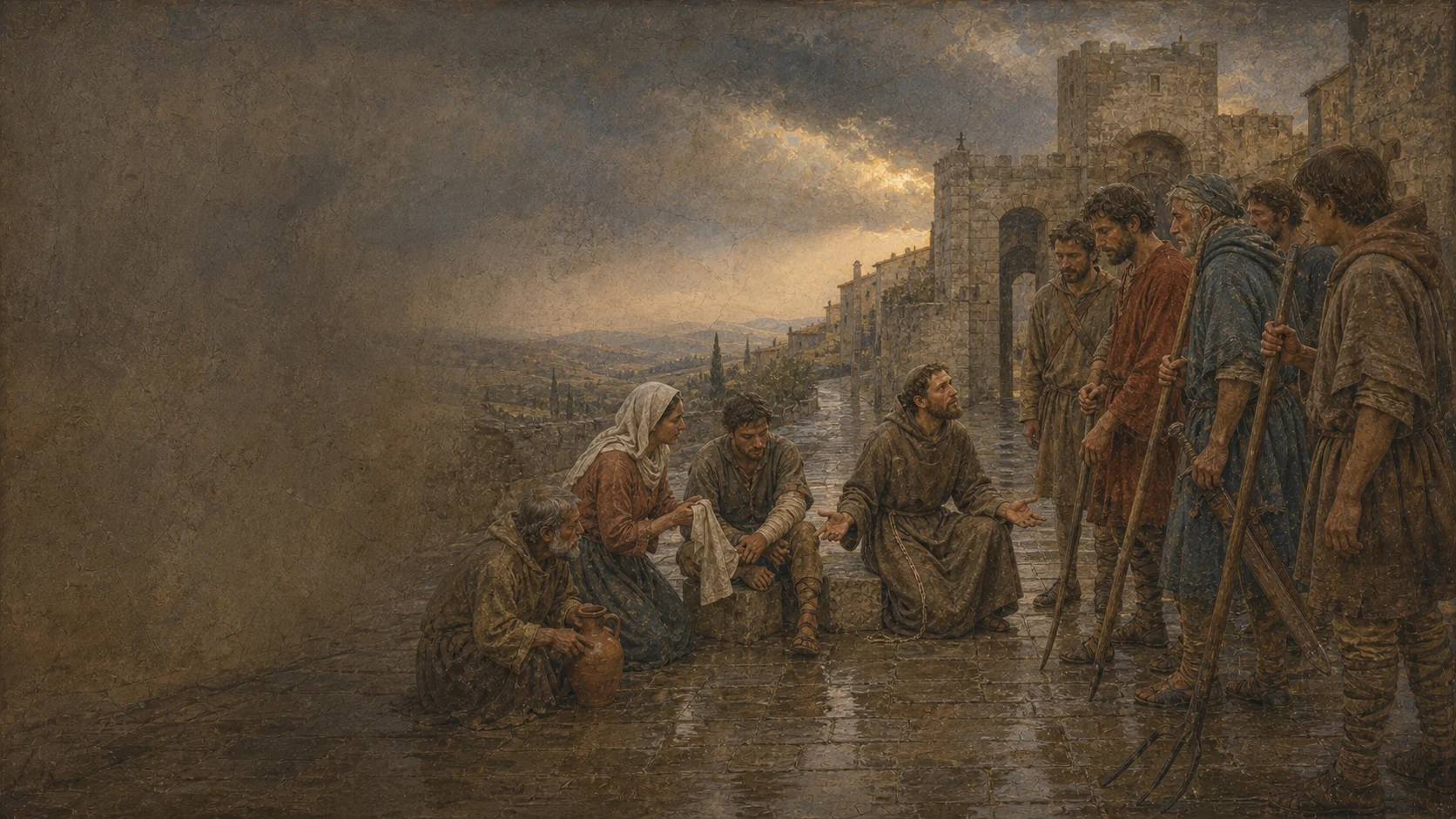
The storm had passed, but no one yet believed the danger was over.
In the courtyard before the gate of Assisi, rain gleamed between the stones. On one side, men held tools. On the other, a young man sat with his arm wrapped in cloth. A woman knelt near him. An elderly man brought water.
Between the two groups, a lesser brother did not climb onto a step to appear greater. He sat on a low stone. His hands were empty. First, he listened.
No one embraced or pretended nothing had happened. But one tool began to lower. Then another. Fear and wounds still remained. Even so, the next blow did not come.
Sometimes peace begins with the courage to stop pain from producing more pain.
Peace is not pretending everything is fine
Sometimes we call something peace when it is only silence.
Two people stop speaking, but continue planning revenge. A class stops arguing because the weakest student has become afraid to speak. Everything looks quiet from the outside. Inside, the suffering continues.
The peace of Jesus is not a lid placed over the truth. According to the Church, it is the work of justice and the effect of love. It cannot sacrifice anyone’s dignity.
Jesus is gentle, but he is not indifferent. He welcomes those who have sinned, defends those who are humiliated, and calls people to conversion. Making peace means allowing truth and mercy to walk together.
When a brother hurts us
In Matthew 18, Jesus teaches how to confront a wrong. First, when it is safe, the conversation should be direct. If the person does not listen, others can help. If the problem remains, the community assumes responsibility.
Evil must be named. The person who hurt someone must hear what they caused, change direction, and, when possible, repair the harm.
Soon afterward, Peter asks how many times he must forgive. Jesus answers with a number that demolishes the accounting system of revenge.
Both parts belong to the same teaching: confront wrongdoing truthfully and refuse revenge. Correction without mercy hardens; forgiveness without protection may abandon the person who suffered.
Forgiving is not calling evil good
Forgiveness means entrusting to God the desire to destroy another person. It means refusing to let hatred own our story. It can begin before the other person apologizes, but it usually takes time.
Forgiving does not erase memory or automatically remove consequences. Nor does it immediately restore the same trust, which requires change and time.
If someone broke a window and was forgiven, the window still needs repair. If they spread a lie, they need to help restore the truth.
The Church teaches that even an offense that has been forgiven may require reparation. Justice is not revenge. Revenge wants to make another person suffer because we suffered. Justice seeks to protect, correct, and restore what was harmed.
Forgiveness frees us from revenge. Justice keeps that freedom from costing the abandonment of the victim.
When it is necessary to stay away
Every child and every adult needs to know this truth: forgiving never requires anyone to return to a dangerous place.
If there is assault, threat, abuse, or serious fear, seeking distance and protection may be necessary. The person who was hurt should speak with trusted adults, trained professionals, or authorities. Keeping a secret to protect the person doing harm is not peace.
Jesus never asks us to call violence love. Catholic teaching recognizes the right—and sometimes the duty—to protect one’s own life and the lives of others, without turning defense into cruelty.
There can be forgiveness without reunion and prayer for an aggressor without a private conversation. In serious situations, other people must manage any contact—and perhaps no contact is safe.
Full reconciliation requires accountability and safety. It must not be demanded as proof of faith from the person who was hurt.
Not returning the blow
Saint Paul knew communities with differences and tensions. In Romans 12, he presents a demanding path: love without pretense, honor others, weep with those who weep, do not repay evil with evil, and, as far as possible, live at peace with everyone.
The phrase “as far as possible” matters: peace does not always depend on you alone. One person cannot force another to put down the stones.
Even without agreement, we can refuse to feed the fire: do not invent rumors, publish humiliations, or weaponize a weakness shared in confidence.
Paul ends with an act of courage: overcome evil with good. Good does not deny evil; it refuses to copy its methods.
The Lord revealed a greeting
At the end of his life, Francis wrote in the Testament that the Lord had revealed a greeting to him: “May the Lord give you peace.” It was a small mission entrusted to the brothers.
“Peace and Good” became a beloved greeting in the Franciscan family. It wishes for peace accompanied by what is good and just. But the words recorded in the Testament are “May the Lord give you peace.”
The Admonitions warn against anger provoked by another person’s sin and describe the peacemaker as someone who preserves inner peace for love of Jesus.
This does not mean swallowing the indignation that moves us to defend the little one. The danger begins when anger takes possession of us and another person’s wrongdoing becomes permission to dehumanize them.
Brothers in the world without quarrels
In the Earlier Rule, Francis asks the brothers to avoid disputes, slander, and evil words. In mission among people of other religions, he proposes that they not enter into quarrels, but live humbly and acknowledge themselves as Christians.
It was in this spirit that Francis met Sultan al-Malik al-Kamil during the Fifth Crusade. The gesture itself is enough: in an armed age, he crossed the lines without a sword and presented himself as a lesser brother. There was dialogue, not a theatrical victory.
Francis did not resolve every war of his century. A peacemaker does not control the whole world. But that person can refuse to increase hatred within the space their feet can reach.
A stanza for a divided city
An early Franciscan tradition says that the bishop and civil ruler of Assisi—called the podestà—were in serious conflict. Francis, already very ill, is said to have added to the Canticle of the Creatures the stanza praising the Lord for those who forgive for love of him and endure sickness and trial.
According to the tradition, brothers sang before the two men, and they reconciled. It was not a magic trick. The song created space to lower their defenses and choose a new step.
The Canticle recalled something greater than the dispute: bishop, ruler, poor people, sun, and water belonged to the same Creator. No one loses the truth by recognizing the opponent’s humanity.
The work of God’s children
Peace is a craft. Those who build it learn to listen without abandoning truth, speak without humiliating, protect without hatred, and correct without wanting to destroy.
Perhaps you will not repair an entire friendship today. You can stop the next cruel word, ask for help, admit your part without accepting blame that is not yours, or first care for the person who was hurt.
In the wet courtyard, the friar remains seated between the groups. Water and a bandage arrive before the speech. The tools lower slowly. The wound has not disappeared, but no one uses it as a reason to make another.
When this happens, however fragilely, the peace of Jesus has already begun rebuilding the house.
To keep in your heart
Peace does not bury a wound; it cares for it without opening another.
Jesus teaches us to unite what revenge separates: truth and mercy, protection and forgiveness, justice and hope. Making peace means preventing evil from choosing who we will become.
A gesture for today
Lower an invisible weapon
Think of a small disagreement where it is safe to act. Choose one “weapon” you will not use: sarcasm, rumor, interruption, or a message written to wound. Then make a truthful gesture: listen for two minutes, acknowledge your part, or ask a fair person for help. If there is a threat or abuse, your gesture of peace today is to seek protection, not face the situation alone.
A prayer in silence
When peace seems difficult
Jesus, our peace,
enter the rooms where no one listens
and the memories that still hurt.
Give me courage to tell the truth,
mercy not to seek revenge,
and wisdom to protect those in danger.
Teach me to ask forgiveness for the harm I have done,
to repair what lies within my reach,
and to respect the time of those who were hurt.
Like Francis, I want to bring empty hands,
a heart without hatred,
and your greeting on my lips:
May the Lord give you peace.
Amen.
For those who want to go deeper
Sources for this chapter
- Gospel according to Matthew, chapter 5 — USCCBThe Beatitudes, including Jesus’ promise to peacemakers.
- Gospel according to Matthew, chapter 18 — USCCBThe path for confronting a wrong in the community and the insistent call to forgiveness.
- Letter to the Romans, chapter 12 — USCCBLove without pretense, the refusal of revenge, and goodness that is not overcome by evil.
- Testament of Saint Francis — Order of Friars MinorRecords the greeting revealed to Francis: “May the Lord give you peace.”
- Admonitions of Saint Francis — VaticanEspecially Admonitions XI and XV, on not appropriating anger at another person’s sin and preserving peace for love of Christ.
- “To Live and Follow” — Franciscan FamilyPresents the Earlier Rule as guidance born from real relationships and its search for true peace of spirit.
- Pope Francis — Homily in Abu Dhabi, 5 February 2019Connects the beatitude of peacemakers with the Earlier Rule’s direction to avoid quarrels and live the faith humbly.
- “Song of Reconciliation” — Order of Friars MinorPresents the Canticle as a prayer of praise and reconciliation and recalls the tradition about the bishop and the *podestà* of Assisi.
- Fratelli Tutti, 226–254 — VaticanExplains that forgiveness does not mean forgetting injustice or abandoning justice, but refusing the spiral of revenge.
- Catechism of the Catholic Church, 2263–2266 — VaticanTeaches about protecting life, legitimate defense, people’s safety, responsibility, and reparation.
The opening and artwork for this chapter are a symbolic composition, not a documented episode. Francis’s meeting with the sultan is historically attested, although accounts of their dialogue came later. The reconciliation between the bishop and the *podestà* is presented as an early Franciscan tradition associated with the Assisi Compilation, not as a scene observed by a chronicler present at that moment.