
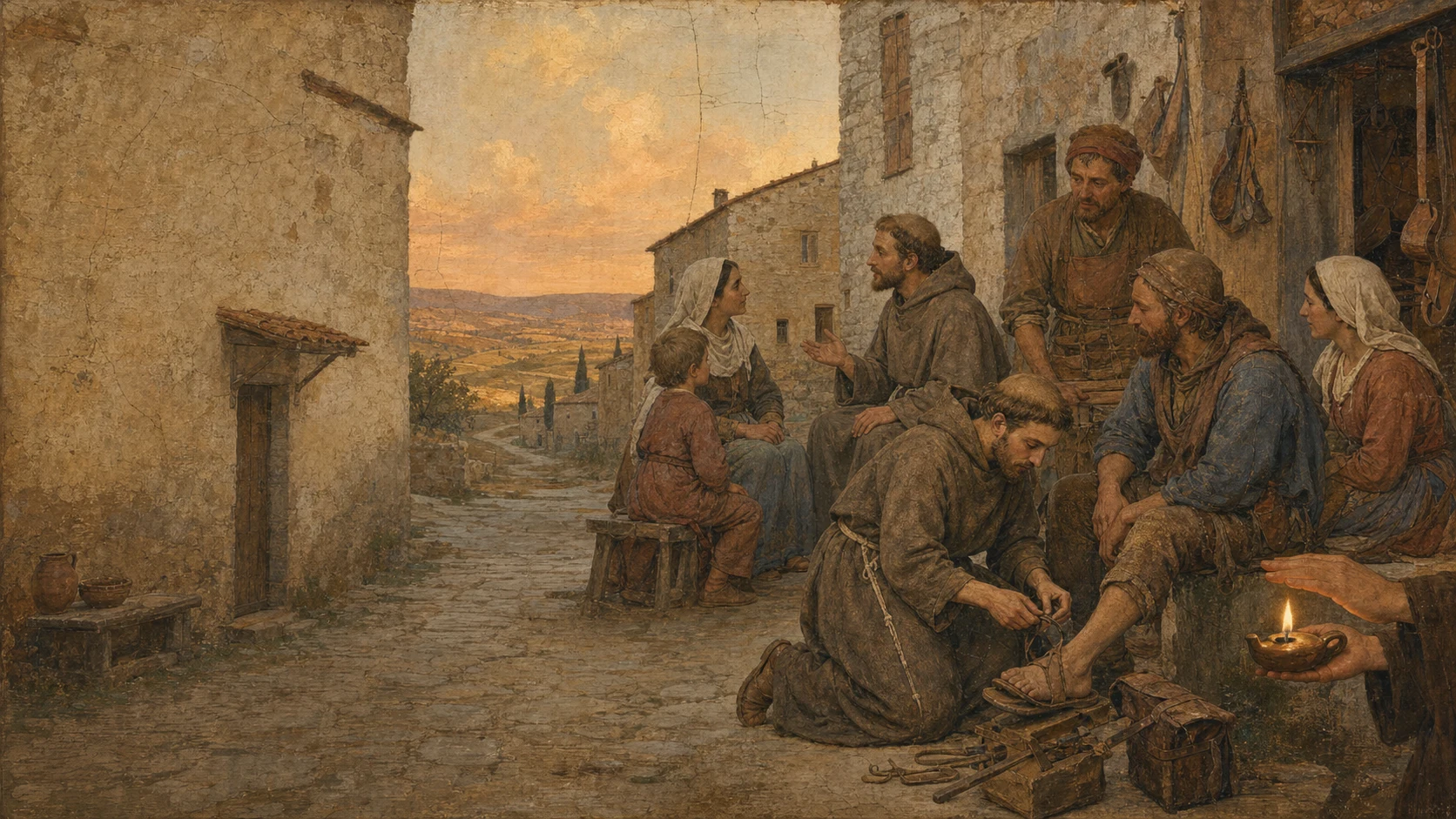
A strap on the traveler’s sandal had come loose, and the road ahead was still long. In the small square, a lesser brother knelt before the worn leather and began to repair it.
Nearby, another brother spoke with a family and an artisan. No one stood in a pulpit. The friar spoke, but he also listened. Beside them, a hand sheltered a small lamp from the wind.
This scene does not record a specific event. It translates the mission Francis taught: work, serve, live as a lesser one, do not argue in order to win, and identify oneself as Christian. At the proper time, the brothers would also proclaim the Word of God.
The Gospel would gain hands, feet, and a voice. Life would make room for the word; the word would reveal the source of that hope.
Mission begins near people’s feet
When Jesus sent the disciples, he asked them to proclaim that the Kingdom was near. He gave them practical tasks: care for sick people, give freely what they had received, and bring peace to homes. Without gold or guarantees, they would arrive as guests, not owners.
Jesus himself united words and gestures: he taught, touched wounded people, welcomed those who were despised, and washed his friends’ feet.
Francis recognized in this the form of his fraternity. The brothers would go through the world as lesser ones. This did not mean lacking worth, but refusing the step that places one person above others. In the artwork, the brother is beside a traveler’s feet: his body explains the mission before any word.
A life must not contradict its voice
In the Rule of 1221, Francis wrote a brief and demanding direction: all the brothers should preach through their deeds. He knew that beautiful speech can lose its truth when behavior says the opposite.
Imagine teaching peace while humiliating someone who disagrees, or speaking of sharing while keeping everything for yourself. The statements might be correct, but life would build a wall before them.
Preaching through deeds removes that wall: keeping a promise, admitting a mistake, sharing time, and treating respectfully someone who offers no advantage. This is not a performance designed to win someone over, but a consequence of belonging to Jesus.
We do not have to pretend to be perfect. Saying “I was wrong and need to apologize” may bear greater witness than a flawless pose. The proclamation is about Christ, who shows mercy and teaches us to begin again.
The saying Francis did not write
You may know the saying attributed to Saint Francis: “Preach the Gospel at all times; if necessary, use words.” It recalls something Franciscan, but it appears neither in Francis’s writings nor in the early biographies. We should not present it as a quotation from the saint.
What he wrote is similar and different. In the Rule of 1221, he told the brothers to preach through their deeds, but he also included a proclamation to be spoken. For mission among Saracens and other non-Christians, he offered two paths: live without quarrels, with humility, acknowledging themselves as Christians; and proclaim the Word when this pleased the Lord.
The popular saying almost suggests that words seldom matter. Francis did not teach that. He wanted coherence between deed and word, not the disappearance of words.
There is a time to speak the name of Jesus
Repairing a sandal demonstrates care, but by itself it does not tell the story of the manger, the cross, and the Resurrection. A time comes to speak. The First Letter of Peter asks us to explain the reason for our hope—with gentleness and respect.
These words protect the proclamation. Gentleness is strength without aggression. Respect means remembering that the other person has a conscience, a history, questions, and freedom.
In the Rule of 1223, Francis required preachers to be prepared and authorized. He asked for words that were considered, honest, useful, and brief. The preacher was not the center of the message.
Sometimes the necessary words can be simple: “I pray because I trust Jesus.” “This Gospel passage helped me.” “Would you like me to pray with you?” The invitation leaves room for a genuine answer, including “no.”
Listening is also part of proclamation
A conversation is not waiting for our turn to speak. Listening means receiving something from the other person’s life. We can ask, “What happened?” “How can I help?”
Jesus asked questions and allowed people to speak. God is already at work in the world before we arrive, and the other person can teach us truth, courage, and compassion.
This does not mean agreeing with everything. We can present faith clearly while listening to a whole objection without mockery. When mission becomes a contest for points, the brother ceases to be a brother and tries to become a victor. Francis specifically recommended avoiding arguments and disputes.
The door love does not break down
Aggressive proselytism treats a person as a number and uses fear, pressure, or conditional help. This contradicts the free gift of the Gospel.
To evangelize is to offer a treasure received, not force it into another person’s home. It is to help because of the other person’s dignity and to speak of Jesus without manipulating their vulnerability.
Pope Francis insists that mission is not proselytism. We bear witness humbly because faith is not property won by merit. The Holy Spirit is the principal agent; we do not control the result.
We can light a lamp, shelter it from the wind, and say where its light comes from. We cannot force anyone to see it in the way we want.
A road still open
At the end of Matthew, Jesus sends the disciples and promises to remain with them. We do not carry an absent Christ, as though God only began loving a place when we arrived. We walk in order to recognize his action, serve, and proclaim what we have received.
Your road may pass through school, a conversation, or the seat beside someone who is alone. Proclamation begins when you refuse to join a humiliation, continues in listening, and finds words when someone asks about your hope.
The small lamp in the square does not illuminate the whole valley. Even so, it protects working hands and faces that encounter one another. Franciscan mission has this human scale: a truthful action, listening without superiority, and the name of Jesus offered with humble courage.
To keep in your heart
My life prepares the place; my words point to Jesus.
Francis does not separate the good we do from the hope we proclaim. The deed gives weight to the word, and the word reveals the source of the deed. Both remain small enough for Christ to be the center.
A gesture for today
Ask a question and listen to the whole answer.
Approach someone without preparing a sermon. Sincerely ask how the person is and do not interrupt. If a question about your faith arises naturally, answer in a few words, beginning with your experience: “I find hope in Jesus because…” Do not pressure, argue, or turn the conversation into a victory.
Prayer in silence
Make me a word that is lived
Jesus, sent by the Father,
place my feet on the roads where love is needed.
Give honest work to my hands,
attention to my ears,
and gentleness to my voice.
Free me from using your name to appear greater.
May I neither hide hope out of fear
nor impose it out of pride.
Teach me to serve without demanding payment,
to listen without preparing a dispute,
and to speak of you simply.
Protect within me the small flame of the Gospel,
so that it warms and illuminates
and never becomes a fire against another person.
Walk with me along the open road.
Amen.
For those who want to go deeper
Sources for this chapter
- Gospel according to Matthew, chapter 5 — USCCBSalt, light, and good works that point to the Father.
- Gospel according to Matthew, chapter 10 — USCCBThe sending with free generosity, simplicity, and peace.
- Gospel according to Matthew, chapter 28 — USCCBThe mission and the promise of Jesus’ presence.
- First Letter of Peter, chapter 3 — USCCBThe reason for hope explained with gentleness and respect.
- Order of Friars Minor — Rule of 1223, chapter IXThe official OFM text on preparing preachers and on careful, useful, and brief words.
- Order of Friars Minor Conventual — The two ways of evangelizingPresents chapter XVI of the Rule of 1221: presence without disputes and explicit proclamation when this pleases the Lord.
- Franciscan Media — The origin of sayings attributed to FrancisExplains that “if necessary, use words” appears neither in the writings nor the early biographies and connects it with the authentic direction to preach through deeds.
- Pope Francis — Message to the Pontifical Mission SocietiesDistinguishes Christian mission from proselytism and emphasizes witness, humility, and the action of the Holy Spirit.
The square and the sandal repair are an artistic composition, not a documented event. They translate the humble work and mission in deeds and words found in the Rules. The popular saying is not treated as a quotation from Francis because it appears neither in his writings nor in the early biographies.