
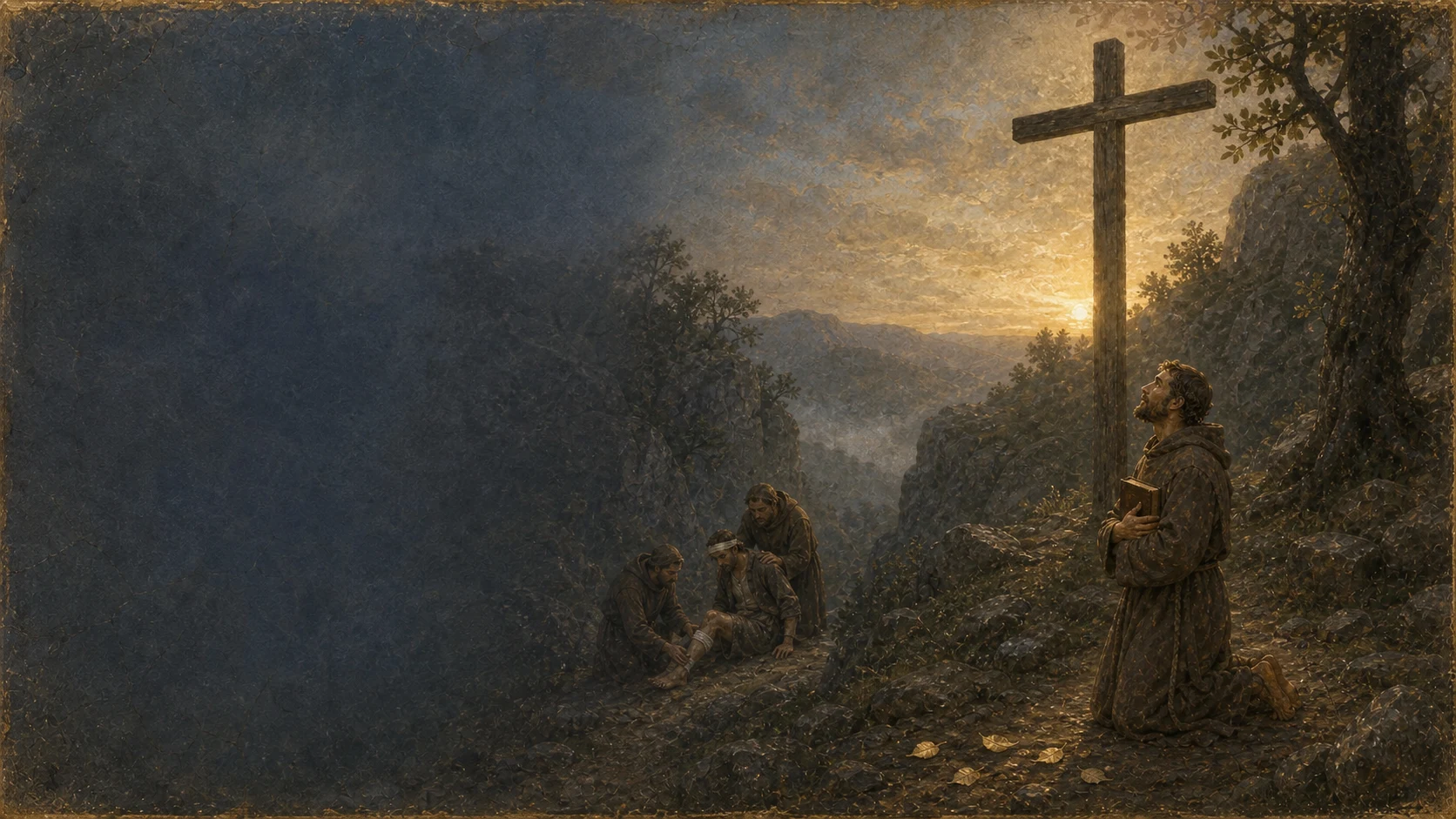
Night still covers the mountain. Behind a rough wooden cross, the first light is rising.
Francis kneels without any pose of greatness. He holds a closed Gospel against his chest, like someone keeping a word that must now be lived. The cross is empty: the Crucified One is risen.
On the road, two brothers have found a wounded traveler. One supports him; the other wraps a bandage around his leg. Prayer has become care.
This contemplative scene brings together three truths dear to Francis: Jesus loved to the end, Easter does not end at the tomb, and contemplating the Crucified One must bring us close to wounded people. Five pale leaves discreetly recall the marks Francis received at La Verna. The center, however, is not his wounds. It is the love of Christ.
“To the end” begins with a towel
John introduces the Passion with a sentence that opens a door: having loved his own, Jesus loved them to the end. Immediately afterward, he rises from the table, ties a towel around his waist, and washes the disciples’ feet.
Before the nails, there is a basin. Before giving his body on the cross, Jesus bends down before dirty feet. This helps us understand that his Passion is not a taste for pain. It is the deepest point of an entire life offered to heal, feed, forgive, speak the truth, and remain faithful to the Father and the little ones.
Paul contemplates the same path in Philippians. Christ does not cling to his greatness; he takes the condition of a servant, humbles himself as far as the cross, and is exalted by the Father. Easter keeps cross and Resurrection together: God truly enters human suffering and opens a path death cannot close.
Jesus did not love pain
On the night he was arrested, Jesus felt anguish and asked that, if possible, the cup pass from him. On the cross, he was thirsty. Risen, he showed his wounds; he did not pretend nothing had happened.
This protects us from a dangerous idea: suffering does not automatically make someone holier. Pain calls for care; it is not a spiritual trophy. Jesus approached sick people, protected those who were humiliated, and never told wounded people to refuse help.
Carrying the cross does not mean seeking suffering, accepting abuse, or remaining silent before violence. No one should endure assault in order to “imitate Jesus.” If someone hurts, threatens, manipulates, or touches you inappropriately, moving away and telling a trusted adult is an act of truth. In danger, protection and the responsible authorities must be sought.
Taking medicine, speaking with a professional, resting, and treating an illness do not show weak faith. Relieving pain may be precisely how we carry someone’s burden together. In the artwork, the bandage on the traveler’s leg is also a sign of the cross: love that does not pass by.
Francis prayed within the Passion
Francis did not contemplate the cross as someone watching a sad scene from far away. He desired to know the mind and heart of Jesus and follow in his footsteps.
In the Letter to the Faithful, he traced Christ’s life from the poverty of his birth to his self-offering on the cross. He wrote that the Son left us an example so that we might follow in his footsteps. This does not mean copying wounds, but receiving the shape of his love: humility, trust, and service.
Francis also arranged the Office of the Passion of the Lord, gathering biblical and liturgical verses for the hours of the day. Its prayer passes through solitude and self-offering, but it is not trapped on Good Friday: it also sings the Lord’s victory and the joy of the day God has made.
For Francis, contemplating the Passion meant entering the whole Paschal mystery. The same Jesus who suffers is the one who lives. This is why sorrow could be crossed by hope.
La Verna, told with restraint
In 1224, about two years before he died, Francis withdrew to pray on Mount La Verna. The earliest Franciscan traditions say that during an experience of prayer centered on the Crucified Christ, marks resembling the wounds of Jesus appeared on his body. These are called the stigmata.
The Church received this event as a sign of Francis’s profound union with Christ. We need neither turn it into a spectacle nor fill gaps with things the sources do not prove.
The event did not make Francis a superhero or give him a mission to display pain. He remained fragile and needed his brothers. The stigmata pointed to Another: the Lord he loved.
This book has already recounted the episode in his biography. Here we keep its meaning: compassion touched Francis’s entire life. The five leaves recall this without depicting wounds. We imitate not the mark on the body, but a love marked by other people’s need.
Remaining beside someone
According to John, Mary, other women, and the beloved disciple stood near the cross. They could not undo the violence of that moment. Even so, they remained.
Sometimes love means acting quickly: calling for help, dressing a wound, reporting an injustice. At other times, it means staying beside someone when words cannot fix everything: listening without rushing, bringing a meal, or respecting silence.
Remaining does not mean controlling the wounded person or demanding that they tell everything. Nor does it mean promising secrecy when someone is at risk. A good companion asks, “How can I help?” and calls someone better able to provide protection.
Francis’s conversion began as he drew near to people with leprosy, who were rejected at that time. The cross had concrete faces. If he looked at Christ and ignored the traveler, his prayer would be incomplete.
The cross is empty
On the morning of the first day of the week, Mary Magdalene found the tomb open. Later, Jesus entered the place where the disciples were locked in fear and said to them, “Peace be with you.” He showed them his hands and his side. He was the same wounded Jesus—and he was alive.
The Resurrection does not erase history, but it prevents the wound from having the last word. Jesus did not return for revenge. He returned bringing peace, forgiveness, and a mission.
This is why the light rises behind the cross. Dawn does not mean every problem ends quickly. Some illnesses and griefs last a long time; some injustices take years to repair. Hope does not tell us to pretend everything is fine: it says that we are not abandoned and no work of love is useless.
Following the crucified and risen Christ means choosing life: protecting those at risk, caring for the body, asking for help, visiting those who suffer, and working so that violence is not repeated. The cross does not teach us to love pain. It teaches us to love within pain, fight it when we can, and not leave alone the person who must pass through it.
To keep in your heart
The cross is not love of pain; it is love that does not abandon
Jesus freely offered his life, and the Father raised him. Francis contemplated this mystery to learn to serve. When we see someone wounded, our faith descends from the mountain and draws near.
The Crucified One is alive; therefore I can care without losing hope.
A gesture for today
Do not let pain walk alone
Think of someone going through a difficult time. Make a respectful, possible gesture: send a message without demanding a reply, offer help with a task, or sit down to listen. If you notice danger, violence, illness, or intense emotional suffering, do not try to solve it alone: immediately seek a trusted adult or a professional able to protect and care.
Prayer in silence
Jesus, love that remains
Jesus,
before your empty cross,
I remember: you suffered,
but death did not keep you.
Free me from admiring pain
and teach me to care for those who suffer.
Give me courage to ask for help,
wisdom to call those who can protect,
and tenderness not to pass by.
When the night seems long,
keep the light of the Resurrection within me.
Make my hands descend to the road
and my heart remain beside those in need.
Amen.
For those who want to go deeper
Sources for this chapter
- Gospel according to John, chapter 13 — Ave Maria BibleJesus loves to the end and makes his self-offering visible in washing feet.
- Gospel according to John, chapter 15 — Ave Maria BibleThe command to remain in love and the life offered for friends.
- Gospel according to John, chapter 19 — Ave Maria BibleThe people who remain near the cross, Jesus’ self-offering, and the completion of his mission.
- Gospel according to John, chapter 20 — Ave Maria BibleThe empty tomb, the risen Christ passing through closed doors, and the peace offered to the disciples.
- Letter to the Philippians, chapter 2 — VaticanChrist’s path of taking the condition of a servant, obeying as far as the cross, and being exalted by the Father.
- Letter to the Faithful by Saint Francis — VaticanFrancis contemplates the Incarnation, the supper, and Christ’s self-offering, which leaves footsteps for us to follow.
- Prayers of Saint Francis — Order of Friars MinorPresents the *Office of the Passion of the Lord* among Francis’s prayers and his contemplation of Christ poor and crucified.
- Easter Letter of the OFM Minister General, 2016Recalls that the *Office of the Passion* also sings Easter, the day made by the Lord, and the newness of the risen Christ.
- Benedict XVI — Homily for the Mass of the Lord’s Supper, 20 March 2008Explains the unity of foot washing, love to the end, cross, and Resurrection as a gift that becomes service.
- The meaning of the stigmata and care for wounds — Vatican NewsConnects contemplation of Francis’s marks with closeness to people bearing suffering and injustice.
The scene of dawn, the empty cross, the five leaves, and the brothers caring for the traveler is a contemplative composition. It is not presented as a historical episode. Tradition places the experience of the stigmata at La Verna in 1224; this chapter mentions it with restraint and invents no words for Francis. The guidance about abuse, health, and seeking help consists of present-day pastoral applications, not quotations attributed to the saint.