
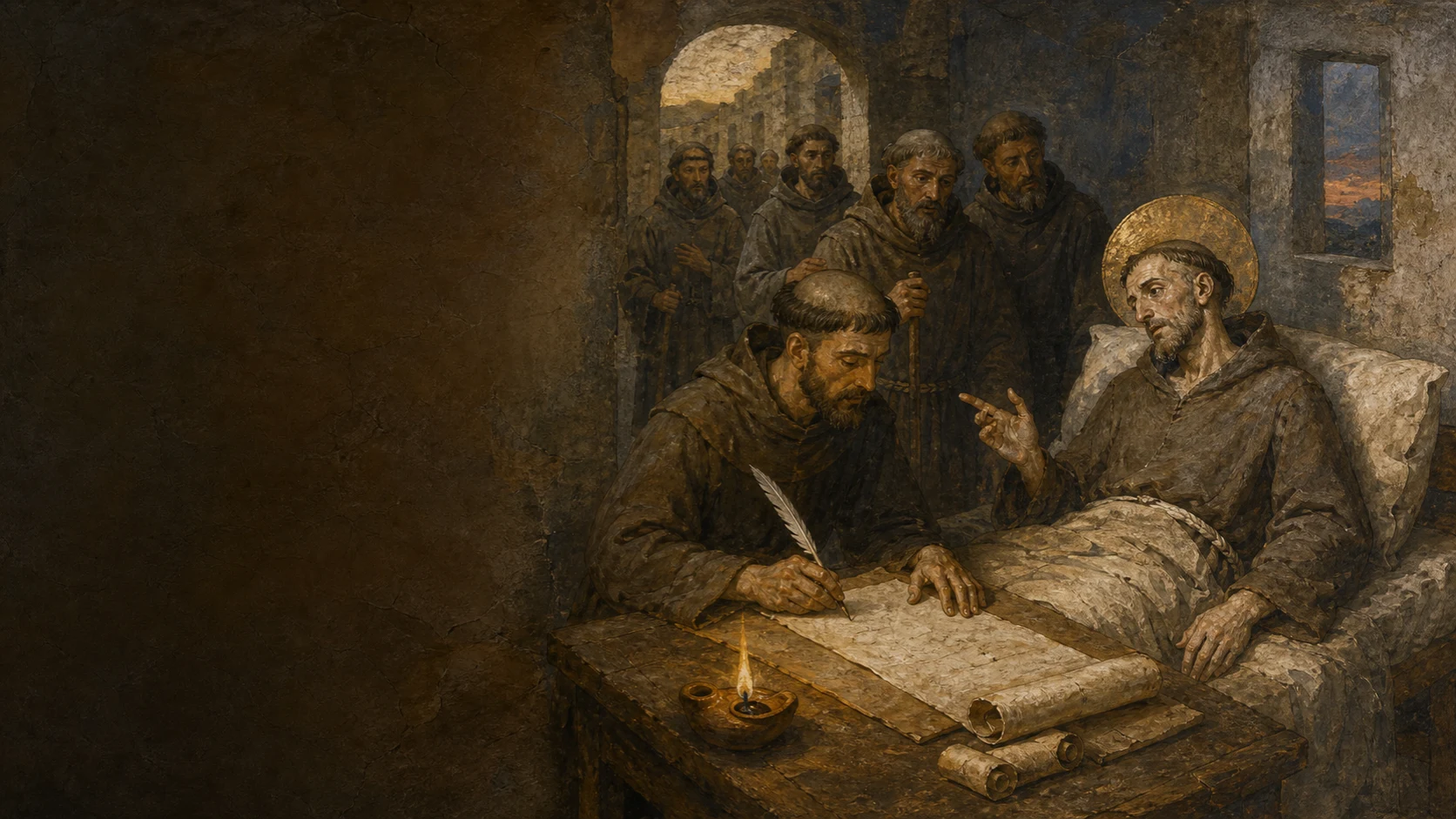
A voice for distant brothers
Imagine a stone room at the end of the day. One friar prepares the pen. Another holds the lamp. Francis is tired and ill, but still thinks of brothers who cannot fit inside that room: some are crossing Umbria, others live beyond the Alps, and still others study or preach in cities he may never see.
We do not know in what room the Letter to the Entire Order was composed. The scene is a literary reconstruction. The document, however, exists and is recognized as authentic. Its text appears in numerous medieval manuscripts, including codices in Assisi, Florence, Paris, and Rome. This means that it was copied, carried, and reread in many places.
Francis was not writing to a small community. By the final years of his life, the fraternity had spread widely. There were ministers, guardians, priests, lay brothers, scholars, and missionaries. The letter tries to cross all these differences. In its opening address, he calls the friars “first and last.” No one is to be left out.
The initial we must not complete
Francis probably dictated many texts to brothers able to write Latin. This was common in the Middle Ages. Dictation does not make the work cease to be his. An author could speak, revise, and entrust the material form to a secretary. In this letter, however, the preserved text does not identify the scribe. We do not know who held the pen or whether one person accompanied the whole composition.
In the address and near the end appears only “Brother N., minister general.” In editions the letter functions as an initial left unexpanded. Some historians have proposed Brother Elias, who governed the fraternity during part of Francis’s final years. This identification may help suggest a probable date, but it is not written in the document and should not be presented as certain.
The letter asks this minister, future ministers, custodians, and guardians to preserve the writing, read it, copy it, and have its teaching observed. We do not possess the original sheet or know the hand that wrote it. We possess later copies which, compared with one another, allow editors to approach the text with considerable confidence.
This is how much of antiquity reaches us: not as a recorded voice, but as a chorus of copies. When numerous witnesses preserve the same letter, small differences can be examined. A word lost in one codex may survive in another.
The manuscripts also show that preservation was a form of obedience. Every copy required parchment or paper, ink, time, and someone able to read Latin. A friar might make an error, notice it, and correct it in the margin. Another might add a title to help the reader. A modern edition therefore does not simply choose “the most beautiful book”: it compares families of witnesses, observes omissions, and seeks the earliest attainable form. It does not recover the lost original, but it narrows the distance from it.
A little man kneeling before the brothers
Francis presents himself as a simple, frail man and a little servant. This is not decorative false modesty. He is constructing a way of speaking. Even when he commands, he wants to remain below the brothers.
At one point he says that he would kiss their feet. The image is powerful because the letter also contains severe warnings. He asks for fidelity to the Rule, reverence in prayer, and particular care from priests. For Francis, authority should not resemble a throne. It should resemble someone bent down before those he wishes to correct.
This does not make him always gentle. Some sentences about the disobedient sound harsh today. It would be dishonest to erase them. Francis belonged to the thirteenth century, believed intensely in God’s judgement, and could use the rigorous language of the Bible and medieval preaching. Reading sympathetically does not mean turning the text into something it was not.
Yet severity is not the center. The center is Christ, who offers himself without the appearance of power.
Wonder before a piece of bread
Much of the letter concerns the Eucharist. Francis asks the friars to revere the Body and Blood of Christ, priests to celebrate with pure intention, and altar vessels to be worthy. For him, this was not about luxury. It was about wonder.
In Francis’s Catholic faith, the Son of God gives himself under humble signs of bread and wine. The Most High comes close without army, riches, or spectacle. This descent corresponded deeply with the Franciscan choice of minority.
The historical context matters too. In the early thirteenth century, the Latin Church was promoting greater care for the Eucharist. The Fourth Lateran Council in 1215 had reaffirmed important teachings and norms. Letters of Pope Honorius III insisted on the worthy custody of the consecrated species and sacred vessels. Francis shares this concern and translates it for his fraternity.
We need not imagine that he merely copied orders from above. The theme returns in his writings with a distinctive emotion. He marvels that Christ humbles himself each day and comes to meet humanity. Doctrine received from the Church becomes personal contemplation.
Priests without a stage
Francis asks brother priests for purity of intention. They must not celebrate to gain money, prestige, or powerful people’s approval. The altar cannot become a stage.
Here the text speaks of a temptation a child can understand. It is possible to do something good merely to receive applause. It is possible to pray while wanting to look better than others. Francis asks that action and heart meet again.
He also wants priests to celebrate according to the Church’s form. Francis never builds his simplicity against the Church. His freedom is not “I do everything my way.” It is an obedient freedom, even when obedience costs.
Some liturgical directions may seem distant to a modern reader. Yet the hidden question remains close: do we treat carefully what we claim to love? A person can call something sacred and then act carelessly. Francis does not accept this separation.
Books, voices, and the Divine Office
The letter directs clerical brothers to pray the Office according to the Rule. The Divine Office marked the hours with psalms, readings, and prayers. In a medieval friary, the day was not measured only by sun and work. It was interrupted by voices rising in the night, at dawn, and in the evening.
Francis did not despise liturgical books. He asked that they be used correctly. At the same time, he opposed knowledge that does not become life. To know sacred words and not obey them would be like owning a lamp and refusing to light it.
At the end, he confesses his own sins before God, Mary, the saints, the minister general, priests, and brothers. It is a surprising moment. The founder who warns the Order also places himself among those who need forgiveness.
He does not say, “I have arrived; you must catch up.” He says, in essence, “I too need mercy and want to observe what I ask.”
A prayer that may close the letter
Many manuscripts place at the end the prayer that begins by invoking God as almighty, eternal, just, and merciful. It asks for two graces: to do what we know to be God’s will and always to desire what pleases him. It then asks for purification, illumination, and inner fire to follow the footprints of Jesus.
Editors observe that the prayer’s position varies in the manuscript tradition. Even so, its union with the letter is ancient and fits it profoundly. Knowledge is not enough. Francis asks for will, action, and grace.
In a brief pastoral rendering, the prayer might sound: “Lord, grant us not only to recognize the good, but to desire and do it.” This is neither a replacement for the liturgical text nor a critical translation. It is a window onto its central idea.
The letter as a road
The Letter to the Entire Order is not a regulation neatly organized by subject. It advances like impassioned speech: it summons, warns, contemplates, confesses, commands, and prays. This irregular form may preserve something of Francis’s presence.
A scribe could copy the letter in dim light. A minister could read it at a chapter of friars. A priest could feel corrected. An uneducated brother could hear his name included among the “simple and obedient.” The document created a room larger than any friary: it held brothers separated by roads and languages.
The parchment was not the goal. Francis did not want his letter merely stored in a chest. He wanted it practiced.
Eight centuries later, the original sheet is lost. The demand remains whole: listen with the heart, treat the sacred reverently, do not use faith to attract attention, and ask for the grace to do the good we already know.
Witnesses and study
Sources for this manuscript
- Letter Sent to the Entire Order — IntraTextFranciscan text in translation. Allows readers to follow the letter’s complete structure and final prayer.
- Paschal Robinson, The Writings of Saint FrancisHistorical edition of 1905. Collects information about the codices and the early Quaracchi critical edition.
- Noel Muscat, OFM — The Letters of Saint FrancisModern Franciscan study. Presents the letters’ dating, themes, and transmission.
- Francis of Assisi: Early Documents, vol. 1 — Franciscan TraditionModern academic edition. Translation and critical introduction to the authentic writings.
- Fourth Lateran Council — VaticanChurch document of 1215. Helps explain the period’s environment of Eucharistic reform.
- C. Knowles — The Writings of St Francis of AssisiAcademic research. Discusses authorship, scribes, and the principal manuscript groups.
How we read this chapter: the letter’s existence, substantial authenticity, and themes are well supported. The exact date is approximate, and its place of composition is unknown. The lamplit opening is a narrative reconstruction. Phrases presented as pastoral translations are our own paraphrases, not quotations from a critical edition.