
A letter larger than a city
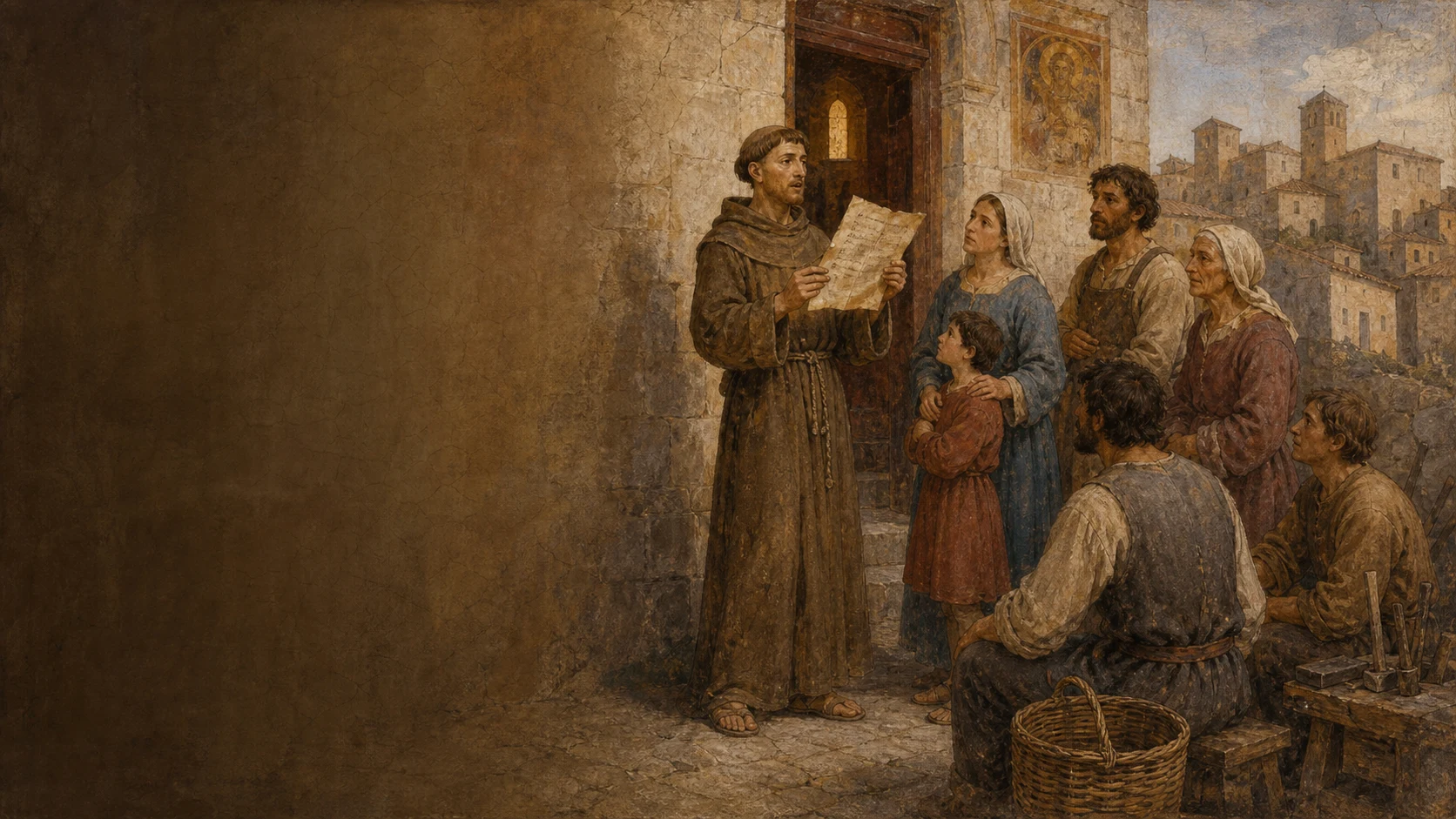
A woman stops her work. A merchant closes his purse. A child comes closer after noticing that the adults have fallen silent. Beside a church door, a brother begins to read words sent by Francis.
We do not know whether this gathering happened. It could have happened in many thirteenth-century towns, because the work known as the Letter to the Faithful is not addressed only to friars. It speaks to religious and lay people, to women and men, “to all who live in the whole world.” This is an enormous ambition for someone who called himself little.
The modern title can mislead. This is not a private letter carrying news to a known person. It is an exhortation: a text intended to circulate, be copied, and perhaps be read aloud. Francis explains that physical weakness prevents him from visiting everyone. Writing becomes a road.
But there is a fascinating detail. Tradition has preserved two related versions. They are not simply two copies containing errors. One is very brief; the other is extensive and elaborate. Discovering how they are related became an adventure of modern scholarship.
The small Volterra leaf
In 1900, the researcher Paul Sabatier published a text found in Codex 225 of the Guarnacci Library in Volterra. The medieval manuscript introduced those lines as “words of life and salvation.” For a time, scholars thought that they were merely a later summary of the longer Letter to the Faithful.
Kajetan Esser, an important editor of Francis’s writings, argued that the short text deserved to be treated as a distinct and earlier version. It is therefore often called the First Version of the Letter to the Faithful or the Exhortation to the Brothers and Sisters of Penance. Esser’s proposal shaped modern editions, but the order of the two texts remains debated. “First” is a useful convention, not a date written in the codex.
The second title also requires care. The text may preserve teaching given to early penitents associated with Francis, women and men who remained in their homes and occupations. We should not, however, automatically imagine it as a “finished rule” for the future Secular Franciscan Order. Institutions took shape over time. The early document offers a root, not a complete organisational chart.
The Volterra codex is the sole witness to this brief version. A single manuscript does not make a text false, but it requires attention. Analysis of its vocabulary, thought, and relationship to the long version supports its Franciscan authenticity.
Doing penance does not mean being sad
Today, “penance” may suggest only punishment or a sombre face. For Francis it has a broader meaning: turning to God, abandoning what destroys, and beginning a new life. The encounter with people affected by leprosy, narrated in the Testament, was a change of this kind. What had seemed bitter became sweet.
In the brief version, those who do penance love God and neighbor, reject vices and sins, receive the Eucharist, and produce fruits worthy of conversion. It is a short, demanding direction: inner change must appear in the way a person loves and acts.
Francis uses biblical family language. Those who live in this way become children of the Father and spouses, brothers, sisters, and mothers of Jesus. The final image is especially beautiful. We become “mothers” of Christ when we carry him in the heart and bring him to birth through luminous works.
This is neither a biological claim nor an attempt to erase Mary. It is a spiritual metaphor: the good received must take flesh in the world.
The version that opens the doors
The long version begins by addressing everyone. Francis presents himself as a servant and subject. Unable to visit people because of illness, he says that he sends the Lord’s words in a letter.
This opening has led many interpreters to place it near the final years of Francis’s life. The date, however, is not written on the sheet. The illness mentioned and connections with other writings provide clues, not a secure calendar.
The text then contemplates the Christian mystery: the Father’s Word receives human flesh in Mary’s womb; Jesus chooses poverty, gives his own life, and leaves the Eucharist as the memorial of his presence. Francis does not begin with a list of prohibitions. He begins by telling who Christ is.
The letter then returns to choices: loving one’s neighbor, confessing sins, receiving the Eucharist, not desiring more than is necessary, and practising humility and mercy. The spiritual path enters the use of money, life with others, and care for those who depend on us.
The money beside the bed
The letter’s most severe section describes a rich man who is ill. Relatives and friends draw near. A priest invites him to repair injustices and return what belongs to others. The man promises but hesitates. His possessions occupy his thoughts to the end.
We need not read the scene as a report of a particular death. It is a moral parable built with images familiar in the thirteenth century. Families debated inheritances; sick people made wills; debts and property decided the future of many lives.
Francis wants to break the illusion that we possess forever what we hold. The man dies and leaves everything. More seriously, he leaves wounds he refused to repair.
The text uses frightening images of the devil and condemnation. They belong to medieval preaching and the author’s religious conviction. It would be wrong to hide them, and also wrong to use them to terrify children. Their question can be stated responsibly: if the heart clings only to what passes away, what remains when all of it is taken away?
Women and men named together
Both versions repeat “men and women.” This deserves to be heard. Francis lived in a society where the possibilities for public action differed greatly from one person to another. Even so, his spiritual exhortation speaks directly to both.
Some scholars connect this vocabulary with penitential fraternities and the setting from which the Order of Brothers and Sisters of Penance would emerge. Others warn against extracting from the text an institutional structure it does not describe.
What we can affirm is enough and precious: women do not appear merely as spectators of a message delivered to men. They are recipients, responsible agents, and people capable of carrying Christ in heart and works.
Clare and the sisters of San Damiano show that this was not an empty idea in Francis’s life. The letter, however, was not written specifically to Clare. Its horizon is much wider.
What changed between the two versions?
No one preserved a diary saying, “Today Francis expanded the old text.” Scholars compare words, order, and manuscripts. A traditional reading sees the short version as catechesis for penitents and the long one as a universal development of that core. Other researchers ask whether the brief form might have summarised or reorganised broader material. The surviving leaves have not ended the discussion.
There may have been an interval between the versions, or they may have organized teachings already repeated orally. A secretary may have helped shape the Latin. Medieval authorship does not always resemble the modern image of one person alone before a page.
This uncertainty does not diminish the writings. It teaches us to hear what both actually say without inventing a sequence the manuscripts cannot prove.
The long version’s transmission is much richer. It appears complete in many codices, including those of Assisi and Ognissanti, and in fragments of others. Scribes sometimes divided the text into chapters or even separate letters. Modern editors compared these witnesses to recover its unity.
A house built within the person
At the heart of both versions is the promise that God dwells in those who live true love. This is not a pleasant feeling lasting a few minutes. The dwelling appears when faith, mercy, and action meet.
In a pastoral paraphrase, the idea might be: “Make your heart a house where Christ can be carried; open the doors of that house through your works.” These words do not claim to replace Francis’s Latin. They simply bring his image closer to a young reader.
A child understands the essential point. Saying “I love you” while continuing to hurt deliberately creates a crack. Asking forgiveness, making reparation, and caring begin the rebuilding. Francis calls this change penance.
The letter still seeks readers
The gathering imagined at the beginning disperses. The merchant returns to the stall. The woman resumes her work. The child carries away a sentence. The parchment goes on to another town.
The scene is invented, but it describes the real function of a circular text. A letter does not choose only great scholars. It meets busy, tired, different people. Its voice depends on someone reading and someone agreeing to listen.
The two versions do not give us rival messages. They show the same flame in different sizes. The smaller speaks with the clarity of a narrow door: there is a way of conversion. The larger opens a landscape: Christ came poor, gave himself, and can dwell in a transformed life.
The Volterra manuscript and the many codices of the long version survived because someone kept them. But surviving is not the same as being heard. The letter’s final crossing happens whenever readers allow an ancient word to examine how they treat God, neighbor, money, body, and truth.
Two versions preserved
Sources for this manuscript
- Letter to the Faithful, first version — IntraTextFranciscan text. Preserves the brief exhortation about those who do and do not do penance.
- Letter to the Faithful, second version — IntraTextFranciscan text. Presents the long form addressed to women and men throughout the world.
- Noel Muscat, OFM — The Letters of Saint FrancisFranciscan study. Explains the discovery of the Volterra version and Kajetan Esser’s assessment.
- Francis of Assisi: Early Documents, vol. 1Modern academic edition. Provides both texts, introductions, and current editorial terminology.
- Paschal Robinson — The Writings of Saint FrancisHistorical edition. Records known codices and the early debate about the Letter to the Faithful.
- Franciscan Journey — documentary readingsSecular Franciscan formation. Places the first version and the penitential tradition in context.
How we read this chapter: contemporary scholarship treats both versions as authentic writings by Francis. Their sequence and development are critical reconstructions; we know neither the exact dates nor the audience of a first reading. The scene beside the church is literary. English paraphrases are our own and are marked as pastoral approximations.