
A page before power
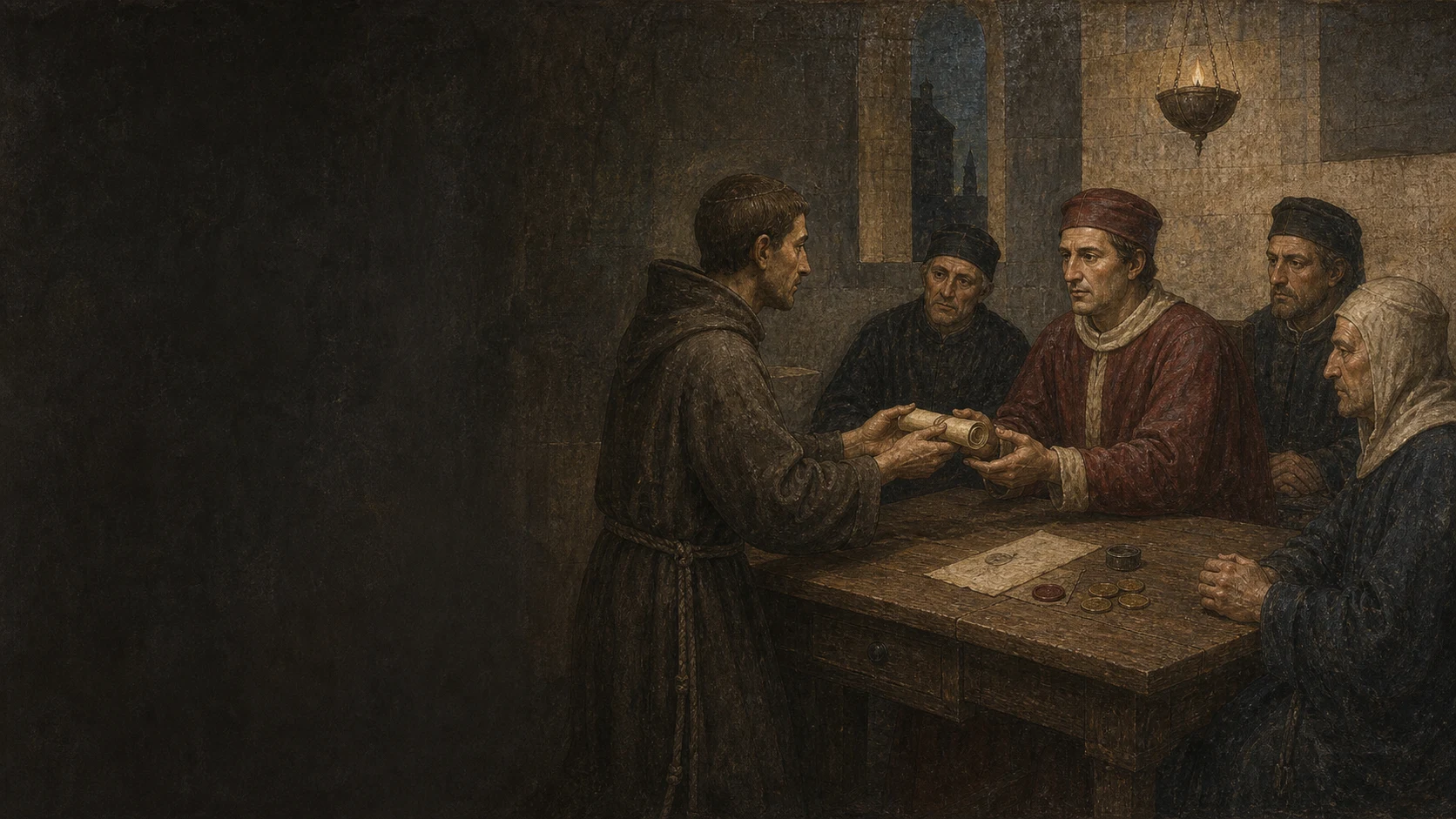
The hall is cold. A judge speaks with counselors. Seals, accounts, and petitions lie on the table. Then a brother arrives dressed in poor cloth. He brings neither money, soldiers, nor title. He brings a page.
We do not know whether Francis entered such a hall. Nor do we know which rulers received his Letter to the Rulers of the Peoples. The text opens very broadly: it addresses podestàs, consuls, judges, governors, and everyone whom the letter may reach.
The podestà was a common authority in thirteenth-century Italian cities. Consuls and judges took part in different forms of government. Cities disputed land, powerful families competed, and local wars could begin quickly. Civil office carried honor, but also violence and responsibility.
Francis introduces himself as a “little and contemptible servant.” Then he speaks a sentence no powerful person can revoke: the day of death is drawing near.
What survived—and what did not
Some writings of Francis are preserved in many codices. This letter is in the opposite position. The known version depends on a publication of 1623, almost four hundred years after the saint’s death. Wadding said that he transmitted a text known through the Spanish tradition.
Francis Gonzaga, a sixteenth-century Franciscan author, reported that John Parenti, minister general from 1227 to 1232, had taken a copy to Spain. We cannot verify whether this report gives the document’s exact path, because the early copy has not been found.
Does this mean the letter is false? No. It means that the degree of certainty is different. Its vocabulary, brevity, and themes fit Francis. It is also related to the Letter to the Custodians, preserved by another route, in which he asks the brothers to promote public signs of praise. For these reasons, major editors included it among the authentic writings.
But we cannot compare many manuscripts, correct scribal errors, or observe the text during its early centuries. Calling it authentic is a responsible historical judgement, not mathematical certainty.
“Do not forget the Lord”
The letter makes only a few movements. First, Francis asks rulers not to let the cares of the world erase the memory of God. Then he recalls death. Next, he invites them to receive the Eucharist and to have the people offer praise every evening. Finally, he warns that they will give an account if they do not do this.
For modern readers, this combination of government and religious worship may feel strange. In many societies today, civil authorities must not impose a religion. In Francis’s world, political organisation and Christian faith were intertwined differently. Bells, processions, oaths, and feasts marked public life.
We should not pretend that the text supports precisely our present ideas. Nor need we abandon its deeper question: does power remember that it is limited?
A ruler may begin by believing that he serves and end by believing that everything belongs to him. Francis places death before him not out of delight in destruction, but as a truth that dismantles illusion.
The name proclaimed at dusk
Francis asks that every evening a herald or other signal summon the people to praise and thank God. In medieval cities, heralds proclaimed orders and news aloud. Bells also organized hours, dangers, and celebrations.
Some researchers connect this request with what Francis may have heard in regions with a Muslim presence, perhaps during his journey to the East: the public call to prayer. The hypothesis is attractive, but the letter cannot prove it. The text does not mention Islam or explain the practice’s origin. We may present it as a possibility, not a fact.
There is also a nearby explanation within the Franciscan movement itself. The Letter to the Custodians asks the brothers to proclaim praise to God before the peoples and exhort authorities. Francis wanted gratitude to interrupt the ordinary course of the day.
Imagine a city pausing for an instant. The blacksmith lowers the hammer. A mother looks through the window. A judge stops signing. The bell does not erase the problems, but recalls that the city does not own the sky.
This image is a reconstruction. The document’s request, however, is real.
Authority as a loan
The letter does not teach how to collect taxes, build walls, or settle a dispute. Francis offers no political treatise. He attacks the invisible point of power: forgetfulness.
Those who govern receive many people into their responsibility. In medieval vocabulary, Francis says that the people were “entrusted” to these men. The word changes everything. What has been entrusted cannot be treated as property.
An authority deciding on war may think of the young people who will not return. A judge may remember that a sentence will touch a family. An administrator may ask whether common resources are used to serve or to enrich friends. These applications are ours, but they follow the letter’s moral nerve.
Francis does not ask rulers to become friars. He asks them not to be swallowed by office. In our own pastoral rendering: “Your power has an expiry date; your responsibility cannot fit inside your pride.”
A severe word about the end
The document threatens punishment for those who do not receive the warning. The language is strong. Francis believed in eternal life, judgement, and the real possibility of a person turning away from God. Medieval preachers used images of hell far more often than preachers usually do today.
The passage can be read without making fear an instrument of control. The warning reveals how seriously he viewed public choices. An unjust decision by a powerful person does not wound only that person’s conscience; it can wound an entire city.
The greater a person’s reach, the greater the care required. This principle remains understandable even in a very different society.
At the same time, we should not sweeten the document until it becomes a vague message about “being kind.” Francis is not offering courtesy. He is calling powerful men to conversion.
Francis knew rulers
Francis’s life crossed spaces of power. He was born into a merchant family in Assisi, a city marked by conflict. He took part in the war with Perugia and was imprisoned. He met church authorities, received papal approval, and traveled East during a crusade, where he stood before Sultan al-Malik al-Kamil.
Sources about these encounters differ in proximity and elaboration. We cannot use every later story as a direct explanation of this letter. His life nevertheless shows that “power” was no abstraction to him.
He knew walls, soldiers, commerce, and civic ambition. His choice to become lesser was born in that world. When he calls himself little before rulers, he does more than use a formula. He places two forms of presence in one room: authority that rises and a servant who descends.
Who might have carried the letter?
Perhaps copies were entrusted to custodians or preachers. Perhaps a friar read it before a magistrate. Perhaps it circulated less than Francis hoped. We do not know.
The better-attested Letter to the Custodians asks Franciscan leaders to deliver writings to bishops and authorities. That connection makes a network of messengers plausible. Even so, we possess no list of recipients and no replies from rulers.
The silence of the archives must not be filled with invented certainty. It too is part of history. A letter may have been written and left almost no trace. One copyist may stand between a text and complete loss.
The form published by Wadding may also have passed through translation or adaptation on its journey into print. Without an earlier witness, we cannot measure every word. Editors judge the whole: the way Francis makes himself small, the remembrance of death, Eucharistic reverence, and the summons to praise all have recognisable parallels. The decision rests on convergence, not a preserved signature. This case teaches us that a medieval library has degrees of light: some documents arrive through open windows, others through a narrow crack.
The question placed on the table
In the imagined hall, the ruler holds the parchment. He may keep it, laugh, or order it read. The scene ends before his reply.
That fits the document’s historical situation. We know the warning, not its effect. We do not know whether a podestà changed a decision because of it. We do not know how many squares heard the evening call.
What remains is a small voice before great offices. It says that cares can become forgetfulness, power does not conquer death, and a people should not be led as a possession.
The letter reached us by a narrow, late passage. Perhaps that fragility suits its content. Seals break. Governments end. Titles disappear. A nearly lost page still asks the powerful person: whom do you remember when everyone is looking at you?
A narrow transmission
Sources for this manuscript
- Letter to the Rulers of the Peoples — IntraTextTraditional text. Preserves the brief warning addressed to authorities.
- Paschal Robinson — The Writings of Saint FrancisHistorical edition. Explains Gonzaga’s report, Wadding’s publication, and the initial critical acceptance.
- Noel Muscat, OFM — The Letters of Saint FrancisModern Franciscan study. Places the letter among the writings and discusses its context.
- Letter to the Custodians — IntraTextRelated and better-attested document. Requests public signs of praise and contact with authorities.
- Francis of Assisi: Early Documents, vol. 1Modern academic edition. Translation, critical title, and notes on the authentic writings.
- Encyclopaedia Britannica — podestàHistorical reference. Explains the urban authority named in the letter’s address.
How we read this chapter: the text is traditionally received among the authentic writings, but it survives in no known medieval manuscript and depends on sixteenth- and seventeenth-century witnesses. Statements about messengers, recipients, and effects therefore remain hypotheses. The hall, herald, and people’s reactions are responsible literary reconstructions.