
An open door for God
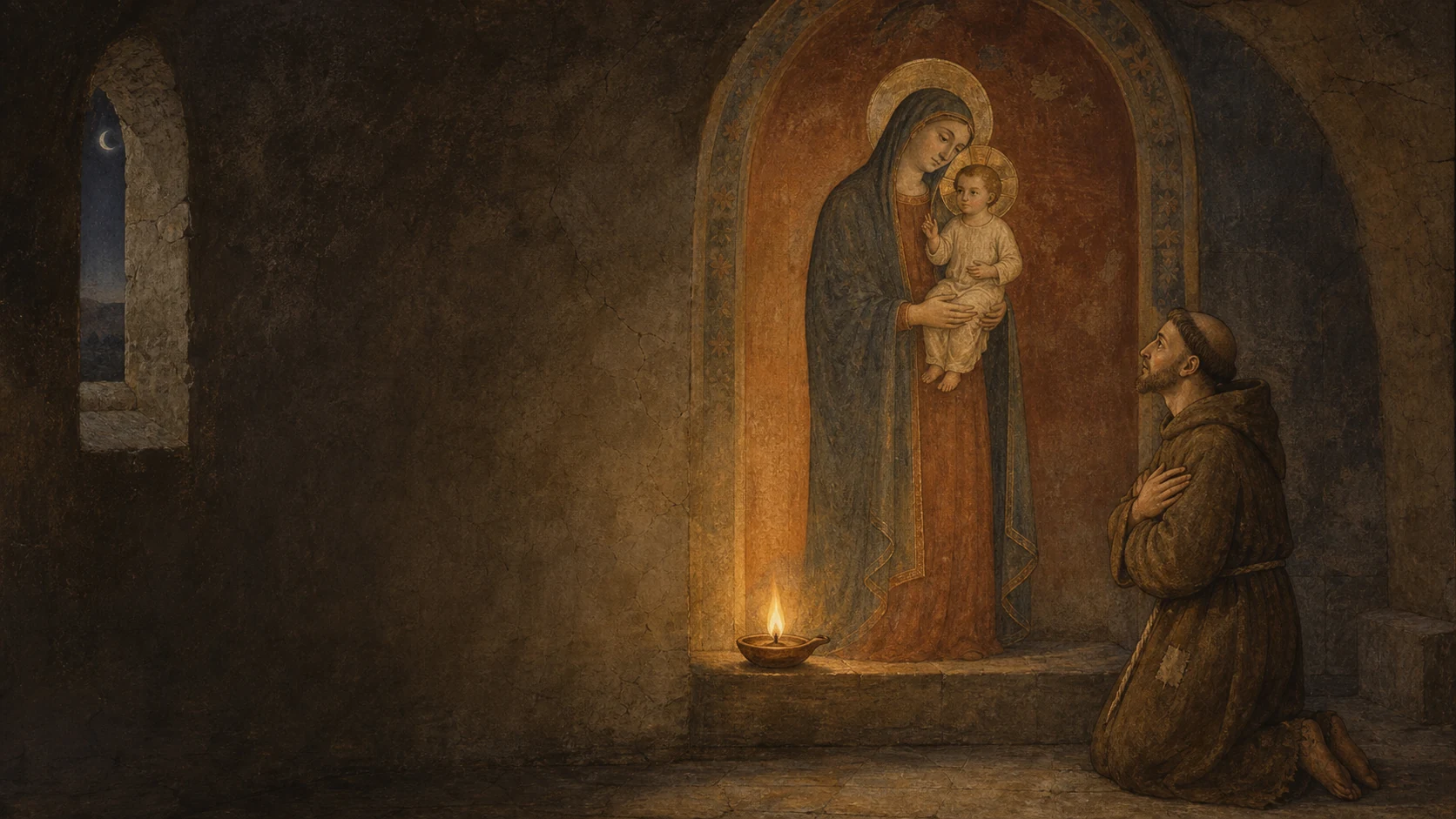
Imagine a small stone chapel after night has covered the fields of Assisi. There is only a small flame, silence, and a man in a patched habit. Francis looks at Mary and contemplates a person who allowed God to enter her life completely.
This is why the prayer on this page repeatedly begins with the word “Hail.” It is not a long explanation. It is a succession of greetings, as when someone meets a dearly loved person and discovers that one name is not enough. Francis calls Mary Lady, Queen, Mother, Virgin, palace, tabernacle, house, robe, and servant. Each word opens a different window.
“Queen” may sound like a word made of crowns and halls. But the queen Francis sees is a young woman from Nazareth who listened, asked, and answered, “May it be done to me according to your word.” Her greatness does not come from the power to command. It comes from the freedom to welcome. She is queen because God has done great things in her and because she gave all that she was to his love.
Francis also calls her “the Virgin made Church.” The image is surprising: before any Christian cathedral existed, Mary had already become a meeting place between God and humanity. She received Jesus in her own body and offered him to the world. In her, the Church appears not as a building, but as a person who hears the Word, keeps Christ, and carries him to others.
Origin and authorship
A prayer truly connected with Francis
The Salutation of the Blessed Virgin Mary belongs to the writings recognized as authentic works of Francis of Assisi. We do not know the exact day or place of its composition. The text was preserved in early manuscript collections of his writings, and its textual tradition is closely related to the Salutation of the Virtues.
This means that we are not dealing with a modern prayer that received the saint’s name many centuries later. We are reading words that Franciscan manuscript tradition attributes to Francis himself. The version below is this portal’s own pastoral translation, made from the Latin text and checked against Franciscan editions. It preserves the original images and meaning in clear English for people praying today.
Prayer text
Salutation of the Blessed Virgin Mary
Hail, holy Lady,
Most Holy Queen,
Mary, holy Mother of God,
Virgin made Church,
chosen by the Most Holy Father of heaven
and consecrated by him
with his most holy beloved Son
and the Holy Spirit, the Comforter.
In you was and is
all fullness of grace
and every good.
Hail, God’s palace!
Hail, his tabernacle!
Hail, his house!
Hail, his robe!
Hail, his servant!
Hail, his Mother!
And hail, all you holy virtues,
poured into the hearts of the faithful
through the grace and light of the Holy Spirit,
so that, no longer unfaithful,
he may make them faithful to God.
Amen.
This portal’s own pastoral translation from the Latin text traditionally titled Salutatio Beatae Mariae Virginis.
What Francis saw in Mary
Palace, tabernacle, and house are not three random compliments. A palace is the place of a king. A tabernacle recalls God’s presence journeying with his people in the desert. A house is where someone finds shelter and intimacy. Francis gathers these images to say: Mary truly welcomed the Son of God—with her body, her faith, and her whole life.
Then he calls her a robe. Clothing makes someone visible in the world. Mary gave the eternal Son the flesh of our humanity: hands that could touch, eyes that could weep, feet that could walk. She welcomed the mystery through which the Son of God became truly human.
Then comes the humblest word: servant. Francis does not separate greatness from service. Mary is the Mother of the Lord and remains the servant who offers herself. For the Franciscan heart, being important does not mean occupying the highest place; it means making space for God to love the world through us.
The prayer ends by greeting the virtues that the Spirit pours into hearts. Francis does not see Mary as someone distant, confined to a golden frame. He contemplates her as a sign of what grace can do in a willing person. Faith is not produced by our strength. It is a gift received, cared for, and transformed into a response.
How to pray this prayer
Pray as if visiting a house filled with light
- Be silent for one minute. Imagine the small house in Nazareth. Do not try to see every detail; simply remember that God chose to come into the world through simplicity.
- Read each “Hail” without rushing. After each title—palace, tabernacle, house, robe, servant, Mother—pause and ask, “What does this word show me about Jesus?”
- Choose one word to keep. Perhaps today you need to be a house for someone who feels alone, a robe protecting someone who feels ashamed, or a servant able to help without being noticed.
- End with your own yes. Tell God, in simple words, what small space in your life you want to open to him.
This salutation does not replace the Hail Mary and need not compete with another devotion. It can be prayed before studying, when entering a church, on a Marian feast, or whenever you want to learn from Mary how to welcome Christ.
Meditation
God is not looking for a perfect house
Sometimes we think God draws near only when we have put everything in order: when we feel no fear, have no doubts, and already know how to be good. Mary shows us something else. She asked the angel a question, received an immense mission, and walked without possessing every answer.
God is not looking for a palace built by vanity within you. He is looking for an open door. Perhaps your heart seems like a small house with cracks and little furniture. Even so, it can become a place of listening, kindness, and presence.
Today, do not try to imitate Mary’s beauty by doing something enormous. Imitate her availability. Listen before answering. Protect a vulnerable person. Carry Jesus to someone through a gentle word. A house becomes holy not because its walls shine, but because love finds room inside it.
For those who want to go deeper
Sources for this page
- Prayers of Saint Francis — Order of Friars MinorThe OFM General Curia includes the Salutation of the Blessed Virgin Mary among Francis’s prayers.
- A Salutation of the Blessed Virgin Mary — Francis of Assisi: Early DocumentsA modern Franciscan edition of the writing, with an introduction and notes on its textual tradition.
- The Writings of Saint Francis of Assisi — 1905 edition, CapDoxA historical public-domain edition describing the manuscripts used and presenting a complete translation.
- Saint Francis of Assisi — General Audience of Benedict XVIThe pope recalls Francis’s love for Mary and quotes one of his authentic Marian prayers.
- Letter on the reopening of the Portiuncula — Saint John Paul IIExplains the Franciscan image of the “Virgin made Church” and the titles tabernacle, house, robe, servant, and Mother.
The exact date and setting of the composition are unknown; the nighttime scene on this page is therefore contemplative, not a documentary reconstruction.