When a familiar prayer breathes again
Perhaps you have known the Our Father since you were very young. Because its words are so familiar, they can sometimes pass quickly over our lips without reaching the heart. We repeat a phrase so often that we stop hearing what it says.
The Our Father was part of the first brothers’ daily life. In a text preserved among Francis’s writings, every phrase taught by Jesus receives an expansion. It is as though he places a lamp beside each word and says, “Look again. There is more light here.”
He does not try to improve Jesus’s prayer. He allows it to unfold within him. “Heaven” becomes God’s presence in the saints. “Kingdom” becomes God reigning in us. “Bread” points to Jesus. “Forgiveness” reaches the place where we hold resentment.
This paraphrase is prayer and teaching at the same time. Pray it without rushing.
Origin and authorship
A meditation born alongside the Our Father
The Latin text is known as the Expositio in Pater noster, “Exposition on the Our Father.” It appears in early manuscript collections. Tradition attributes it to the saint, although one codex associated the paraphrase with Brother Giles. The principal Franciscan editions receive it among Francis’s authentic writings.
We do not know the exact date of composition, and the original sheet has not survived. The text reached us through early copies. The version below is this portal’s own pastoral translation, made from the Latin and checked against Franciscan editions. The expansions belong to the ancient writing; only the English form has been prepared for clear reading.
Prayer text
Prayer inspired by the Our Father
O our most holy Father:
our Creator, Redeemer,
Comforter, and Savior.
Who are in heaven:
in the angels and the saints,
enlightening them so that they may know you,
for you, Lord, are light;
setting them aflame so that they may love you,
for you, Lord, are love;
dwelling in them and filling them with happiness,
for you, Lord, are the supreme Good,
the eternal Good,
from whom all good comes
and without whom no good exists.
Hallowed be your name:
may knowledge of you shine within us,
so that we may know the greatness of your blessings,
the breadth of your promises,
the height of your majesty,
and the depth of your judgments.
Your Kingdom come:
so that you may reign in us through grace
and lead us to your Kingdom,
where we will see your face without shadows,
love you perfectly,
live in your joyful company,
and rejoice with you forever.
Your will be done on earth as it is in heaven:
so that we may love you with all our heart,
always thinking of you;
with all our soul,
always desiring you;
with all our mind,
directing our intentions toward you
and seeking your honor in all things;
and with all our strength,
placing the energies and affections of body and soul
at the service of your love, and nothing else.
May we love our neighbor as ourselves,
drawing everyone, as far as we can, to your love;
rejoicing in the good of others as in our own,
suffering with them in their difficulties,
and offending no one.
Give us today our daily bread:
your beloved Son, our Lord Jesus Christ,
so that we may remember, understand, and revere
the love he had for us
and all that he said, did, and suffered for us.
Forgive us our trespasses:
through your immeasurable mercy,
through the power of your beloved Son’s Passion,
and through the merits and intercession
of the Blessed Virgin Mary and all your elect.
As we forgive those who trespass against us:
and what we have not yet forgiven completely,
grant, Lord, that we may forgive entirely,
so that we may truly love our enemies for your sake,
pray for them sincerely before you,
return evil for evil to no one,
and seek to do good to everyone in you.
And lead us not into temptation:
hidden or visible,
sudden or persistent.
But deliver us from evil:
past, present, and future.
Amen.
This portal’s own pastoral translation from the Expositio in Pater noster.
A prayer that always says “we”
Francis calls God Creator, Redeemer, Comforter, and Savior. The Father gives us life, rescues us, remains beside us, and leads us home.
The prayer does not say “my Father” or “give me my bread.” It says our and us. When a child is hungry, that child’s need enters our prayer. When someone who hurt us appears in the petition for forgiveness, that person enters too. The Our Father does not allow the heart to remain locked inside the self.
Francis does not pretend that forgiveness is complete. He prays about what we still cannot forgive. Forgiving does not mean approving evil or returning to a dangerous situation. It means asking God to free us from returning the wound and teach us to seek what is good.
How to pray this prayer
One phrase at a time
- First pray the Our Father as you already know it. Do not force feelings. Simply say Jesus’s words attentively.
- Choose a single petition. Instead of reading the entire paraphrase, remain today with “your Kingdom come,” “give us bread,” or another phrase that touches your life.
- Read Francis’s expansion twice. The first time, seek to understand. The second, turn each line into a personal and communal petition.
- Give the prayer an action. If you asked for bread, share. If you asked for forgiveness, stop an act of revenge. If you asked for the Kingdom, do something just that no one needs to applaud.
Move through the seven petitions over one week. On the seventh day, pray the whole Our Father and notice how the words have gained a face.
Meditation
The bread on the chapel floor
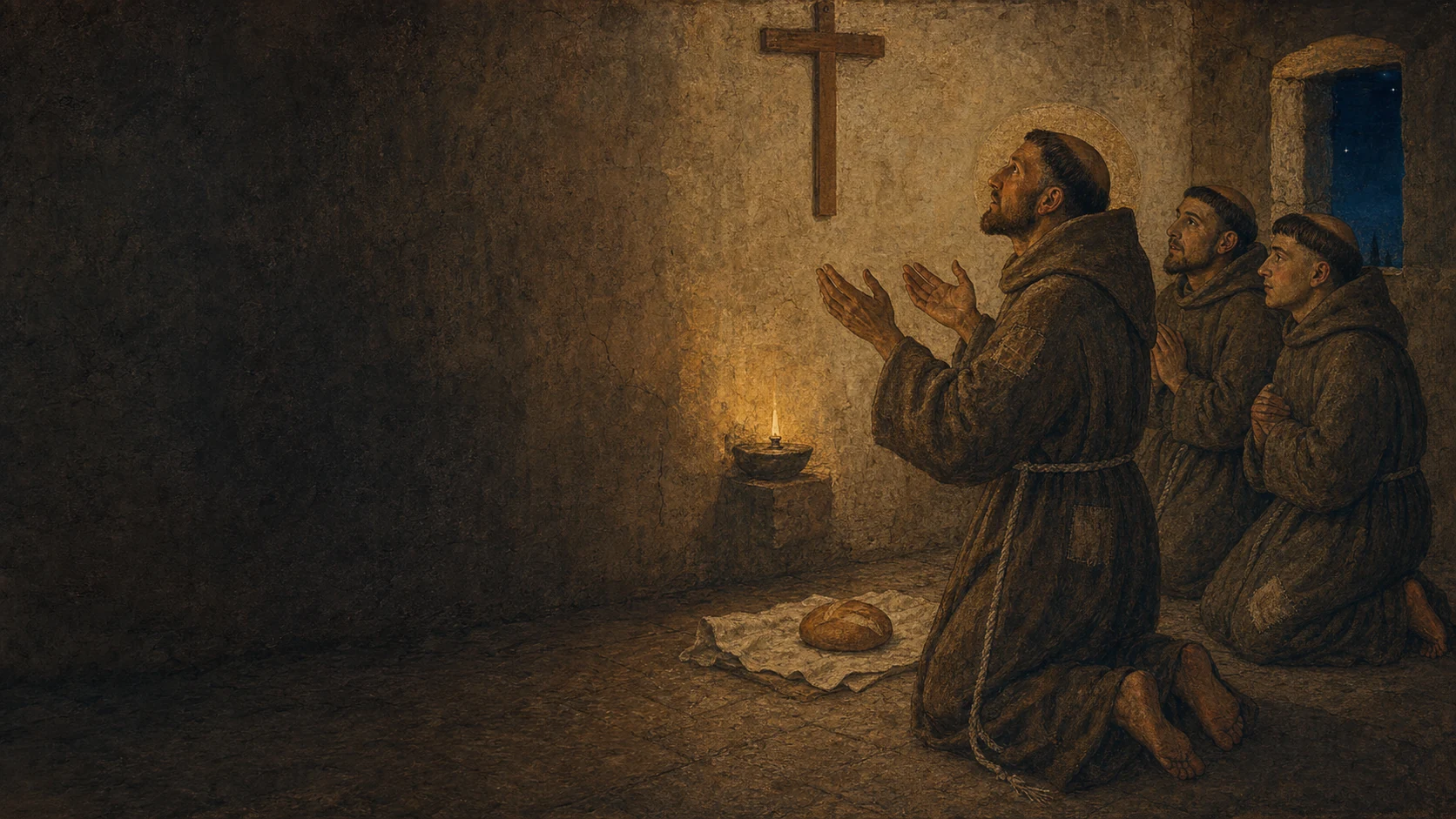
Imagine Francis praying with the brothers in a poor chapel. There is bread on a cloth. It came from work, soil, rain, and someone who shared. Jesus also offers himself as the Bread of Life.
In saying “give us today,” no one asks to store up all of tomorrow’s bread. We ask for what is needed and learn to trust. In saying “our,” no one can forget those who did not receive their share. Prayer raises our eyes toward God and, in the same movement, opens our hands to a brother or sister.
The Our Father takes less than a minute to pray, just as a seed fits in the palm of a hand. When welcomed, it takes root and becomes shelter. A whole Kingdom is hidden in these words.
For those who want to go deeper
Sources for this page
- Prayers of Saint Francis — Order of Friars MinorThe OFM General Curia presents the Prayer Inspired by the Our Father among Francis’s prayers.
- A Prayer Inspired by the Our Father — Francis of Assisi: Early DocumentsA modern Franciscan edition of the text, with an introduction, the petitions divided, and biblical references.
- The Writings of Saint Francis of Assisi — 1905 edition, CapDoxA historical public-domain edition that discusses the manuscript tradition and includes the complete paraphrase.
- Catechism of the Catholic Church, 2759–2865 — VaticanPresents the Our Father as the fundamental prayer received from Jesus and explains its seven petitions.
- “Father of us all” — General Audience of Pope FrancisRecalls that the Our Father is prayed in the plural and makes us responsible for our brothers and sisters.
The community in this artwork is a contemplative interpretation, not a reconstruction of a documented moment.