
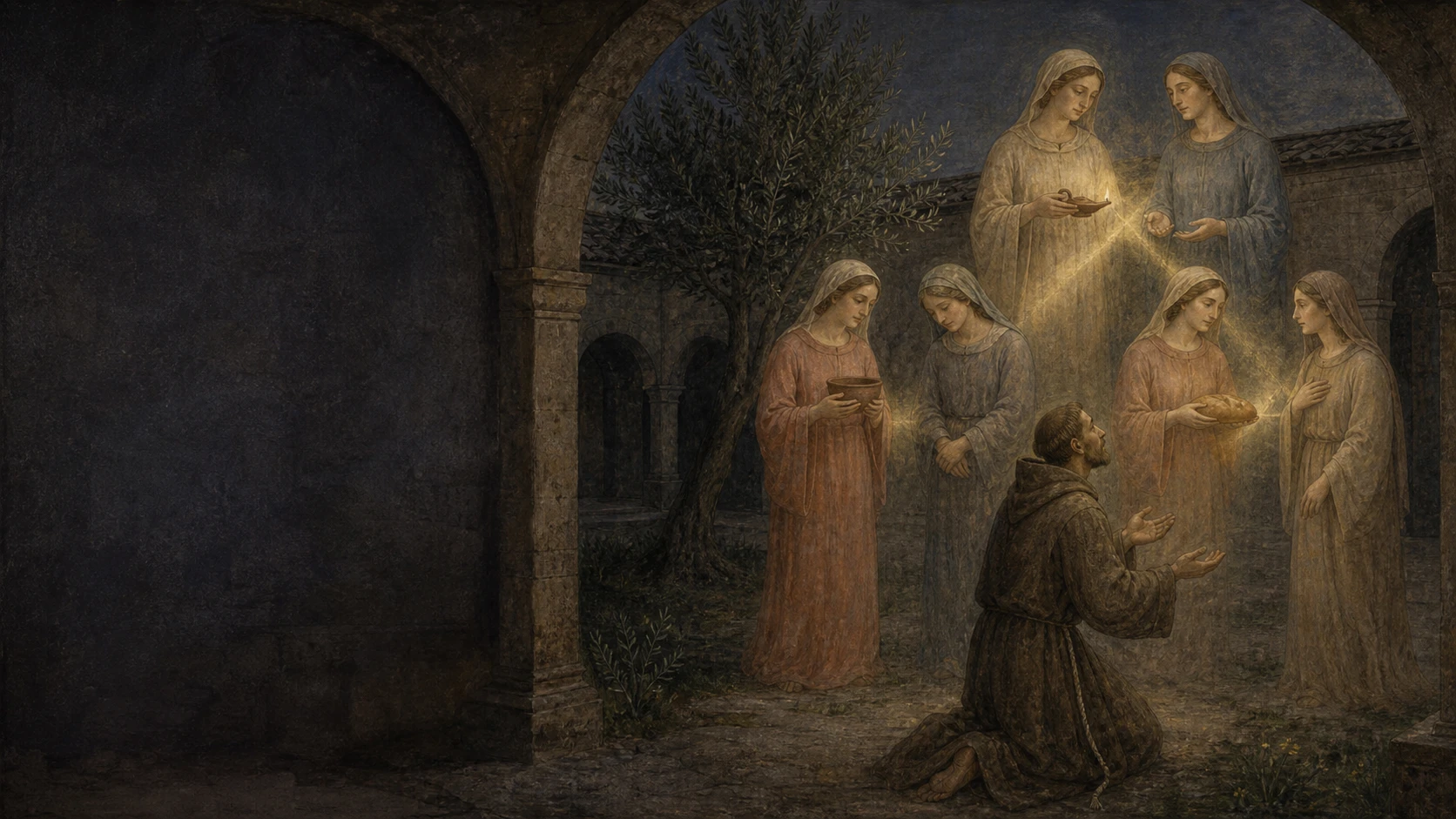
Imagine six sisters arriving together at the door of the heart. The first knows how to see what truly matters. The second does not make love complicated. The third walks with empty hands. The fourth does not need to feel superior. The fifth brings warmth to those nearby. The sixth learns to listen.
Francis called these sisters Wisdom, Simplicity, Poverty, Humility, Charity, and Obedience. For him, the virtues were not decorations that made someone look holy. They were strengths received from God that changed the way a person thought, chose, shared, and treated every creature.
In the Salutation of the Virtues, he arranges the six in pairs: Wisdom with Simplicity; Poverty with Humility; Charity with Obedience. None seeks to shine alone. Wisdom without simplicity can become pride. Poverty without humility can become display. Obedience without charity can become harshness. Together, they protect one another.
Where does this prayer come from?
The Salutatio Virtutum, or Salutation of the Virtues, is one of the authentic writings of Saint Francis. The text was transmitted in several medieval manuscripts, and Thomas of Celano, one of the saint’s earliest biographers, already knew and quoted this composition in the thirteenth century.
Francis uses a form of speech common in the religious poetry of his time: he addresses the virtues as if they were people. This does not mean that he believed in six magical beings. It is a poetic way of making visible what happens within the soul. He calls them “most holy” because they come from God and lead a person toward God.
One sentence requires care: no one possesses a virtue “without first dying.” Francis is not asking anyone to harm their body. He means the death of selfishness: allowing dishonesty, the desire to dominate, and the wish to keep everything for oneself to die. This is the language Jesus uses about losing one’s life in order to find it.
The text below is this portal’s own pastoral translation, made from the Latin original. We have kept the force of its images while using clear words so that a young reader can pray without confusing humility with humiliation, obedience with abuse, or poverty with abandoning those in need.
The salutation
Hail, Queen Wisdom!
May the Lord keep you,
with your sister, holy and pure Simplicity.
Holy Lady Poverty,
may the Lord keep you,
with your sister, holy Humility.
Holy Lady Charity,
may the Lord keep you,
with your sister, holy Obedience.
Most holy virtues,
may the Lord keep you all,
he from whom you come and proceed.
No one in the whole world
can truly possess one of you
without first dying to self.
Whoever possesses one
and does not wound the others
possesses them all.
Whoever wounds one
possesses none
and wounds them all.
And each one puts to flight
vices and sins.
Holy Wisdom puts Satan to flight
with all his wickedness.
Pure and holy Simplicity puts to flight
the proud wisdom of this world
and the body’s selfish cleverness.
Holy Poverty puts to flight
greed, avarice,
and the cares that bind us to this world.
Holy Humility puts to flight
pride before people
and before all things that exist.
Holy Charity puts to flight
every temptation of evil and selfishness
and every fear that closes us in.
Holy Obedience puts to flight
the selfish desires of the body;
it keeps the body ready
to obey the spirit
and to serve one’s brother.
It makes a person simple and available
before all human beings,
and not only human beings,
but also animals and free creatures,
so that they may relate to that person
as the Lord from above permits them.
— Saint Francis of Assisi, Salutation of the Virtues
This portal’s own pastoral translation from the Latin “Ave, regina sapientia…”
How to pray this salutation
Do not try to embrace all six virtues at once. Read the whole prayer and notice which name remains lit within you. Perhaps it is Simplicity, because your thoughts are tangled. Perhaps it is Charity, because someone needs patience. Perhaps it is Humility, because you made a mistake and need to apologize.
Repeat slowly, “Lord, make this virtue grow in me.” Then look for its sister. If you chose Wisdom, ask how Simplicity can accompany it. If you chose Poverty, ask how Humility can keep you from judging others. If you chose Charity, ask what concrete action of listening and service Obedience is calling you to.
Finally, choose one vice or harmful habit that needs to be “put to flight.” Do not fight it only by saying no. Put something good in its place. Against dishonesty, a truth spoken kindly. Against avarice, sharing. Against pride, gratitude. Against fear that closes the heart, a small act of love.
Goodness never walks alone
Francis noticed a truth we sometimes forget: the virtues form a family. When one truly grows, it calls the others. A wise person begins to speak more simply. Someone who chooses to live with less learns not to feel superior. Someone who loves learns to listen.
It is also important to understand what each word does not mean. Simplicity is not a lack of intelligence. It is intelligence without pretense. Poverty does not mean thinking it beautiful for someone to go hungry; it means not making possessions the masters of the heart and sharing so that no one is abandoned. Humility does not mean allowing others to mistreat us; it means knowing our worth without trampling another person’s worth. Christian obedience never commands obedience to evil: it begins by listening to God, conscience, and the call to love.
When Francis says obedience makes a person available even to animals, he portrays a human being without the desire to control everything. It is not an invitation to place oneself in danger. It is a radical image of gentleness: living in the world without treating people, animals, and nature as objects made only for our wishes.
The virtues, then, are not medals won by perfect people. They are seeds. God offers them, and we cooperate through small choices. Today, a patient answer. Tomorrow, a possession shared. Then, the courage to admit, “I do not know; can you teach me?” In this way, almost without noise, a heart begins to resemble the heart of Christ.
Breathe and ask: which of these six sisters is knocking on my door today? You do not need to open every window at once. Open a narrow space. Grace knows how to enter through small places.
Sources for further reading
- Complete Latin text of the Salutatio Virtutum — Franciscan Custody of Saint Francis of Assisi
- catalog of Franciscan Sources: Salutation of the Virtues, FF 256–258 — Secular Franciscan Order of Italy, Calabria region
- Franciscan reflection on the Salutation of the Virtues and the Holy Spirit — Commission on the Franciscan Intellectual-Spiritual Tradition
- Formation study on the virtues in Francis’s writings — National Fraternity of the Secular Franciscan Order, USA