
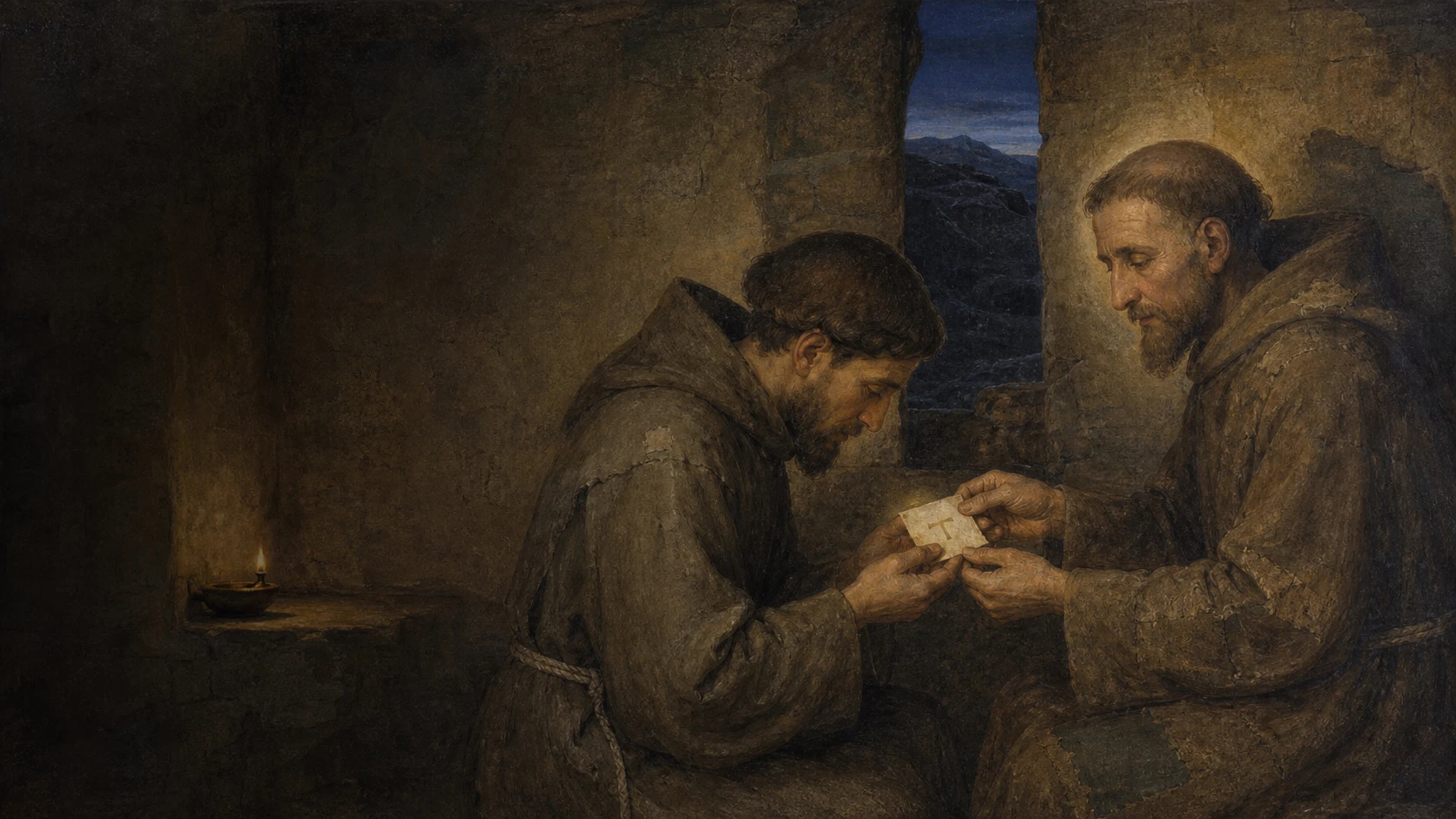
Perhaps you have wished you could place someone you love inside a safe place—not inside a house or behind a locked door, but within God’s care. Francis did something like that for his friend Brother Leo.
The year was 1224. Francis was on Mount La Verna, a place of rocks, woods, and silence. His body carried weariness and suffering. Brother Leo, one of his closest companions, was also going through an inner struggle. The early sources speak of temptation and a need for comfort, but they do not explain every detail. There is something beautiful in that: we do not need to know the name of every fear to understand the need for a blessing.
Francis took a small piece of parchment. On one side, he wrote praises to God. On the other, he copied a blessing from the biblical Book of Numbers and added a personal word for his friend. He also drew a large Tau, the T-shaped sign he loved. That sheet was small enough to fit in one hand. Brother Leo kept it throughout his life. This is why, more than eight hundred years later, we can still see Francis’s own handwriting.
Where does this prayer come from?
This is an authentic prayer by Saint Francis. We do not know it only from a copy made many years later: the original parchment, called a chartula, survives and is kept at the Sacred Convent in Assisi. Brother Leo wrote brief explanations on it, identifying Francis’s hand and recalling that he received the text at La Verna.
The heart of the blessing comes from Numbers 6:24–26. In the Bible, the Lord teaches Moses words with which to bless the people of Israel. Francis received these ancient words, wrote them for one particular person, and called his friend by name at the end. It was as if he were saying, “Leo, this promise is not far away. It is for you too.”
The text below is this portal’s own pastoral translation, made directly from the Latin, seeking to preserve the simplicity of the autograph. The line divisions are only there to help readers pray slowly.
The blessing
May the Lord bless you
and keep you.
May he show you his face
and have compassion on you.
May he turn his gaze toward you
and give you peace.
May the Lord bless you,
Brother Leo.
Amen.
— Saint Francis of Assisi, Blessing for Brother Leo
This portal’s own pastoral translation from the Latin text: “Benedicat tibi Dominus et custodiat te…”
How to pray this blessing
You can pray it for another person or receive it for yourself. Choose a name before you begin. It may be the name of someone who is tired, ill, afraid, or facing a difficult decision. It may also be your own.
Read one line at a time, without rushing. After “may the Lord bless you,” picture that person before God. When you say “and keep you,” do not imagine a life without problems; imagine God’s love accompanying that person through the problems. When you reach the Lord’s face and gaze, remain silent for a few seconds. In biblical language, for God to show his face means making his presence and goodness felt.
In the final line, replace “Brother Leo” with the name you brought. For example: “May the Lord bless you, Mary”; “May the Lord bless you, Dad”; or “May the Lord bless me and teach me to walk.” If you are praying with someone, ask before gently placing a hand on their shoulder. A blessing never imposes; it offers care.
You can also copy the prayer by hand onto a small piece of paper and keep it inside a book. Not as a magical object, but as a reminder: some words return us to God’s presence when the heart grows noisy.
A piece of parchment against loneliness
Francis did not answer Leo’s suffering with a long speech. He did something small, personal, and possible. He wrote. He drew the Tau. He called his friend by name. He gave him a promise of peace.
Perhaps the most moving part is precisely the name. The biblical blessing could be used for anyone, but Francis wanted Leo to know, “I am thinking of you.” True love sees the crowd without losing sight of any face. Jesus did this. Among so many people, he noticed the person who wept, the person who touched his clothing, and the person who was alone beside the road.
The phrase “may the Lord keep you” also deserves attention. Being kept does not mean being placed inside a bubble where nothing hurts. Francis and Leo knew illness, misunderstanding, and exhaustion. To be kept by God is not to be abandoned in those hours. It is to discover that fear does not have the final word about us.
And there is the gaze. We all need to be seen without contempt. Some looks diminish us; God’s gaze raises us up. Some looks search for faults; God’s finds a son, a daughter, a story that can still blossom. To ask the Lord to turn his face toward someone is to ask that this person recognize that they are loved.
Today you may have no parchment, ink, or silent mountain. But you can offer someone what Francis offered Leo: presence, a name, and a blessing. An unhurried message. A prayer said in secret. An “I thought of you.” Small gestures do not solve everything, but they can open a window in the middle of a closed night.
Remain silent for a moment and ask: who needs to be called by name before God today?
Sources for further reading
- Latin text and historical account of the Blessing for Brother Leo — official magazine of the Basilica of Saint Francis of Assisi
- Memory of a great bond: the autographs of Francis and Brother Leo — L’Osservatore Romano
- Priestly blessing in Numbers 6:22–27 — Vatican Bible
- catalog of the writings of Saint Francis, including the Blessing for Brother Leo at FF 262 — Secular Franciscan Order of Italy, Calabria region