
There are times when peace seems too great for our hands. We see wars in the news, arguments at home, classmates who do not speak to each other, and harsh words that still hurt after their sound has faded. Perhaps the conflict is happening around us. Perhaps it is within us.
At such times, praying for peace does not mean pretending that nothing happened. Nor does it mean remaining silent in the face of injustice. The peace of Jesus looks at the wound, names evil for what it is, and seeks a path that does not create another wound.
Francis of Assisi knew violence. As a young man, he desired the glory of battle and became a prisoner of war. Later, he dismounted from his horse, drew near to rejected people, asked forgiveness, entered into dialogue, and called all creatures brothers and sisters. He discovered that peace begins when we stop treating another person as an enemy and begin to see someone loved by God.
That is precisely what this prayer asks: not that we do everything alone, but that we offer God what we can do today.
Where does this prayer come from?
You may know the famous prayer that begins, “Lord, make me an instrument of your peace.” It is beautiful and expresses many Franciscan values well, but Saint Francis did not write it.
Its earliest known appearance was anonymous, in December 1912, in a small French Catholic magazine called La Clochette. Francis had died almost seven centuries earlier, in 1226. In time, the prayer was printed alongside an image of the saint and became associated with his name. Franciscan Media, a ministry of the Franciscan Friars of Our Lady of Guadalupe Province, explains this history in “Origin of Saint Francis’ Peace Prayer”.
The text you will pray below is likewise neither a work by Saint Francis nor a copy of that twentieth-century prayer. It is an original prayer by this portal, inspired by Francis’s life, the Gospel, and the Christian vocation to build peace. Its authorship is stated clearly because loving tradition also means telling the truth about it.
Prayer to be an instrument of peace
Jesus, our peace,
enter my heart first.
Visit the part of me that is still at war,
the memories that burn,
the answers I prepare to cause pain,
the fear of seeming weak when I apologize.
Where my voice has grown harsh,
teach me to speak the truth without crushing anyone.
Where I kept silent out of cowardice,
give me courage to defend someone who stands alone.
Where I listened only so that I could answer,
open within me a place for understanding.
Do not let me turn people into enemies.
Remind me that every face holds a story,
that every heart carries pain I cannot see,
and that no one ceases to be your son or daughter.
Make my hands a bridge:
may they share bread,
raise those who have fallen,
set stones down,
and care for wounded creation.
Make my steps a movement toward others:
may I seek those left on the margins,
return to finish an interrupted conversation,
and cross the small distance
that my pride made enormous.
When I cannot end a war,
show me the quarrel I can stop feeding.
When I cannot dry every tear,
show me the eyes before me.
When peace seems impossible,
remind me that a seed is small
and still breaks through dark soil.
Lord Jesus,
make my life an open door to reconciliation.
May I receive your peace,
learn your gentleness,
and have the courage to take the first step.
Amen.
Original prayer by Portal São Francisco, inspired by Franciscan spirituality.
How to pray this prayer
Before you begin, think of a specific situation that needs peace. It may be an argument, a wounded friendship, a news story that frightened you, or even a struggle within your own heart. Do not try to resolve everything at once.
Breathe slowly three times. As you breathe in, think: “Jesus, give me your peace.” As you breathe out, think: “Teach me to share that peace.” Then read the prayer without rushing. When a line touches you, stop. Silence also prays.
At the end, choose one possible action: listen without interrupting; do not spread gossip; apologize without adding excuses; call an adult when someone is suffering violence; write a respectful message; pray for someone you find difficult to love.
Building peace does not mean remaining in a dangerous place. If there is a threat, assault, or abuse, seek a responsible and safe person. Reconciliation never requires a victim to accept continued harm.
A bridge begins on one bank
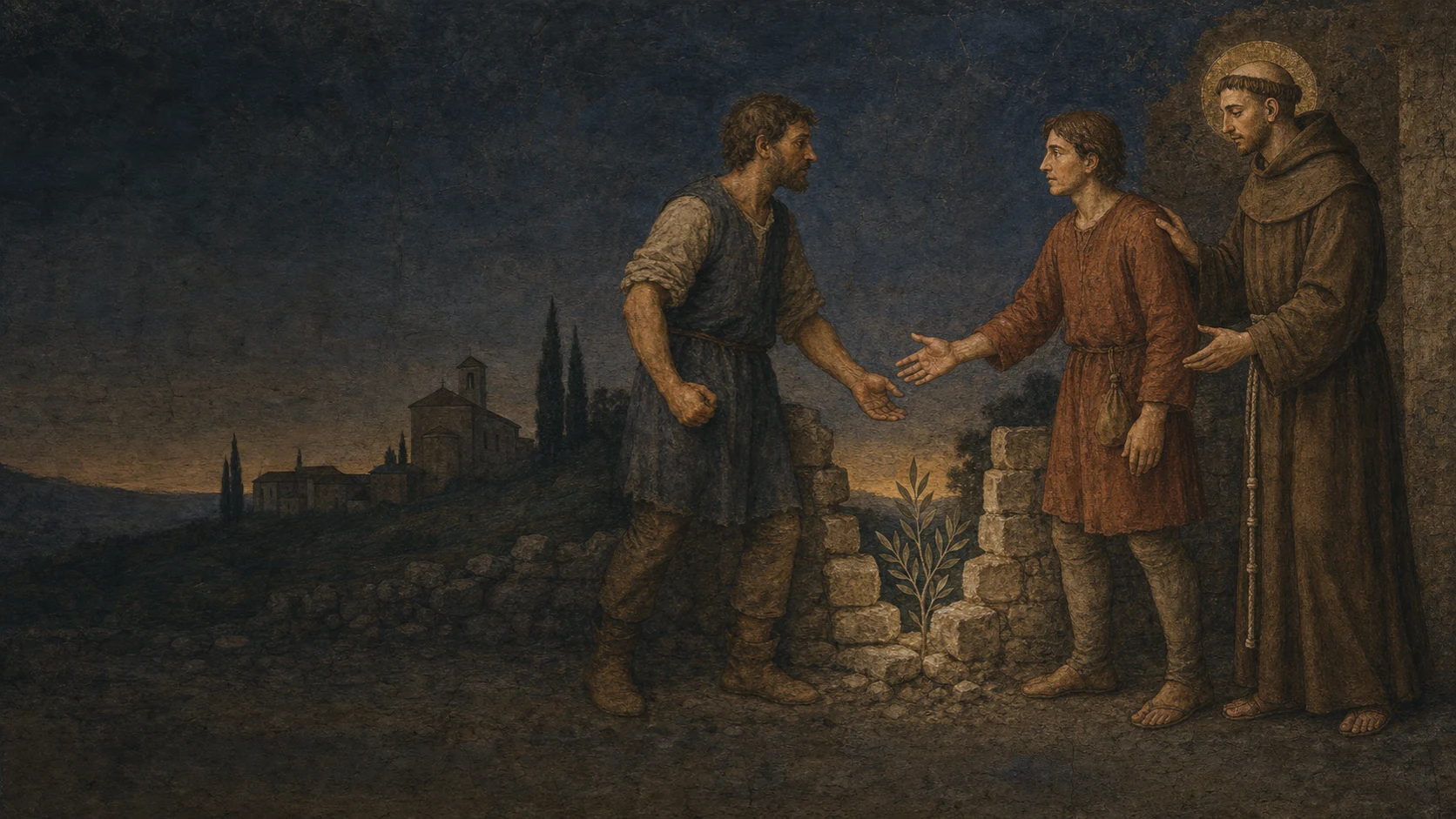
Imagine two people before a broken wall. Neither can rebuild the entire city that afternoon. But one can remove the first stone from the path. The other can extend a hand. Between them, perhaps an olive tree will grow.
Christian peace is not merely a tranquil feeling. It is a way of living. It needs truth, justice, love, and freedom. In Assisi, Saint John Paul II recalled these four pillars and called Christians to be builders of peace in thought and action. Francis remains so beloved because his gentleness was not weakness: it had the strength to bring him close to a person with leprosy, lead him to abandon violence, and take him across borders to meet a brother.
Perhaps your action today will seem small. Almost every bridge, however, begins this way: someone decides not to throw the next stone.
Explore the sources
- Franciscan Media — Origin of Saint Francis’ Peace Prayer — explains its anonymous appearance in 1912 and why the prayer cannot be attributed to Francis.
- Franciscan Media — Francis Is Our Model for Peace — distinguishes the prayer’s historical authorship from the Franciscan life it recalls.
- Holy See — Prayer meeting for peace in Assisi, 27 October 1986 — Saint John Paul II presents Francis as a man of peace and speaks of truth, justice, love, and freedom.
- Holy See — Letter to the Faithful, by Saint Francis of Assisi — an authentic text showing Francis’s prayer directed toward following in the footsteps of Jesus.