
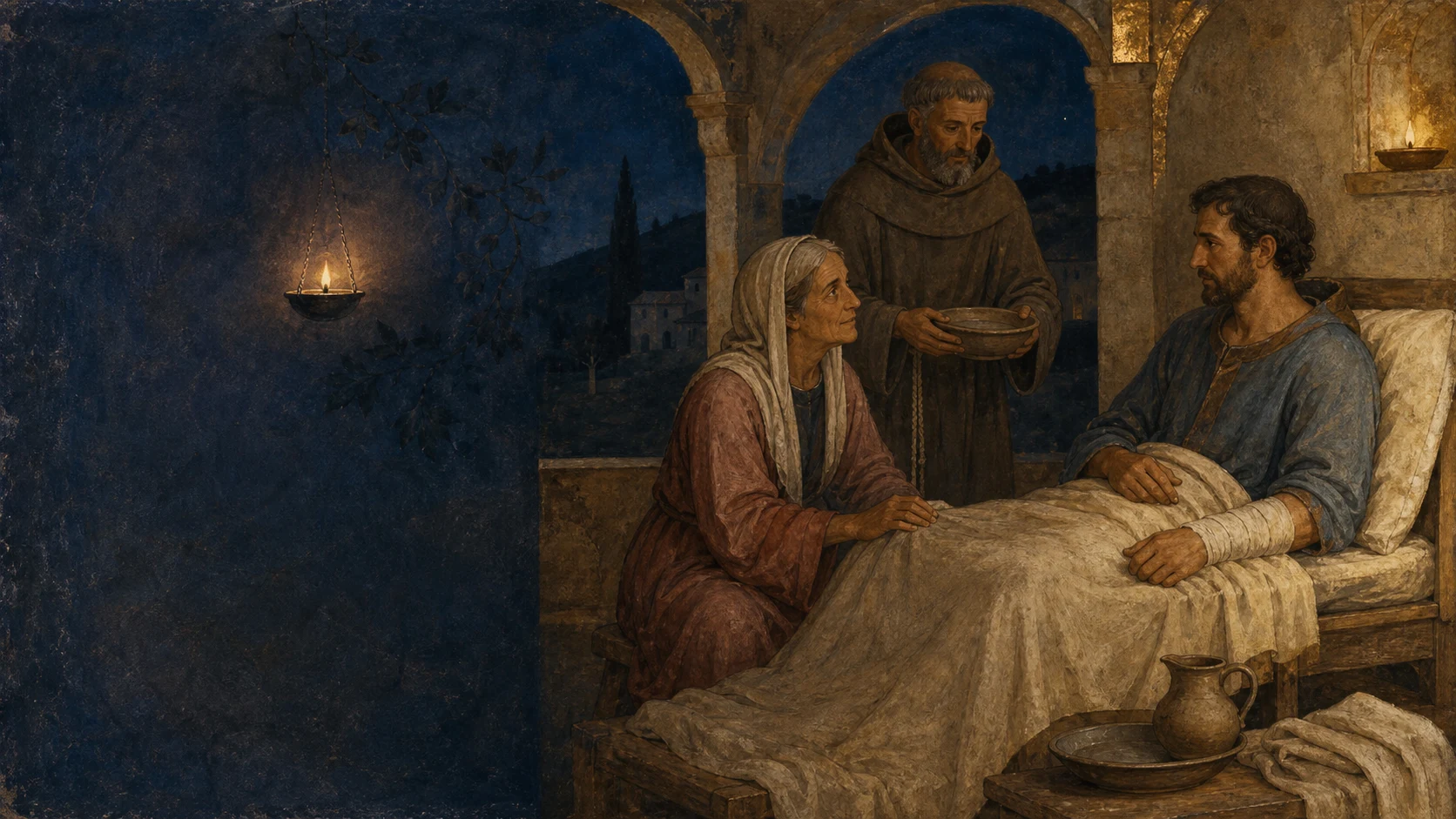
Some forms of suffering appear in the body, while others cannot be seen. Illness, grief, loneliness, a family crisis, fear, violence, or deep sadness can leave a person without words. At such times, ready-made phrases cause pain. Saying “you just need faith” or “everything happens for a reason” can make someone feel even more alone.
Jesus did not treat pain as a spectacle or automatically blame those who suffered. He drew near, listened, touched with respect, and restored people to the community. In the story of the Good Samaritan, compassion does not remain only a feeling: it interrupts the journey, tends the wounds, and finds a safe place.
This prayer asks for presence. Sometimes there will be improvement; at other times, the road will be long. We do not promise a healing we cannot guarantee. We ask that no one cross the night abandoned and that love become real care.
Where does this prayer come from?
The “Prayer for those who suffer” is a text inspired by the Gospel and Franciscan spirituality, originally written for this portal. Saint Francis did not compose it.
It springs especially from the parable of the Good Samaritan in Luke 10:25–37. The Samaritan sees the injured person, is moved with compassion, draws near, and arranges concrete help. Christian tradition reads these actions as a path: noticing, stopping, caring, and remaining responsible.
Saint Francis of Assisi experienced a profound change when he drew near to people with leprosy, who in his time were excluded from the community. The encounter did not erase the reality of illness. It broke down a distance within the heart and made room for fraternity.
The prayer therefore does not replace a doctor, psychologist, medicine, protection, rest, reporting violence, or an emergency service. God also cares through competent professionals, responsible family members, friends, communities, and public policies. Seeking help is not a lack of faith.
Prayer for those who suffer
Compassionate Jesus,
you who did not pass pain by,
stay close to those who suffer today.
Sit beside those who received difficult news,
those waiting for a test,
those who feel pain in the body,
those mourning an absence,
those who wake in fear,
and those who can no longer explain what they feel.
Do not let loneliness have the last word.
When there is no answer,
give us courage to remain.
When we do not know what to say,
teach us the silence that accompanies.
When tears come,
free us from the haste to stop them.
May no one be blamed for becoming ill,
for being tired,
for needing treatment,
or for being unable to appear strong.
Protect those who are in danger.
Open paths to safe care,
necessary medicine,
food, rest,
and trained professionals.
Give wisdom to doctors,
nurses, therapists,
caregivers, and researchers.
Sustain those who provide care too:
may they ask for help before they collapse,
find rest without guilt,
and never forget the name
behind each problem.
Lord, where there is violence,
break the silence that imprisons.
Lead the person to true protection
and place trustworthy adults and services beside them.
If pain is hidden in the mind,
take away the shame of seeking help.
May an honest conversation open the first window,
and may care continue for as long as necessary.
Saint Francis, brother of those who were excluded,
teach us respectful closeness.
May we not intrude,
ask questions out of curiosity,
use another person’s story,
or promise miracles.
Give us prudent hands,
attentive ears,
and faithfulness to return tomorrow.
Bless those who will not improve quickly,
those who live with disability,
chronic illness, or lasting limitations.
May their lives never be measured
by productivity, appearance,
or what they can do alone.
Remind us that every person
possesses a dignity that pain cannot erase.
And when we ourselves are suffering,
give us the humility to say:
“I need help.”
May we find a face that does not turn away,
a door that opens,
care that respects,
and enough hope for this day.
Jesus, companion of the wounded,
stay with us on this road.
Transform our compassion into presence,
our presence into care,
and our care into faithful love.
Amen.
Inspired prayer, originally written for Portal São Francisco.
How to pray this prayer
You can pray for someone you know, for a group, or for yourself. If you pray with someone, first ask whether they would like your company. Do not touch their body or share details of their situation without consent. Respect is also care.
Light a small lamp, if it is safe to do so, or place a glass of water near you. Read the prayer without hurrying. When you find the sentence that best fits the situation, repeat it three times. Then remain silent for one minute. Do not try to explain the suffering to God; simply present the person as they are.
When you finish, choose a concrete action: send a message without requiring a reply, prepare a meal, offer transport to an appointment, help with a task, listen, or ask: “What would actually be helpful to you?” Accept it if the person says they would rather rest or be alone.
If there is immediate danger, violence, thoughts of self-harm, difficulty breathing, or another serious sign, seek a responsible adult and local emergency or health services now. Prayer can accompany this step, but it must never delay it. Do not stop medicines or treatments because of this text; any change must be discussed with qualified professionals.
The oil lamp that does not flee
Imagine an oil lamp during a long night. It does not light the entire road or make the wound disappear. But it allows us to see the face of the person beside us, find the water, and take the next step safely.
We often want to be the sun: to solve everything, find the perfect phrase, and tear away the pain. When we cannot, we think we have failed. The Good Samaritan teaches something else. He offers what he can, seeks help, and ensures that care continues. He does not need to be the story’s only savior.
Nor did Francis draw near in order to turn a sick person into a secondary character in his own holiness. He approached as a brother. Another person’s suffering calls for reverence, not curiosity. There are times when love means speaking; at others, it means listening. Sometimes it means praying; often it means taking someone to the doctor, protecting them, providing food, organizing a support network, and returning the next day.
Perhaps today you can be only a small oil lamp. That is not insignificant. A humble presence does not promise to control the night. It says: “As we cross this stretch, you are not alone.”
Explore the sources
- Holy See — Salvifici doloris, 28–30 — reads the parable of the Good Samaritan as a call to stop, be moved, and offer effective help, never passive assistance.
- Holy See — Fratelli tutti, 56–86 — reflects on the Good Samaritan and the decision to become a neighbor to the wounded person.
- Holy See — Samaritanus bonus — an official document on accompaniment, integral care, and responsibility toward people in critical and terminal phases of life.
- CNBB Bible portal — Luke 10:25–37 — the text of the parable of the Good Samaritan.