
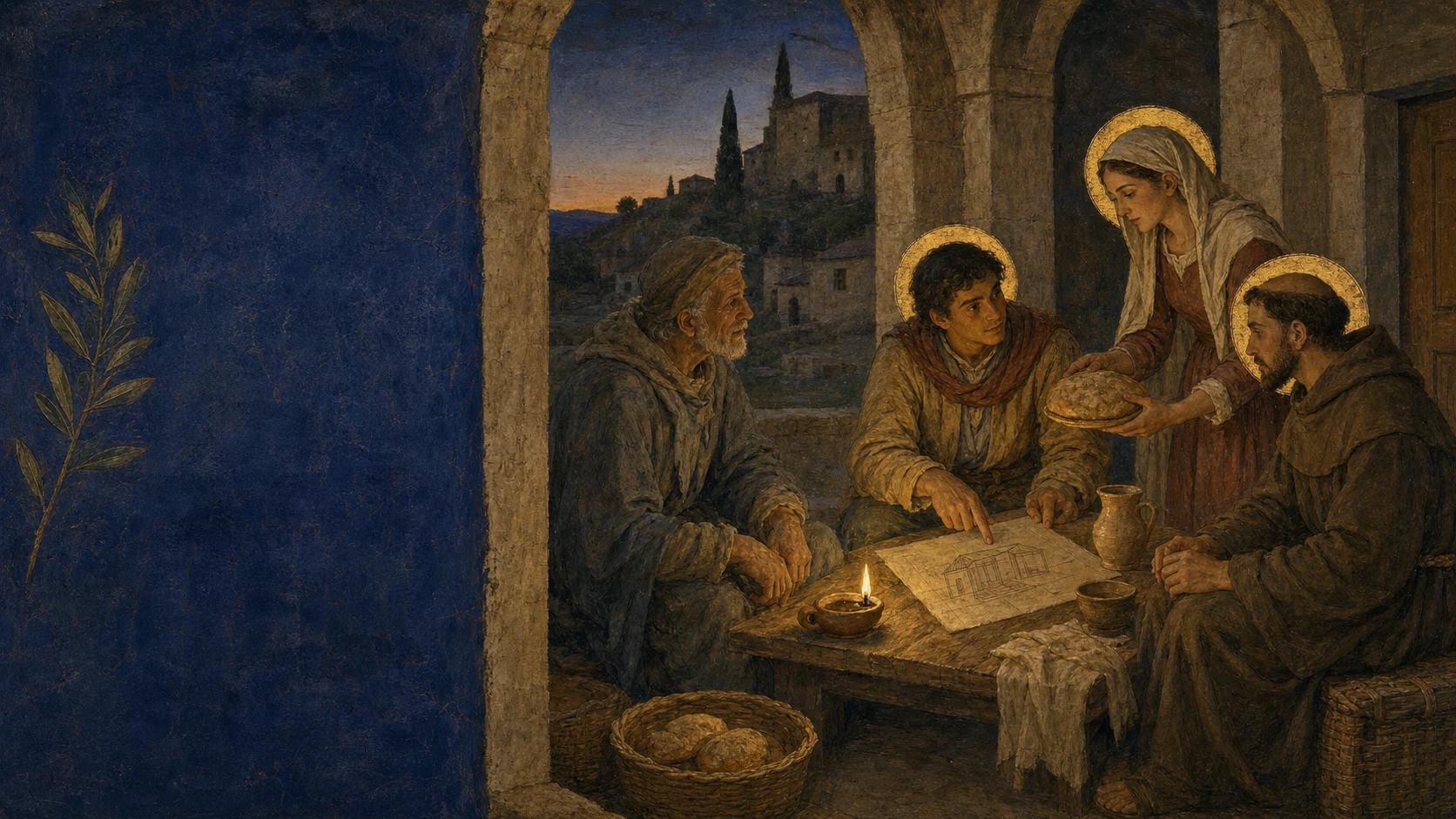
Perhaps you have met someone who was hungry, a family without a safe home, or someone worried because their money ran out before the end of the month. Perhaps this is the reality in your own home. Poverty is not a distant landscape. It has names, stories, talents, and dreams.
It is important to say this clearly: being poor does not make anyone less intelligent, less hardworking, or less loved by God. Nor is deprivation something beautiful that we should romanticize. Hunger, homelessness, abandonment, and unjust work wound human dignity. God does not ask us to admire these wounds. He calls us to care for those in need now and also to change what produces so much inequality.
Saint Francis of Assisi drew near to the little ones as a brother. That changes everything. A brother does not look down on another person, turn them into a sad photograph, or offer help to seem important. He listens, shares, and walks beside them. In this prayer, we ask for a heart like this.
Where does this prayer come from?
The “Prayer for the poor” below is a text inspired by Franciscan spirituality, originally written for this portal. It is not an authentic prayer by Saint Francis.
Its roots lie in the Gospel. Jesus identifies himself with those who are hungry or thirsty, lack clothing, are far from home, ill, or imprisoned. He also announces the Good News to the poor and asks his disciples not to pass by human suffering.
The Franciscan tradition calls this path fraternity and minority: no one occupies the throne; all recognize one another as brothers and sisters. The Church’s social teaching adds that charity is not only emergency assistance. It also means defending rights, decent work, housing, food, education, and participation. A person experiencing poverty must take part in decisions about their own life.
This prayer therefore asks not only for generosity. It asks for justice, friendship, and courage to bring change.
Prayer for the poor
God of the whole human family,
you know by name
every person who lacks necessities today.
You see the table where food is missing,
the room where the cold enters,
the mother quietly working out the bills,
the father looking for work,
the child trying to study while worried,
the older person who must choose
between buying food and buying medicine.
Do not allow them to be invisible to us.
But do not let us look down on them.
Free us from pity that humiliates,
the photograph that exploits suffering,
the handout offered in exchange for applause,
and the excuse that blames those already carrying such a heavy burden.
Give us the eyes of Jesus,
able to encounter a whole person:
with a voice, intelligence, history,
rights, talents, and hope.
Teach us to ask before deciding,
to listen before speaking,
to share without controlling,
and to serve without taking center stage.
When someone is hungry,
may today’s bread not be lacking.
When someone has nowhere to stay,
may they find protection and a safe door.
When work is lacking,
move us to defend opportunities and fair wages.
When rights are denied,
give us courage not to remain silent.
Show us the hidden causes too:
indifference, waste,
prejudice, exploitation,
and the choices that concentrate too much
in the hands of a few.
May our charity meet the urgent need,
and may our justice help transform tomorrow.
Saint Francis, brother of the little ones,
teach us to arrive without superiority,
to sit at the same table,
to receive what another person offers too,
and to discover that no one is only in need:
we all have gifts to share.
Bless those who live with poverty in their own lives,
those ashamed to ask for help,
those who work and still cannot make a living,
those who migrated in search of safety,
those who live on the street,
those our city has forgotten.
May they find trustworthy people,
welcoming communities,
and policies that protect their dignity.
And if poverty is present in our own home,
protect us from despair and shame.
Give us courage to ask for assistance,
wisdom to recognize safe hands,
and the certainty that our life is of great worth.
Lord, make us a family
in which no one eats alone,
no one is discarded,
and everyone has a place, a voice, and a future.
Amen.
Inspired prayer, originally written for Portal São Francisco.
How to pray this prayer
Before you begin, place a piece of bread or an empty bowl before you. Do not use this sign to imagine “the poor” as a distant group. Remember a real person, a community, or a concrete situation. If the need is your own, you can present God with exactly what is lacking, without shame.
Read slowly. When you reach the words “listen before speaking,” be silent. Ask: “What do I still not understand about this person’s life?” Do not try to answer on their behalf.
After the prayer, choose a possible and respectful action. You might share good-quality food, support a community kitchen, learn about a trustworthy project, talk with someone without hurrying, call for a just policy, or study why poverty exists in your city. If you are a child, speak with a responsible adult before offering money, approaching strangers, or going out alone to help.
Immediate help is necessary, but it is not enough. Prefer actions done with people, not only for them. Do not publish photographs or tell someone’s story without permission. Protecting dignity is also prayer.
If your family is without food, safe housing, or essential items, seeking help from social services, a school, a responsible faith community, or another public service is an act of courage. Faith accompanies this search; it does not replace it.
A table with no place of honor
Imagine a round table. It has no head. The person who brought bread shares it. The person who knows the neighborhood shows the way. The person who knows how to build draws a house. The person who arrived tired can rest. Someone who received yesterday may offer tomorrow. Everyone speaks and everyone listens.
This table helps us understand Francis’s fraternity. For him, being “minor” did not mean believing that no one has value. It meant renouncing the desire to command and stand above others. A lesser brother chooses closeness. He knows he can give, but he also knows he needs to receive.
Jesus did not say hunger is holy. He said the hungry person is his brother or sister. He did not declare a lack of clothing beautiful. He asked that the naked be clothed. The Gospel does not turn injustice into religious decoration; it moves us from where we stand and leads us into encounter.
Perhaps you cannot solve such a great problem. Even so, you can reject indifference. A loaf of bread can confront today’s hunger. A friendship can break through loneliness. A collective choice can change tomorrow’s unjust rule. When compassion and justice walk together, prayer begins to grow hands.
Explore the sources
- Holy See — Evangelii gaudium, 186–201 — presents the option for the poor, their dignity, and everyone’s commitment to social justice.
- Holy See — Fratelli tutti, 116–127 and 183–189 — teaches that solidarity includes confronting the structural causes of poverty and guaranteeing participation and rights.
- Order of Friars Minor — Franciscan Administration of Finances — reflects on solidarity, the use of goods, and Franciscan closeness to the poor.
- CNBB Bible portal — Matthew 25:31–46 — the passage in which Jesus identifies himself with those who are hungry, thirsty, and in need of welcome.