
A prayer for those who cannot yet see the path
Francis was not born knowing what to do with his life. As a young man, he wanted celebrations, prestige, and knightly adventures. Then came war, prison, and illness. His dreams no longer guided his heart. He was changing, but he still did not know who he would become.
Perhaps you know this feeling. You do not have to be an adult to feel confused. Sometimes we do not know how to correct a mistake, face a conversation, or discover what God expects. We want a complete map. Francis left a short prayer for these moments. It asks for enough light for the heart to take the next true step.
Where this prayer comes from
Words from the beginning of a conversion
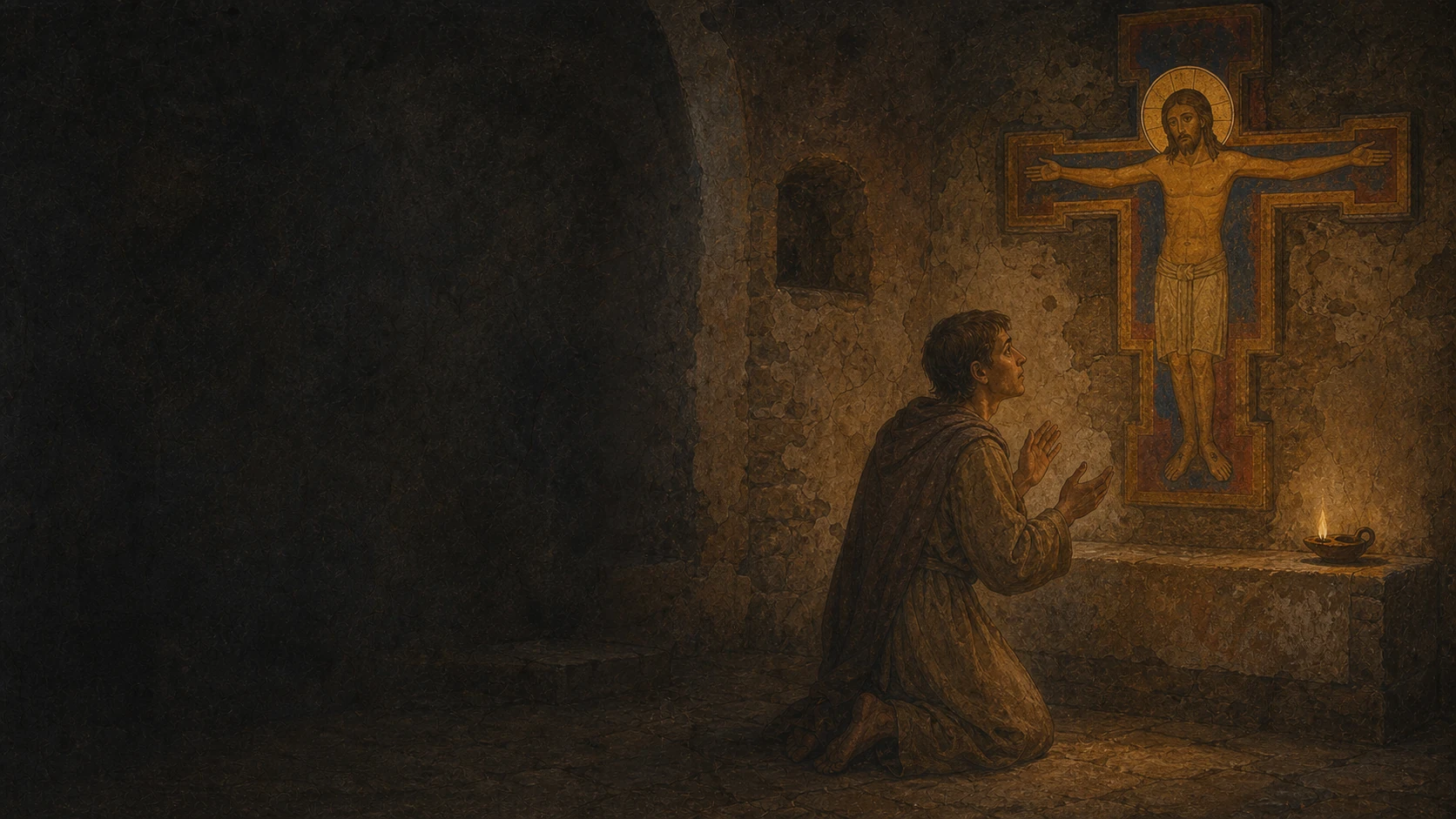
The Prayer before the Crucifix is recognized among the authentic writings of Saint Francis and belongs to the early period of his conversion. Franciscan tradition connects it with his prayer before the San Damiano Crucifix, in the small ruined church near Assisi. Early biographies placed there the call to “repair Christ’s house.”
It is important to distinguish two things. Manuscript tradition attributes the text to Francis, and the Franciscan family officially receives it. The scene of Francis saying every word before that icon, however, does not come from a diary. The prayer does not mention San Damiano. The connection is ancient and consistent, but we do not need to invent details.
Early forms close to the speech of Umbria and widely transmitted Latin versions survive. The version below is this portal’s own pastoral translation, checked against Franciscan sources. We have kept its brevity and added no petitions.
Words of Saint Francis
Before the Crucifix
Most High and glorious God,
enlighten the darkness of my heart.
Give me true faith,
firm hope,
and perfect love.
Give me, Lord,
understanding and knowledge,
so that I may carry out
your holy and true will.
Amen.
Francis asks for light within himself
When we feel lost, it is common to think, “If every person and situation changed, I would be fine.” Francis begins somewhere else. He asks God to enlighten the darkness of his heart. He does not accuse the city, his family, or his former friends. He allows the light to enter him first.
Darkness of the heart does not mean that a person is a monster. It can be fear, pride, haste, sadness, anger, or such a strong desire to please others that we can no longer hear the truth. God’s light does not come to humiliate. It comes to show gently what needs healing and the path on which we can begin.
Francis then asks for three gifts that travel together. True faith means trusting God and taking the Gospel seriously. Firm hope means continuing to walk when we cannot yet see the outcome. Perfect love does not mean never making a mistake; it means desiring a wholehearted love that does not use people as objects and does not disappear when service costs something.
Some translations say “perfect charity.” In Christian language, charity is the love that comes from God and seeks another’s good. For clarity, we use “perfect love.”
This is not a prayer for predicting the future
Francis also asks for “understanding and knowledge.” He wants to comprehend inwardly and discern clearly. Understanding without knowledge can become confused; knowledge without love can grow cold. He asks for both.
The final request is decisive: not only to know God’s will, but to carry it out. The prayer ends in hands and feet. Little by little, Francis prayed, drew near to poor people, cared for people with leprosy, repaired small churches, and discovered brothers. He did not receive the whole plan in a flash of lightning. The answer became clear as he walked.
This protects us from treating faith as fortune-telling. Not every thought that arises during prayer is an order from God. Important decisions must respect the Gospel, human dignity, reality, and sound advice. God never asks a child to hide abuse, accept danger, or keep a harmful secret. In such cases, seeking a safe adult and responsible help is a step into the light.
The Crucified Christ also teaches us to recognize God’s will. Jesus does not rule through fear; he loves, serves, forgives, and gives his life. A cruel or dishonest choice does not become holy because someone says, “God commanded it.” Christ’s light leads to truth and love.
How to pray this prayer
Ask for light one step at a time
- Choose a simple place. If there is a cross, stand or sit before it. If there is not, close your eyes and remember Jesus, who loves to the end.
- Name your uncertainty. In one sentence, tell God what is unclear. Do not explain ten subjects at once.
- Pray the text slowly. After “enlighten the darkness of my heart,” be silent. Ask: is fear, pride, or haste clouding my vision?
- Notice the three gifts. Which do you need most today: faith, hope, or love? Ask for it again in your own words.
- Choose one safe and good step. It may be apologizing, speaking with someone wise, fulfilling a responsibility, or waiting before acting. If the decision is significant, do not walk alone.
If nothing seems clear, do not force an answer. Sometimes the first grace is to remain before God without running away. Light also comes through the Word, time, community, and people trained to help.
A brief meditation
A small light inside the chapel
Imagine the young Francis entering the damaged church. The walls do not hide their cracks. He does not need to hide his own cracks either. Before him, Jesus has his arms open.
Place your uncertainty in that silence. You do not need to know everything to be loved. Say, “Enlighten the darkness of my heart.” Perhaps the light will not show the entire road. Perhaps it will reveal only one stone you can put back in place, one person you can speak with, or one act of goodness you can already do.
Remain for another moment. Christ does not ask you for an impressive life. He asks for a willing heart. When you leave this silence, take this question with you: what is the next true action that faith, hope, and love can carry out through me?
For those who want to go deeper
Sources for this page
- Order of Friars Minor — Prayers of Saint FrancisOfficial publication of the OFM General Curia with the text of the prayer before the Crucifix.
- Franciscan Family — original text and translation of the prayerPresents the traditional Latin text for checking its words and structure.
- Benedict XVI — General Audience of 27 June 2012Offers the Church Francis’s prayer before the Crucifix and quotes its text.
- Benedict XVI — Angelus in Assisi, 17 June 2007Recalls San Damiano and the tradition of the call to repair the house.
- Testament of Saint FrancisFrancis’s own testimony about his gradual conversion, his faith in churches, and a form of life according to the Gospel.
Historical note: Franciscan authorship of this prayer is accepted in editions of the writings of Saint Francis. Its association with San Damiano belongs to Franciscan tradition, but the brief text gives neither place nor date. The English version above is this portal’s own pastoral translation, not a complete reproduction of a modern translation.