
Anyone arriving at the Portiuncula today first enters a gigantic church. The nave of the Basilica of Santa Maria degli Angeli seems large enough to hold a town. There are tall columns, side chapels, and a dome that draws the eyes upward.
But the heart of the place is below, almost hidden by that very grandeur: a little stone church that fits entirely inside the basilica.
Its name means “little portion.” The word may once have meant a small piece of land. With Francis, it also became a perfect image: he did not want to own the world, but received a small patch where he could live the Gospel with his brothers. From that tiny space, the fraternity went out along the roads.
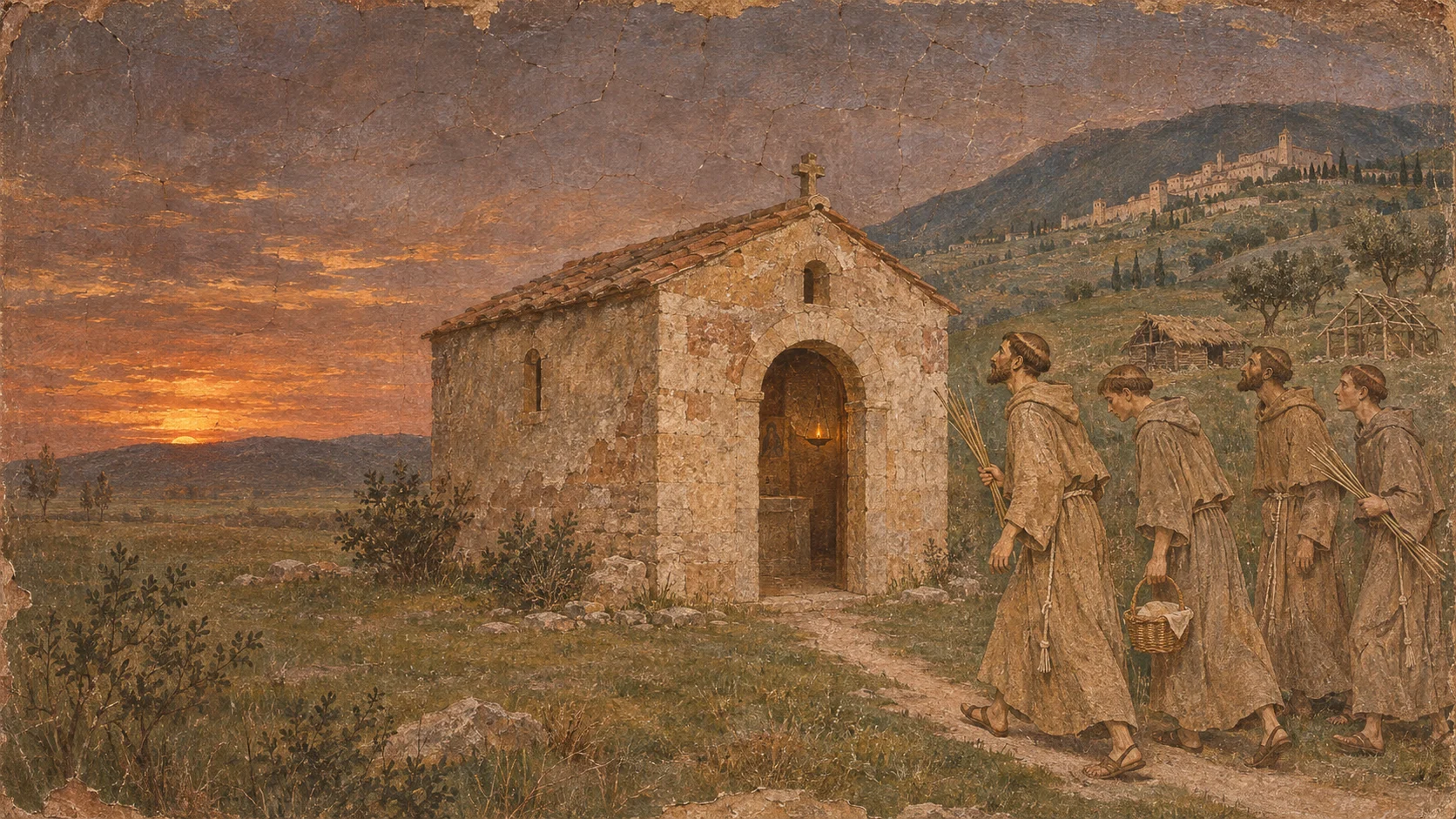
A visitor’s first task is to remove mentally everything that came later. Construction of the basilica began in 1569, more than three centuries after Francis. In his time, the chapel stood on the plain among fields and paths. Assisi appeared above it on the mountain. There was no dome, monumental façade, or square like the one we see today.
The chapel before Francis
Santa Maria degli Angeli did not begin with the friars. The little church already existed and was connected to the Benedictines of Mount Subasio. Later sources and traditions give different dates and stories for its origin. Some push it far back into ancient times; secure documentation does not allow us to accept every detail like a birth certificate.
When Francis found it, the chapel needed care. Medieval biographies say he repaired it after working at San Damiano and another church dedicated to Saint Peter. That sequence belongs to the early Franciscan narratives. We do not know how much of each wall he rebuilt with his own hands or the building’s exact appearance at the time.
We know something more important: he remained attached to the place. Life with the first brothers found a center there. They were not monks enclosed forever in a monastery. They went out to work, serve, and proclaim peace, and then they returned. The Portiuncula was shelter, starting point, and meeting place.
Its legal relationship with the Benedictines is told in different ways. Franciscan memory preserves the idea that the friars did not want to take the chapel as property and offered a small payment, remembered in stories as a basket of fish. The gesture fits Francis’s concern not to possess. Yet the details of the grant and payment come from narrative tradition, not from a contract preserved before our eyes.
A sentence from the Gospel and a path
The early biographies say that during Mass Francis heard the passage in which Jesus sends out the disciples without gold, a bag, or a second tunic. He asked the priest for an explanation and recognized what he wanted to live.
“This is what I want,” tradition sums up.
We have no recording of that day. The sentence reached us through authors writing later. Even so, the episode belongs to the old heart of Franciscan memory and accurately explains the style that emerged: walk simply, proclaim the Kingdom, offer peace, and depend more on fraternity than on reserves.
The chapel, then, was not merely the setting for a private inspiration. It became a school. In a very small space, men from different backgrounds had to share food, silence, and weariness. It was easy to speak about poverty on the road; it was harder to share the last piece of bread when everybody returned hungry.
This life was not romantic. There was cold, illness, misunderstanding, and work. The brothers cared for people affected by leprosy, helped in the fields, and accepted humble tasks. As the group grew, one little church could no longer solve every problem. Yet it kept reminding them that the beginning did not depend on power.
Returning to the little portion
The general gatherings of the friars, later called chapters, became associated with the Portiuncula. Brothers from different regions gathered to pray, decide, and return to their missions. Tradition called the famous meeting of 1221 the Chapter of Mats because of the simple shelters raised around it.
It is difficult to fix the exact number of participants. Later accounts love crowds and may enlarge the figures. The fraternity’s growth, however, is beyond question. Within a few years, the little Assisi group had crossed borders.
That created a challenge Francis knew from within. How can simplicity survive when there are many people, studies, journeys, leaders, and houses? The Portiuncula offered no ready-made administrative answer. It offered a measure: everything that grew should remember the little chapel.
Not because small is always better. A large infirmary can care for more sick people; a well-made book can teach more readers. The question is different: does size still serve the Gospel, or has it begun serving itself?
Clare crosses the night
On the night of Palm Sunday in 1212, according to early Franciscan tradition, Clare left her Assisi home and was received by Francis and the brothers at the Portiuncula. There her hair was cut and her clothing changed. It was the visible beginning of a decision that would mature in the community at San Damiano.
The details of the flight received a literary shape in the sources about Clare. We cannot follow every step like a modern reporter. Her religious choice, connection with Francis, and the beginning of the women’s community are firm historical facts. The night scene in the chapel belongs to the old tradition that preserved that beginning.
It is beautiful to realize that the Portiuncula was not only a place for the first friars. A young woman found the doorway to her own vocation there. She did not then become a copy of Francis. With her sisters, Clare built a stable, contemplative, and poor life, challenging authorities in order to preserve what she called the privilege of poverty.
One chapel opened different paths.
The pardon and what we can say
Another tradition links the Portiuncula with an indulgence: Francis is said to have asked Pope Honorius III that all who visited the chapel repentant and confessed should receive pardon. The celebration became known as the Pardon of Assisi.
The devotion is deeply rooted and has been recognized by the Church. Its documentary history, however, requires care. No original papal document from 1216 granting the indulgence survives. The earliest known written testimonies are later and seek to defend a practice that already existed.
It is therefore right to say two things together. The tradition of the Pardon has formed generations of pilgrims and expresses the Franciscan desire to open mercy to everyone. At the same time, we cannot present every detail of the vision, request, and papal response as if a contemporary parchment confirmed it.
Faith does not lose beauty when history names the quality of its evidence. On the contrary, it learns not to force a devotional narrative to do the work of an archive.
The last return
In 1226 Francis was very ill. He asked to be carried from the bishop’s residence in Assisi to the Portiuncula. He wanted to finish near the place he loved. The small complex near the chapel received his final days.
The early sources describe the death with powerful gestures: blessing the brothers, singing, reading the Gospel, nakedness on the earth. The accounts are not identical in every detail. They agree, however, that the Portiuncula was the place of his death on the afternoon of October 3, 1226.
The Chapel of the Transitus recalls that moment today. The building and its decoration carry centuries of memory. They are not an untouched photograph of the room in 1226, but they mark a location venerated from very early on.
Francis returned to the little portion when he was already known in many places. He did not choose a square in which to receive applause. He returned to the house without owning it.
The painted wall and the old wall
Anyone looking at the Portiuncula today finds frescoes from later periods on the façade and inside. They are a true part of the place’s history, but they do not all belong to Francis’s time. The chapel itself was repaired, decorated, and protected over the centuries.
After the earthquake of 1832, much of the enormous basilica was damaged and had to be rebuilt. The little chapel remained standing. That survival deepened its symbolic force: the small heart endured when the body around it fell.
Our image neither tries to erase later art nor pretends to know every original detail. It shows the chapel alone on the plain at dusk, with brothers returning from work. The action is on the right; to the left, quiet grass lets us feel the size of the world around them.
Perhaps the Portiuncula teaches this: we do not need to occupy everything in order to belong somewhere. A portion received with gratitude can become a place of meeting, sending, pardon, and farewell.
The immense building that protects it today need not destroy that message. It can act as a question built in stone. At the center of every great achievement, is there still a little house? At the center of everything we do, is there still room for someone poor, tired, and without status?
If the answer is yes, the little portion is still alive.
Stones checked
Sources for this pilgrimage
- Portiuncula shrine — history of the chapelOfficial site source. Presents the chapel, its connection with the fraternity, Clare, the Pardon, and Francis’s death.
- Saint Francis 800 National Committee — PortiunculaHistoric heritage. Places the little church within Franciscan history and the monumental complex.
- Ministero della Cultura — Basilica of Santa Maria degli AngeliBuilding and chronology. Records construction beginning in the sixteenth century and later changes.
- Comune di Assisi — basilica and PortiunculaOfficial guide. Locates the chapel, Transitus, rose garden, and the shrine’s main phases.
- Medieval Sourcebook — early lives of FrancisMedieval narrative sources. Allows comparison of the Gospel call, first brothers, and final days.
- Franciscan Institute — guide to the early sourcesCritical reading. Explains the diversity of Franciscan documents and why their details must be compared.
- Benedict XVI — pastoral visit to AssisiMemory and spirituality. Connects the Portiuncula with conversion, fraternity, and mission without replacing historical research.
How we read this place: the chapel’s medieval existence, its role as the brothers’ center, and Francis’s death there are historically firm. Hearing the Gospel, receiving Clare, and the basket offered to the Benedictines belong to old traditions with varying degrees of detail. The painted scene, four friars, and dusk are an artistic reconstruction.