
Before Francis was painted with birds on his shoulders, he heard hammers, arguing merchants, and horseshoes striking stone.
Assisi was not a quiet town. At the end of the twelfth century, its houses climbed the slope of Mount Subasio along narrow streets. There were workshops, ovens, churches, fountains, animals, soldiers, and sellers. The smell of wet wool might meet the smell of warm bread. Powerful families measured their standing on street corners; in the square, the new commune was trying to govern itself.
Giovanni, later called Francesco, grew up in that world. His father, Pietro di Bernardone, traded cloth. This placed the family among townspeople who prospered through commerce, but it did not make Francis a prince. He knew the city from the side of people who bought, sold, counted coins, learned songs, and wanted to be noticed.
Today Assisi seems built to preserve silence. During his childhood it was also a place of ambition and conflict. To understand Francis, we need to listen to both cities at once.
A city built over another city
Assisi was already old when Francis was born. Its medieval plan grew over the terraces and walls of the Roman town. Part of the ancient forum remains beneath today’s Piazza del Comune. Above it still stand the columns of the so-called Temple of Minerva, built many centuries before Francis.
That continuity helps us imagine his experience. A child could walk past stones that nobody in his family had placed there. Houses changed and governments fell, but certain columns remained. Without saying a word, the city taught that one generation receives the world from other generations.
At the same time, much of what visitors see today came later. The Torre del Popolo, the Palazzo del Capitano, and other parts of the square were built or altered in the thirteenth century and afterward. We cannot take a present-day photograph and simply call it “the Assisi of Francis.”
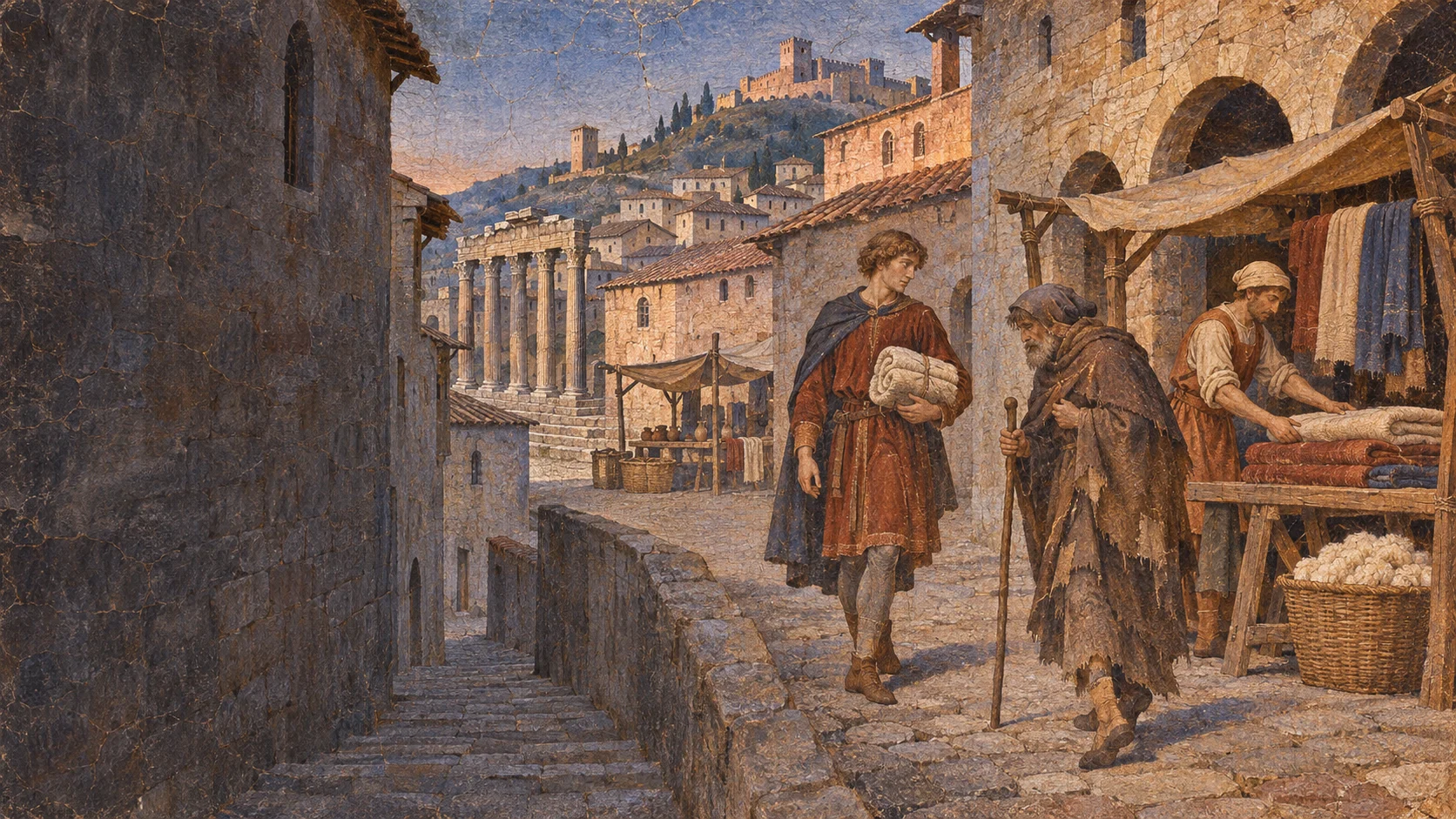
Our artwork shows a plausible square around 1200: the Roman temple, simple buildings, market stalls, and the fortress on the hill. It is a historical synthesis. We do not know the exact appearance of every roof, awning, or workshop on that imagined morning.
The cloth that passed through their hands
Pietro’s work connected Assisi with longer roads. Fine fabrics, dyes, and raw materials traveled. Buying and selling required contacts, credit, measurements, and trust. Francis probably learned something of that world, although the early biographies prefer to tell of his generosity, his parties, and his dreams of honor.
A cloth workshop was not a modern shop. Bales, shears, scales, tables, and helpers might share a space connected to the home. Cloth represented money, work, and social position. Fine clothing said something about a person before they opened their mouth.
That is why Francis’s later renunciation of his clothes before the bishop carries such force. He was not abandoning just any object. He was leaving a sign of the family trade, his father’s protection, and the place the city had prepared for him.
But it would be unfair to paint his youth as nothing but vanity. The old sources remember that Francis could be generous. The problem was not that he had never loved; he did not yet know where to place all the desire he carried. He wanted greatness. The city taught that greatness could mean money, victory, or fame. His conversion would change the meaning of the word.
The house that may have been the house
Near the Piazza del Comune stands the Chiesa Nuova, built in 1615. Tradition places the Bernardone family home there. A small barred cell is shown as the place where his father supposedly imprisoned Francis, and a lower room is remembered as the cloth workshop.
We should walk there with reverence and caution. The present building is from the seventeenth century, nearly four hundred years after the young Francis. Its identification rests on tradition, not on a medieval property deed saying, “Francis slept in this room.”
Nearby, another small oratory is associated with his birth. Franciscan studies show that some details of the birth grew in late accounts shaped to draw Francis closer to Jesus. That does not make the place useless. It shows how a city turns memory into space.
A traditional site can hold the prayers of millions of people without therefore becoming archaeological proof. Honesty does not close the shrine door. It only keeps devotion from having to pretend to a certainty it does not possess.
The square where the city argued with itself
Assisi lived through tensions between social groups. Noble families owned towers and land; merchants and craftspeople sought power in the commune. Internal conflict drove nobles into exile and drew Assisi toward wars with Perugia. In 1202 Francis took part in a battle and was captured.
The war did not happen in the square, but its decisions and consequences crossed urban life. A young man could leave through a city gate dreaming of glory and return months later sick, defeated, and different.
The biographies do not let us reconstruct every political conversation Francis had. We know he belonged to a real city, not a nativity scene. There was inequality, revenge, fear, and desire for advancement. When he began calling people sisters and brothers, that language met real divisions.
Franciscan peace was not born because Assisi was already peaceful. It was born because the city knew how to make enemies.
Gates that separated and connected
The walls protected Assisi, but they also defined who was inside. People affected by leprosy lived apart from the population. Strangers arrived along the roads. Poor people might enter the city to ask for help, while merchants left it to trade.
Francis crossed the gates in both directions. He left for war and commerce; later, he left to draw near people he had once feared. He returned to churches, squares, and the bishop, but he no longer saw the boundaries in the same way.
In his Testament, he does not say that his change began with a beautiful idea or a landscape. He begins by remembering the lepers. The Lord led him among them, he showed mercy, and what had been bitter changed into sweetness.
Assisi helps us understand the distance of that movement. It was not only a distance in miles. It was the passage between the respectable world of his family and the social place of those who had been rejected.
The city he did not entirely leave
Francis chose a poor, wandering life but remained connected to Assisi. He preached there, sought out nearby churches, received companions from the town, and lived at places on the plain and mountain. Clare also left an Assisi family and built another form of life at San Damiano.
That does not mean everybody understood him. A town is made of many answers. Some laughed, others became angry, some followed him, and others went on selling, planting, or governing as before.
After Francis died, Assisi changed deeply. The basilica began to rise in 1228 and received his body in 1230. Artists covered the walls with stories. Pilgrims arrived. The merchant’s town became the saint’s town.
Growth also created a question: how do you preserve the memory of someone who chose poverty inside magnificent buildings? That tension runs through Franciscan history. It need not be solved by despising art or forgetting poverty. It can remain an examination of the heart.
How to enter Assisi without turning everything into a relic
Not every stone was touched by Francis. Not every window existed when he was young. Assisi’s greatness does not depend on claiming that every corner was the scene of a miracle.
We can walk more attentively. Watch how the pale stone changes in rain. Notice the slope of the streets. Imagine the effort of carrying a bale. Distinguish a Roman column from a medieval tower and a later façade. Read the signs without letting them replace history.
Then the city stops being a theme park about a famous person. It becomes a complex witness. It preserves ancient structures, devotional traditions, reconstructions, absences, and changes.
The scene painted for this chapter places the young Francis carrying a bale of cloth before a poor traveler. We know of no meeting exactly like it on that street. The scene brings together two documented realities: his mercantile background and the world of poverty that his conversion would teach him to see. In the distance, Assisi still lacks the basilica that would one day be built for him.
The reader knows something the young man does not. We know those streets will keep his name. Francis, however, walks on without seeing the future. Perhaps that is the place’s first lesson: a life can change the meaning of a city before it knows what it is doing.
Stones checked
Sources for this pilgrimage
- UNESCO — Assisi and the Franciscan sitesHeritage and landscape. Explains the continuity among the Roman town, medieval fabric, shrines, and Mount Subasio.
- Comune di Assisi — official historical mapMonuments. Locates the Roman forum, Temple of Minerva, Chiesa Nuova, and major buildings, with their dates.
- Visit Assisi — Chiesa NuovaLocal tradition. Describes the 1615 church and the spaces traditionally associated with the Bernardone home and workshop.
- Medieval Sourcebook — early lives of FrancisMedieval sources in translation. Gathers early testimony about the merchant father, youth, conversion, and family conflict.
- Noel Muscat — the birth of FrancisCritical Franciscan study. Shows how later traditions identified and interpreted the places of his birth.
- Jacques Dalarun — “Assisi,” in To Govern Is to ServeAcademic research. Studies families, neighborhoods, and political power in medieval Assisi society.
- Franciscan Institute — guide to the early sourcesHistorical method. Guides readers to the scholarly collection Francis of Assisi: Early Documents.
How we read this place: the ancient urban structure, merchant setting, and Francis’s family belong to documentable history. The exact home and details of his birth depend on later traditions. The street, traveler, and workshop shown in the art are a responsible visual reconstruction, not a record of a known meeting.