
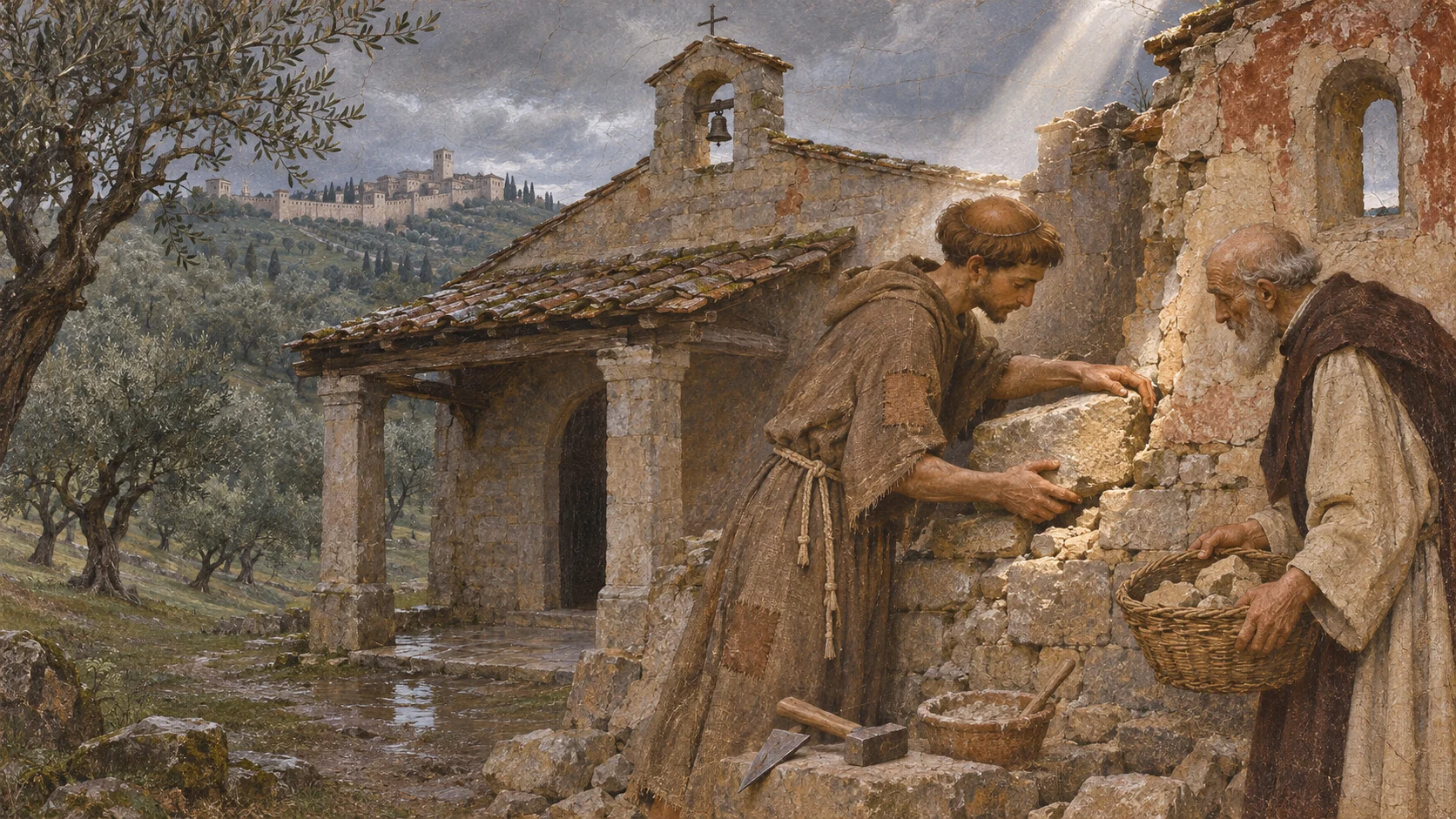
The path descends from Assisi among walls, olive trees, and sloping earth. The city remains above. San Damiano appears without the great front of a basilica: pink stone, a low roof, small doors, and courtyards that seem to have learned silence.
It is easy to think it was always like this. It was not.
When Francis arrived, the church was old and in poor condition. It was dedicated to Saint Damian, one of the physician brothers whom Christian tradition remembers with Saint Cosmas. The young man who entered had no rule, order, or disciples yet. He had questions, fear, and the beginning of a transformation.
Centuries of devotion have covered the place with explanations. To hear it well, we need to separate three voices: what the documents allow us to affirm, what the early narratives tell, and what we reconstruct in order to imagine the scene.
A church older than Franciscan history
San Damiano existed before Francis was born. Heritage guides date its origins at least to the eleventh century. That means generations had already prayed there when he found it. Walls had been built, repaired, and perhaps forgotten by people whose names we do not know.
The present building preserves a medieval atmosphere, but it did not freeze in 1205. It received additions, paintings, changes for the women’s community, and restorations. Every century touched the complex. A door can be old without having been used by Francis in exactly the same way; a dormitory can preserve the historic volume of a room without keeping every original board.
That warning does not impoverish the visit. It makes it truer. San Damiano is a house that continued to live, not an object buried and then lifted intact from the soil.
“Repair my house”
The early biographies say Francis was praying before a painted image of Christ crucified when he heard a call: he should repair the house which, as he could see, was falling into ruin. He understood the command concretely and began working on the church.
The crucifix associated with the episode is a painted cross in the style of twelfth-century Italian icons. Today the original is in the Basilica of Saint Clare; a copy stands at San Damiano. The move preserves the work and links it with the place where Clare is buried.
The episode of the voice belongs to medieval Franciscan sources, not a document written that same day. A historian cannot prove the sound a person heard in prayer. A historian can study when the account appears, how different authors transmit it, and the effect it had on Francis’s life.
We should not erase the first meaning of his response. Later Christians understood “the house” to mean the whole Church in need of renewal. Francis began with stones. The wider interpretation does not make the physical work a childish mistake. Perhaps that is exactly the lesson: great changes begin when someone cares for what is broken at their feet.
Money through the window
According to Thomas of Celano, Francis sold cloth and a horse to obtain money and offered it to the priest of San Damiano. The priest, afraid of Pietro di Bernardone’s reaction, refused. Francis then threw the coins into an opening in the church.
The scene is intense and comes through a narrative written years later. It reveals the growing conflict: the young man wanted to turn family goods into religious repair; his father saw waste and disobedience. This was not just about money. It was an argument over who could decide the son’s future.
Francis hid for a time near the church. Then he faced the town and publicly broke with his father’s protection before the bishop. The narratives arrange these events differently. We do not know every interval, word, or movement. The historical core is clear: conversion caused family conflict, and San Damiano was one of the central places in that passage.
It would be easy to make Pietro a heartless villain. That would flatten the story. A medieval merchant saw goods, horse, and family standing disappear. Francis, in turn, was beginning to measure value differently. The meeting was painful because both men recognized something much larger than metal in those coins.
Asking for stone after stone
An old tradition describes Francis walking through Assisi to ask for materials and help. He promised a spiritual reward to anyone who gave him one stone, two stones, or several. The speech has the rhythm of a memory made to be repeated. It is not an archaeological list of donors.
Even so, the repaired church shows a simple truth: nobody rebuilds a building alone. Even if Francis carried stones, other people had cut, moved, or offered them. The priest opened the space. Workers knew the techniques. Townspeople, perhaps still suspicious, helped.
The image of a solitary saint may be beautiful, but the wall teaches fraternity even before the brothers arrive. Each block depends on the block beside it.
Our visual reconstruction avoids a blazing apparition or a finished building. Francis bends over an uneven wall. The action is on the right; on the left are cold stone and shadow. The light is ordinary morning light. If there is mystery, it does not erase the world’s weight.
Clare’s house and the sisters’ house
A few years later, San Damiano received another story. Clare, first received by Francis and the brothers, passed through other communities and settled here with her companions. The community remained at San Damiano until 1260, when it moved inside the walls of Assisi.
The place should therefore not be told only as a setting for Francis. For decades it was the house of the Poor Ladies. Clare lived, prayed, fell ill, wrote, and led a community here. Her sisters cooked, cared for one another, received news, and faced the insecurity of a poor life.
Sources about Clare recount extraordinary episodes, such as the defense of the monastery during an attack, when she is said to have had the Eucharist carried to the door. The event reached us through testimony connected to her canonization process and through her legend. Its details should be read as sworn religious memory and hagiographic literature, not as a modern military report.
Yet there are very strong documentary facts. Papal letters, Clare’s Rule, and her own writings show her struggle to live without stable property. She was not a silent shadow. San Damiano became a workshop for a women’s form of Franciscan life, with its own voice, resistance, and intelligence.
A garden seen by sick eyes
In Francis’s final years, illness especially attacked his eyes. Light could hurt him. Early sources place much of the composition of the Canticle of the Creatures at San Damiano, while he stayed in a little hut or cell near the sisters.
The contrast is striking. A man who could barely endure brightness called the sun his brother. A sick person gave thanks for earth, water, fire, and wind. That does not prove his pain was small. It shows that praise did not depend on pretending the body was well.
Scholars debate the stages of the canticle. The stanza about forgiveness may be linked to a conflict between the bishop and the ruler of Assisi; the stanza about death, to the last days. The text probably grew as it accompanied real situations.
We do not know Francis’s exact position when each line was born. The place preserves a strong memory of the composition, but its intimate setting must be imagined humbly. Perhaps he heard water. Perhaps he felt the wind in the leaves. Perhaps creation entered through other people’s voices when his eyes had to remain covered.
The refectory and the bread we cannot see
Today the visitor walks through choir, cloister, oratory, refectory, and dormitory. Those spaces make the community more concrete. Holiness is not only a moment before a cross. It is waking, praying, sharing work, eating, and sleeping near the same people for years.
Objects along the route have different histories. Some belong to later phases; others are traditional associations. Instead of asking only, “Did Francis touch this?” we can ask, “What kind of life did this space make possible?”
A long table speaks of shared food. A narrow corridor speaks of living together. A small window speaks of cold and light. The garden speaks of care continued. None of those things needs the saint’s signature in order to teach.
The house that kept being repaired
San Damiano holds three repairs. Francis worked on the structure. Clare and the sisters turned the building into a community. The canticle repaired a way of seeing the world when the poet’s body was wounded.
We should not blend everything into an undated legend. The church existed before; the crucifix’s voice is hagiographic testimony; the sisters’ long presence is documentary history; the exact appearance of our scene is a reconstruction.
When the categories are clear, the place breathes. Tradition need not disguise itself as stone, and stone need not explain the whole spiritual experience.
Walking back up toward Assisi, a visitor may understand that repair does not mean returning to the perfect state of an imagined past. A repaired wall shows seams. A healed community keeps scars. The church itself has layers.
Francis did not receive a finished house. Neither did Clare. They accepted an old, wounded, limited place and made it shelter for something new. San Damiano remains because many hands continued the work.
Stones checked
Sources for this pilgrimage
- Comune di Assisi — Sanctuary of San DamianoOfficial guide. Presents the complex, crucifix, Clare’s community, and the rooms visitors can see.
- Umbria Tourism — Church of San DamianoRegional heritage. Summarizes its medieval origins, architecture, and main Franciscan phases.
- Medieval Sourcebook — early lives of FrancisMedieval sources in translation. Preserves narratives about the crucifix, money, work, and final years.
- Franciscan Institute — guide to the early sourcesHistorical method. Helps distinguish Francis’s documents, biographies, and later compilations.
- UNESCO — Assisi and the Franciscan sitesHeritage context. Includes San Damiano in the cultural and religious landscape connected with Francis.
- Benedict XVI — visit to AssisiSpiritual interpretation. Recalls the call at San Damiano within the process of conversion.
- Saint Francis 800 National CommitteeResearch and heritage. Gathers Italian projects devoted to Franciscan places, texts, and historical legacy.
How we read this place: the church’s age, the repair work, Clare’s community, and the connection with the Canticle have a strong historical basis. The crucifix’s words and scenes such as the coins at the window come from medieval biographies. The morning, priest, basket, and arrangement of stones in the art are a plausible reconstruction.