
The spring in the woods
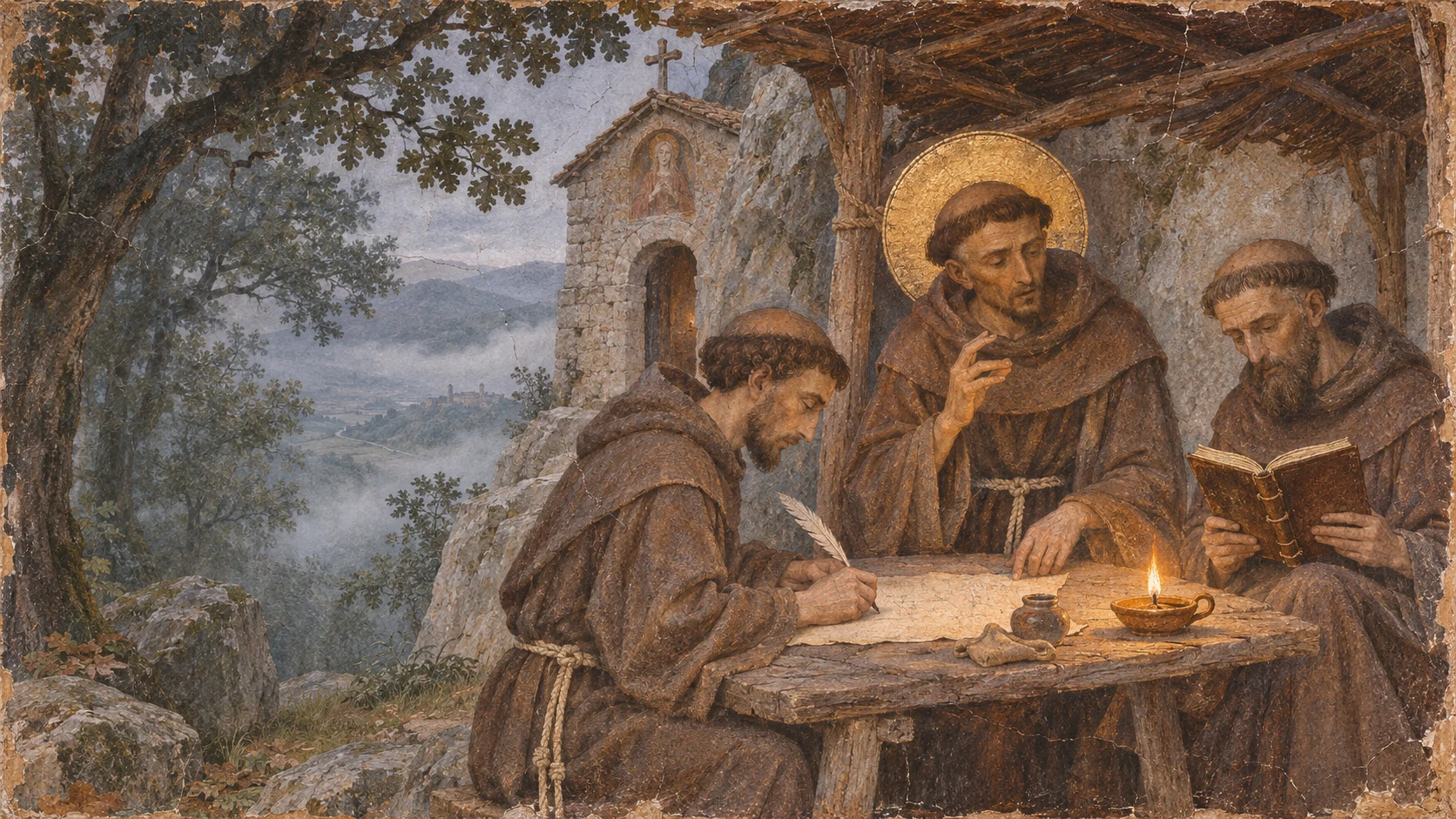
Fonte Colombo stands above the Rieti Valley, on the slope of Mount Rainiero. Its name is associated with a clear spring, whose water tradition likens to water a dove would drink. The woods close around the path. A small chapel dedicated to Mary Magdalene already belonged to the early memory of the place.
Today visitors find a sanctuary with buildings from different periods. In 1223, the setting was simpler: a hermitage, a little chapel, rock, and forest. Francis sought silence here to work on the final form of his brotherhood’s Rule.
Fonte Colombo’s connection with the Rule is an early tradition supported by Franciscan sources, although not every detail is equally certain. Documents and modern studies place the decisive work of 1223 in the Rieti Valley. Later generations called the place the “Franciscan Sinai,” comparing Francis to Moses receiving the Law. This is a devotional image, not a literal description of a revelation written in heaven.
A brotherhood that had grown enormous
When Francis began, he had few companions. They could speak directly, travel together, and solve problems face to face. Within a few years, the brothers had spread to distant regions. People came with different languages, education, and customs. What had worked for a small group now had to guide an entire order.
Francis had already presented a form of life to the pope early in the movement, and another, longer Rule survives in its 1221 form. It is usually called the Earlier Rule, or the Rule without a papal bull, because it did not receive formal confirmation through such a document. In 1223, a shorter text, suitable for legal approval, was needed.
This is documented by the texts themselves. We can compare the two Rules. The 1223 Rule was confirmed by Pope Honorius III on 29 November that year. It remains the official Rule of the Friars Minor.
Francis did not write alone
A popular image shows Francis alone, receiving every sentence directly from God. The sources offer a more human picture. The text grew out of prayer, the brotherhood’s experience, advice, and dialogue with the Church. The official Italian Francis centenary page places Brother Leo and Brother Bonizo of Bologna beside him in September 1223.
Leo was a close companion and could write. Bonizo had legal training. We can imagine them gathered over a parchment: Francis insists on Gospel poverty; Bonizo notices a sentence that could cause confusion; Leo writes, scrapes the surface, corrects it, and writes again.
This scene is a plausible reconstruction, not a meeting transcript. We have no record of every conversation. Later sources were also shaped by debates within the Order about who best preserved Francis’s intention. Historians therefore treat very detailed stories about the writing with care.
Words that had to support lives
A rule is no cold list when people are going to live by it. Each sentence could determine how brothers worked, travelled, prayed, obeyed, and used material goods. Francis wanted the Gospel to remain at the centre. At the same time, an international community needed clarity.
The 1223 Rule begins by declaring that the life of the Friars Minor is to observe the holy Gospel, living in obedience, without property, and in chastity. It addresses prayer, fasting, work, money, preaching, missions, and care for sick brothers. At the end, it asks them to remain faithful to poverty and humility.
The text is short. That does not mean it was easy to produce. Sometimes writing little means making many choices. Fonte Colombo preserves the memory of that effort: turning a burning insight into words other people could live by after the founder’s death.
The story of the lost Rule
Franciscan accounts say that one version of the Rule disappeared and Francis had to write it again. Some narratives say that dissatisfied ministers deliberately lost it; others describe fierce opposition to Francis’s strictness. These stories appear in hagiographical compilations and in texts connected with later disputes within the Order.
They belong to a debated early tradition, rather than to facts we can repeat without explanation. A researcher must ask when each account was written, which conflicts its authors knew, and what they wanted to defend.
This does not mean everything was invented. Real tensions very probably existed. A growing brotherhood seldom agrees on every point. But we cannot safely reconstruct a scene of brothers stealing a manuscript on a particular night.
The chapel of Mary Magdalene
Near the original heart of the site stands the little chapel of Saint Mary Magdalene. Its simplicity suits the place: a small space, stone, painting, and silence. Tradition associates it with the first friars’ prayer. Over the centuries, marks and paintings have received devotional interpretations.
We should be careful not to turn every line on a wall into Francis’s signature. The building was repaired and decorated at different times. The chapel is early material evidence, but its features do not all belong to the same year.
Even so, it helps us understand the rhythm of the work. The Rule was not born only at a table. It grew between prayer and conversation, between chapel and forest. For Francis, organising the brotherhood was a spiritual act too.
The sick man returns
A few years later, around 1225 or 1226, Francis returned to Fonte Colombo seriously ill. His eyes were badly inflamed. Early sources describe pain, watering eyes, and great difficulty tolerating light. Doctors recommended cauterisation: heating an iron instrument and applying it close to the affected area.
The procedure sounds terrible, and probably was. Medieval medicine used cauterisation in attempts to treat various illnesses. We should neither laugh at the doctors nor pretend they had modern resources. They worked with the knowledge available to them.
Francis is said to have spoken to “Brother Fire,” asking him to be gentle. The account says he endured the treatment and afterwards declared that he had not felt the expected burning. This belongs to early hagiography, passed down to show his trust in God and his kinship with creation. It is not a medical report and cannot tell us exactly what his body felt.
Fear, courage, and Brother Fire
We can imagine the instrument being heated. One brother looks away. Another holds a cloth. Francis breathes and remembers that, in his canticle, fire is beautiful, cheerful, sturdy, and strong.
The specific gestures in this scene are narrative reconstruction. The prayer to fire and the treatment come from the sources; each person’s position does not. The difference matters, because an honest narrative welcomes readers into a scene without misleading them.
Courage does not mean feeling no fear. It means passing through something difficult without letting fear be the only voice. Francis did not seek pain for show. He was ill and accepted the recommended treatment. His way of addressing fire made a threatening force part of God’s creation.
The Rule and the wound
Fonte Colombo’s two great memories seem different. In 1223, Francis wrestles with words and laws. Later, he wrestles with his own injured body. But a thread connects them: accepting limits.
A brotherhood cannot live on enthusiasm alone. It needs structure, responsibility, and agreements. A body cannot live on determination alone. It needs care, help, and sometimes unpleasant treatments. At Fonte Colombo, Francis encountered limits he could not ignore.
Accepting a Rule did not make him less free. Franciscan freedom does not mean doing anything you like. It means choosing a way of life that protects what matters most. Nor did he lose his faith by accepting a doctor. Seeking care did not mean trusting God less.
What we know and what we have inherited
We know that the 1223 Rule exists and was confirmed by Honorius III. We know that Francis spent periods in the Rieti Valley and that Fonte Colombo has an extremely old Franciscan connection. Early sources describe his eye disease and treatment with fire.
We have also inherited traditions: the dove at the spring, the title of Franciscan Sinai, precise discussions during the writing, and details of the treatment. Some may preserve facts. Others express the meaning generations found here. When we identify each layer, we care for the memory rather than destroying it.
Fonte Colombo asks us to look closely. It is not the setting of a simple story in which a saint dictates and everyone obeys. It remembers a community learning how to carry on.
The page that still breathes
The parchment of 1223 did not stay on the mountain. Brothers took it to Rome. The pope confirmed it. Generations copied, studied, debated, and lived it. Even today, men promise to follow that form of life.
But Fonte Colombo reminds us that before the document came silence, doubt, prayer, and work. A living rule does not fall ready-made from heaven. It grows when people listen to the Gospel and seek words that can protect their choice.
Between spring and stone, Francis learned that faithfulness also means revising a sentence, hearing a companion, and accepting help. Perhaps this is the place’s quietest beauty: holiness does not remove human effort. It lights it from within.
Annotated sources
- Italian Ministry of Culture, “Days of Life — Fonte Colombo”. Official Franciscan centenary page; places Francis, Leo, and Bonizo at work on the Rule in September 1223 and recalls the eye treatment. Read
- The Later Rule of 1223 and the bull Solet annuere. Primary source for the text confirmed by Honorius III on 29 November 1223; allows comparison between the place’s memory and the actual surviving document.
- OFM General Curia, pilgrimage to Greccio and Fonte Colombo. Official Franciscan source on the spiritual and historical importance of the two Rieti Valley sanctuaries. Read
- Italia.it, the Way of Saint Francis in the Rieti Valley. Official Italian tourism portal; provides geographical and heritage context for the sanctuary. Read
- Visit Rieti, “Shrine of Fonte Colombo”. Local overview of the chapel, hermitage, Rule, and memory of the treatment. Read
- Noel Muscat, OFM, studies of Franciscan sources. Franciscan scholarly discussion important for understanding how later accounts of the Rule’s composition were shaped by internal controversies. Read PDF
- Early Franciscan compilations on cauterisation. Hagiographical sources for the prayer to “Brother Fire”; preserve a spiritual memory rather than clinical documentation.