
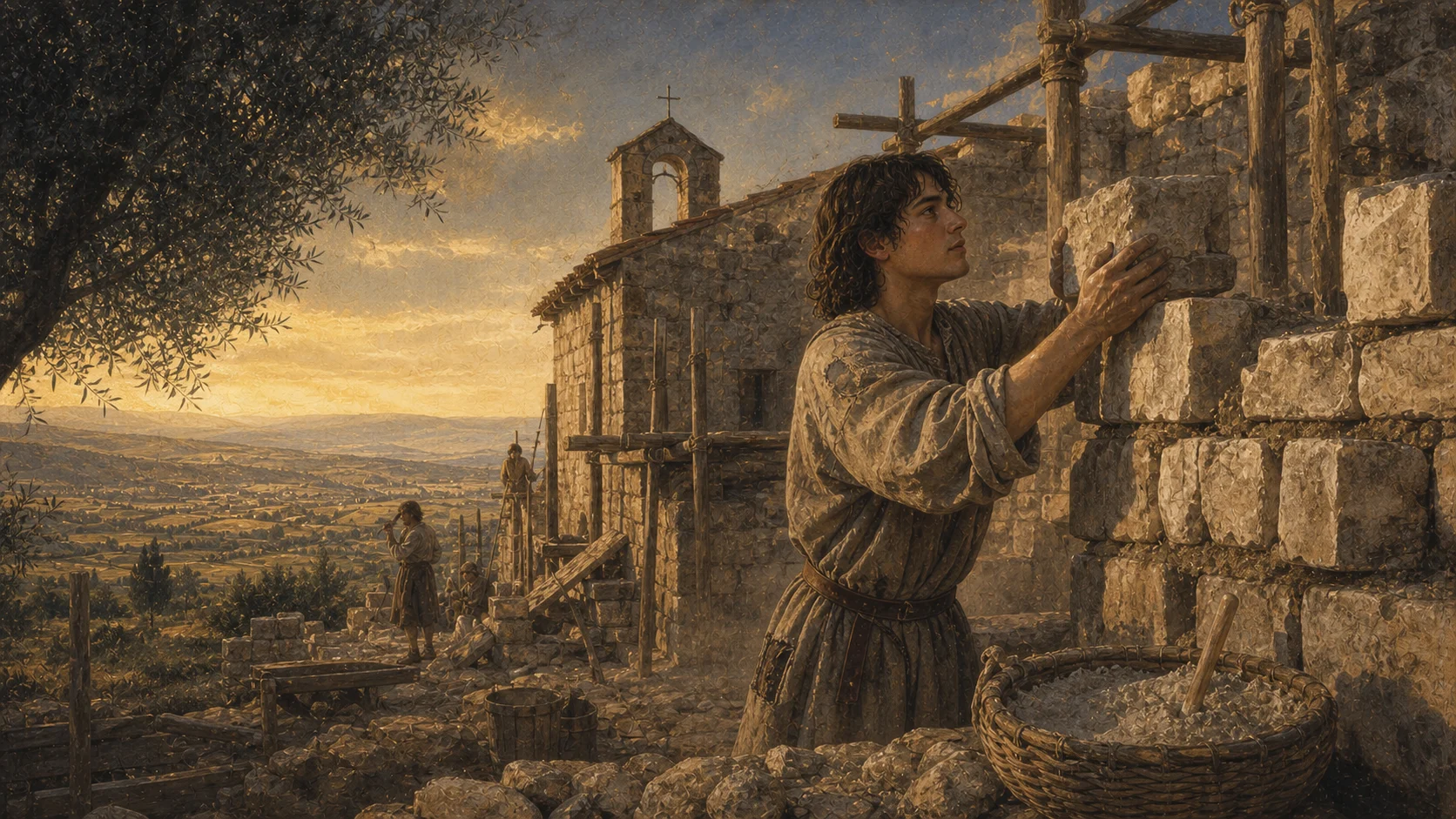
Now he had a wall
Francis had left behind money, elegant clothes, and the security of working in the family shop. But the call of San Damiano remained before him.
“Repair my house.”
Without enough coins, a very concrete task remained: find stones, mix mortar, raise timber, and learn to build.
Francis had not trained as a stonemason. His hands knew fine fabrics, parties, and perhaps a horse’s reins. Now they would learn the rough weight of limestone.
A stone does not move because someone had a beautiful inspiration. You must bend down, grasp it, search for the right fit, and try again. The faith born in the chapel’s silence became dust on his sleeves.
The beggar for stones
The earliest biographies say that Francis went through the streets of Assisi asking for building materials.
He called to people joyfully. One tradition preserves his playful appeal: whoever offered one stone would receive one reward; whoever gave two would have two; whoever gave three would have three.
It was not a commercial promise. Francis spoke like God’s troubadour, turning the request into song. The young man who once used his voice to lead parties now used it to invite a city to rebuild.
Not everyone was delighted.
Some probably laughed. Others thought him mad. It was difficult to recognize Pietro Bernardone’s elegant son in this dust-covered man. He had to endure the looks of people who knew his former life.
Every stone he received carried two things: the weight of matter and someone’s trust.
A stone never arrives alone
Imagine a woman setting aside a stone from her land. A worker lending a tool. Someone offering water. A mason showing him how to prepare the mixture. The sources do not record every helper’s name, but work like this is hardly born from only two hands.
The story often says that Francis rebuilt San Damiano “with his own hands.” This means that he truly worked, not merely ordered others to work. It need not mean that he did everything alone.
The work began gathering a small community even before there were friars.
Someone gave. Someone taught. Someone lifted. Someone laughed. Someone passed without helping. And the wall grew.
Francis discovered that asking can also be an act of humility. Before, family money allowed him to buy without depending on anyone. Now he had to look people in the eyes and say, “Will you take part?”
Work that prays
For Francis, carrying stones was not a break between spiritual moments. The work was part of his answer.
Some prayers are spoken in words. Others are made when we care well for the task we have received.
A wall must stand firm. Mortar needs the right proportions. A poorly placed tile can let in the rain. Doing something with love does not mean doing it carelessly. Care is also a form of respect.
Francis learned from matter. One stone alone may seem useless. In the right place, it supports another. A small one helps a larger one remain steady. Empty spaces need to be filled. No wall is strong when every stone tries to occupy the same place.
It was almost a parable of the fraternity still to be born.
Peace is not a wall made of identical stones. It is a structure in which differences find a place to support one another.
Dust on his face, joy in his heart
The Franciscan accounts insist on Francis’s joy—not a comfortable joy, but one that could sing amid exertion.
This does not mean he never grew tired. His body had already endured illness, prison, and deprivation. Sun, cold, aching muscles, and hunger were real. Joy did not erase his weariness; it gave it a direction.
Before, Francis spent his energy trying to be admired. Now, at the end of a day, he could look at part of the wall and know that someone would once again have a place to pray.
The result did not need to bear his name.
There is a special happiness in doing something useful that perhaps no one will photograph. Cleaning without being told. Arranging books for the next person. Preparing food. Repairing a chair. Planting a tree whose shade will be enjoyed by someone not yet born.
The world is kept alive by countless works like these.
More than one small church
After San Damiano, Francis restored other chapels in the region. The sources mention Saint Peter’s and then Saint Mary of the Angels, the little Portiuncula.
Portiuncula means something like “little portion.” The chapel belonged to the Benedictine monks of Mount Subasio and had been abandoned. Francis repaired it and came to love it deeply.
There, later, he would understand the Gospel of the disciples’ mission in a new way. Companions would arrive there. The fraternity would begin there. And near there, many years later, he would ask to be placed on the ground as death approached.
A building that seemed small would become the cradle of a spiritual family spread throughout the world.
Francis did not know this as he fitted the first stones.
We almost never see the future hidden within faithful work.
The prophecy sung at San Damiano
While he worked at San Damiano, an early tradition says that Francis announced in French that holy women would live there and praise God.
Years later, Clare of Assisi and her first companions would make the rebuilt church their home. The place of broken stones would become a space of prayer, courage, and fellowship among women.
That part of the story is still to come. For now, it is enough to notice something beautiful: Francis was raising walls for people he did not yet know.
Service often means preparing a place for someone’s arrival.
A teacher prepares the lesson before the students enter. A family arranges the room of a baby yet to be born. Someone installs a ramp with people in mind whom they may never see. All hospitality begins before the door opens.
Poverty did not mean careless dirt
Francis loved simplicity, but simplicity is not neglect. He repaired churches precisely because poor places also deserved care.
He did not desire luxury in order to impress. He desired dignity in order to welcome.
The difference matters. We can spend greatly to display wealth and still welcome no one. We can have few resources and care beautifully for what we share.
A flower in a glass, a clean table, a well-made patch, or a carefully written word says, “You matter.”
Franciscan art is not born from excess. It is born from looking at the simple until we discover light there.
When he began rebuilding himself
As the walls changed, Francis was also rebuilt.
Stone taught him patience. Asking taught him humility. Receiving help taught him gratitude. Work taught him perseverance. Being misunderstood taught him not to depend on applause.
Perhaps this was one of the hidden meanings of the call at San Damiano. Christ did not give Francis a task merely to obtain a repaired church. The task became a school in which the builder himself would be transformed.
This happens to us. When we care for someone, we also learn to love. When we study with discipline, our mind does not merely receive information: it learns to persevere. When we apologize, we rebuild not only a friendship but also honesty within ourselves.
Those who work on a good work are also worked upon by it.
A building project for today
You do not need to raise a stone chapel. Many small ruins are waiting for care:
- a corner of the house that everyone uses and no one tidies;
- a forgotten garden;
- a friendship weakened by neglect;
- a damaged book that can still be repaired;
- a skill that can help a community;
- a tired person carrying everything alone.
Choose something possible and ask for guidance before you begin. A Franciscan gesture need not be enormous. It needs to be true.
Perhaps others will not even notice. Dust may cover your clothes. The task may take longer than it seemed.
Even so, a stone placed with love is never merely a stone.
The workshop's golden dust
Make the stone remember the light.
Choose a small work your hands can begin today. The ordinary shines when it is offered with care.
The light did not fall ready-made from heaven: it was waiting inside the work.
For those who wish to go deeper
Sources for this chapter
- Thomas of Celano and Collected Franciscan SourcesEarly texts on the restoration of San Damiano and the first churches.
- Saint Francis, Restorer of ChurchesA description of gathering stones, the work itself, and the invitations made to local people.
- The Chapel of Our Lady of the AngelsA Franciscan history of the Portiuncula, the third chapel Francis repaired and the cradle of the fraternity.
The sources state that Francis worked directly on the restoration. They do not provide a complete list of helpers or techniques; this chapter presents the scenes of collaboration as plausible imagination, not documented fact.
Historical note: studies vary regarding the sequence and exact location of some churches. The most widespread tradition presents San Damiano, Saint Peter’s, and Saint Mary of the Angels—the Portiuncula—as the three chapels Francis restored before the fraternity was fully formed.