
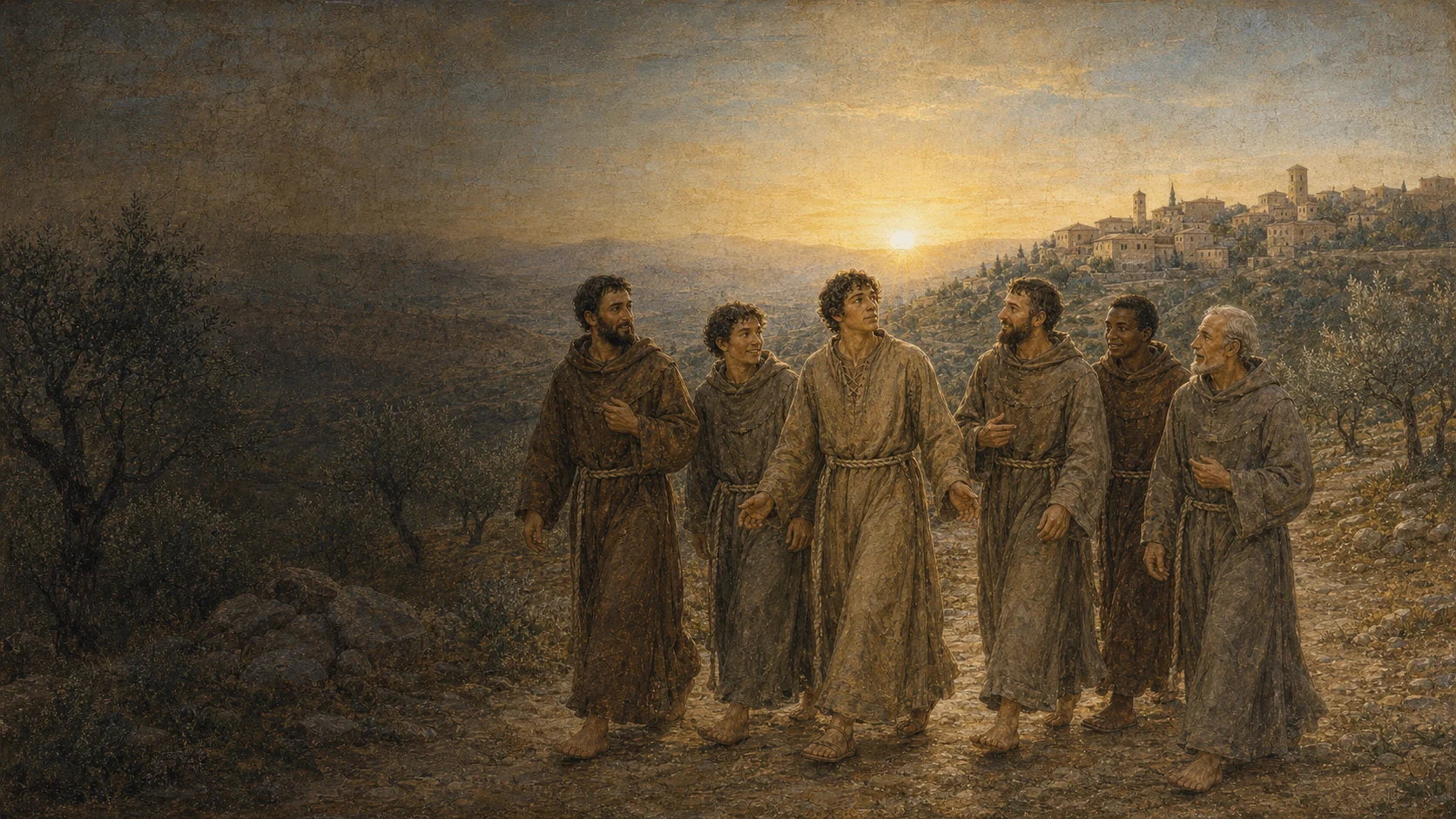
The man who seemed to be alone
For a time, Francis was easy to recognize in the streets of Assisi. He wore a rough tunic, worked with his hands, and spoke of peace. Some admired him. Others laughed. Many perhaps did not know what to think.
He had left his father’s shop, the banquets, and the dream of becoming a knight. He repaired small churches, cared for sick people, and begged for stones to rebuild walls. He had neither a comfortable home nor a plan to found a great organization.
He seemed simply to be a man trying to answer the Gospel with his whole life.
But a genuine life asks silent questions of those who watch it. If someone can be joyful with so little, where does that joy begin? If he can embrace those everyone avoids, what has he discovered? If he lost his place in the city and still found peace, what has he begun to see?
Those questions began to reach other people.
Bernard watches through the night
One of the first to draw near was Bernard of Quintavalle. The accounts describe him as a wealthy and respected man of Assisi. He knew Francis’s former reputation: the elegant young man, generous at parties and full of dreams. Now he saw the same person living in a completely different way.
Bernard grew curious. Was this poverty sincere or merely a performance? Did the joy continue when no one was watching?
An early tradition says that he invited Francis to dinner and to sleep at his house. During the night, he pretended to be asleep and watched his guest. Francis rose and remained in prayer.
We cannot reconstruct every minute of that night. The account was written to show what Bernard would have perceived: Francis was not playing a role for the city. His hidden life matched his public life.
The next morning, Bernard spoke of his desire to follow the same path.
Francis did not answer as the owner of every certainty. He did not hand over a finished rulebook. He proposed that they listen to the Gospel.
The first Franciscan fraternity did not begin with someone saying, “I know everything.” It began with two people asking together, “what does Jesus invite us to live?”
Three open pages
Francis and Bernard went to a church in Assisi, traditionally identified as Saint Nicholas. With a priest’s help, they opened the book of the Gospels three times, a medieval way of seeking guidance in Scripture.
The earliest biographies connect that moment with three invitations from Jesus:
- share possessions with the poor;
- carry neither riches nor securities on the journey;
- take up the cross and follow Jesus.
Francis recognized a kind of map there. According to tradition, he said that this would be their life and the life of all who wished to join their company.
Bernard took the call seriously. He distributed his possessions. This drew attention in the square. A priest named Sylvester, seeing so much money being given away, is said to have complained about an amount he believed he was still owed for the stones used at San Damiano. Francis placed coins in his hands. Later, Sylvester himself would join the brothers.
The episode does not show perfect people arriving ready-made. It shows desires, doubts, attachments, and changes. A fraternity is not formed by copies. It is formed by people who allow the same love to transform different stories.
Peter, Giles, and those who came later
Another man named Peter of Cattani appears among the earliest companions. We do not know his story as clearly as we would like. Later sources describe him as an educated man, perhaps connected with the law. What matters is that he also left his former position to live among the lesser brothers.
Soon Giles arrived, also known as Brother Giles. Tradition says that he sought Francis because he wished to share that life. He was simple, ready to work, and full of brief sayings that the brothers would preserve for many years.
Names continued to appear: Philip, Moricus, Sabbatinus, John, Barbarus, Bernard of Vigilante, Angelo, and others. The lists and exact order vary among accounts. What remains clear is that Francis was no longer alone.
They came from different circumstances. Some had resources. Some read better. Others worked with their hands. Some had known war. Each brought abilities and also limitations.
Francis did not call them employees or soldiers. He called them brothers.
The gift Francis did not plan
Years later, Francis wrote a very important sentence in his Testament:
“The Lord gave me brothers.”
He did not say, “I found useful people for my project.” Nor did he say, “I built a team that obeyed my ideas.” For Francis, every brother was a gift received.
Gifts, however, also require work.
When a person lives alone, they can choose their schedules, their silences, and almost all their decisions. When others arrive, different rhythms appear. Someone walks more slowly. Someone becomes irritated. Someone understands a task differently. Someone needs care on precisely the day when everyone is tired.
Fraternity is not liking the same things. It is learning not to abandon the other person when differences appear.
The first brothers had to discover together where to sleep, how to obtain food, when to pray, how to work, and what to say in the towns. They did not have the large friaries that would arise later. They sheltered in modest places such as Rivo Torto, a cramped building near Assisi.
An early source says the space was so small that Francis wrote each brother’s name on the beam above his place. The scene may make us smile: a community capable of crossing continents began by trying to arrange where everyone could fit in a hut.
Two by two along the roads
Francis sent the brothers along the roads in small groups. They announced peace, invited people to conversion, and worked when they could. They were not always received kindly.
Their poor clothing made some people suspicious. They could be mistaken for vagrants or dangerous people. In certain towns they were insulted. They also endured hunger, cold, and exhaustion.
When they returned, they told what had happened. The fraternity was a place of departure, but also of return. No one needed to carry alone everything they had lived through.
This simple movement became one of the strengths of the Franciscan experience: to go out without dominating and return without believing themselves greater than others.
They did not carry a message of luxury. The message was their very way of walking: without weapons, without a full purse, and without treating anyone they met as inferior.
Why “Friars Minor”?
In time, the group adopted the name Friars Minor. The word “friar” comes from a word meaning brother. “Minor” did not mean less loved, less intelligent, or without worth.
In Assisi’s society, there were the greater people, connected with power and ruling families, and the lesser people, who had less influence. Choosing to be lesser meant refusing the race to stand above others.
Francis did not want his brothers to form a new class of power. They were to remain close to the lowly, work, serve, and treat every creature as part of a common home.
To be lesser is not to think, “I am worth nothing.” It is to know: “my worth does not depend on placing someone below me.”
A fraternity larger than the hut
The number of brothers soon grew. The little building at Rivo Torto could not contain them. The group came to have a special place for meeting and prayer at the Portiuncula, the small church of Saint Mary of the Angels.
Nothing there seemed to announce a worldwide movement. The chapel was small. The dwellings were fragile. The brothers had no full treasuries.
They had a story they could live together.
The young man who had wanted all Assisi to shout his name now rejoiced because other names were spoken beside his own. Bernard. Peter. Giles. Sylvester. Every arrival reduced loneliness and increased responsibility.
One light did not need to extinguish another. Together, they could illuminate a longer road.
What the first brothers teach us
Some dreams discover their true form only when they are shared. One person begins. Another recognizes something good. A third brings an ability that was missing. Little by little, what seemed small takes shape.
But the secret is not to gather identical people. It is to gather people willing to listen to the same good.
Francis teaches us to receive the other person as a gift, not a tool. Bernard teaches us to observe before following. Giles teaches us that simplicity also has wisdom. The first brothers teach us that walking together requires room for every step.
Perhaps someone near you has a small light that only needs to meet yours.
This is how fraternity begins
Gather the little lights.
Francis did not plan a crowd. He received one brother, then another, and learned that no light needs to shine alone.
The lights are still scattered across the hills.
For those who wish to go deeper
Sources for this chapter
- Bernard of Quintavalle: First Companion of Saint FrancisPresents the tradition about Bernard, the night of prayer, and the three Gospel passages.
- You Are All Brothers — Order of Friars MinorA Franciscan study of fraternity as gift and the identity of the lesser brothers.
- Meet the Mystics: St. Francis of AssisiPlaces the first evangelical choices of Francis and his companions in context.
The scenes about the night at Bernard's house, the opening of the book, and life at Rivo Torto come from medieval biographical traditions. They communicate the spiritual memory of the first brothers but do not function as an exact recording of conversations and gestures.
Historical note: the accounts agree that Bernard of Quintavalle was among the first companions and that the group grew quickly. The exact order of arrivals, some occupations, and certain personal details vary among sources.