
The request to return
In 1226, Saint Francis of Assisi knew that his body was reaching its limit. He was about forty-four years old, but illness, travel, and years of difficult living had weakened him deeply.
He was being cared for near Assisi. When he realized that death was approaching, he asked to be taken to the Portiuncula—the little church of Saint Mary of the Angels.
It was a tiny place, but it held almost his entire story.
There he had prayed at the beginning of his conversion. There the first brothers had formed a fraternity. From there they had set out to announce peace. Nearby, Clare had begun her new life.
Saint Francis did not wish to die in a palace or a grand church. He wanted to return to the place where it all began.
When life becomes confusing, remembering the beginning can show us what truly matters.
Looking at Assisi one last time
The accounts say that the brothers carried Saint Francis. On the way, he asked them to stop and turn him toward Assisi.
His eyes could barely see. Even so, he blessed the city.
Assisi had given him parties and prison, family and conflicts, friends and rejection. There he had been Giovanni, the merchant’s son. There he had heard the San Damiano Crucifix. There he had removed his clothes before the bishop. There he had embraced a life no one could have predicted.
Saint Francis did not bless a perfect city. He blessed the real city, filled with good and painful memories.
Forgiving a place does not mean saying that everything that happened was right. It means refusing to let pain destroy the ability to wish it well.
Then the brothers continued on to the Portiuncula.
Sister Jacoba arrives with care
A Roman friend of Saint Francis, Jacoba of Settesoli, is part of the traditions about his final days. She was a woman of means and courage and a close friend of the friars.
Saint Francis wanted her to come and bring several things, including cloth for his burial and a food he liked. Before the message was sent—some sources say—Jacoba arrived.
The friars usually restricted women from entering their spaces. In view of that friendship and that hour, Saint Francis is said to have declared that the rule did not need to be applied to her in the same way.
Jacoba did not arrive to give a speech. She arrived bringing practical care.
True friendship knows that love also needs bread, cloth, medicine, presence, and willing hands.
Even a man remembered for letting go of everything received, at the end, the care offered by a friend.
The brothers’ last supper
Saint Francis asked for bread. He blessed it and shared it with his companions.
The gesture recalled Jesus’s supper with the disciples. It was not a perfect reenactment; it was a frail man surrounded by people who knew they would soon miss him.
He asked them to read the passage from John’s Gospel in which Jesus washes his friends’ feet. That text had guided his life: the greatest places himself at the service of others.
Saint Francis did not leave the brothers a secret for gaining power. He reminded them of service.
A community can build churches, write books, and cross centuries. If it forgets to wash feet—that is, to serve with humility—it loses the way.
The shared bread said: no one crosses the difficult hour alone.
Why “naked upon the earth”?
The biographies recount a request that may seem strange: Saint Francis wanted to be placed naked on the ground.
It was not contempt for the body. Nor was it a scene created to humiliate him. It was a sign of surrender.
At the beginning of his conversion, he had returned his clothes to his father before the bishop. Now, near death, he wished to show again that he owned nothing—not even the time that remained to him.
Out of obedience and charity, a brother offered him a simple tunic. Saint Francis received it as something borrowed, not as property.
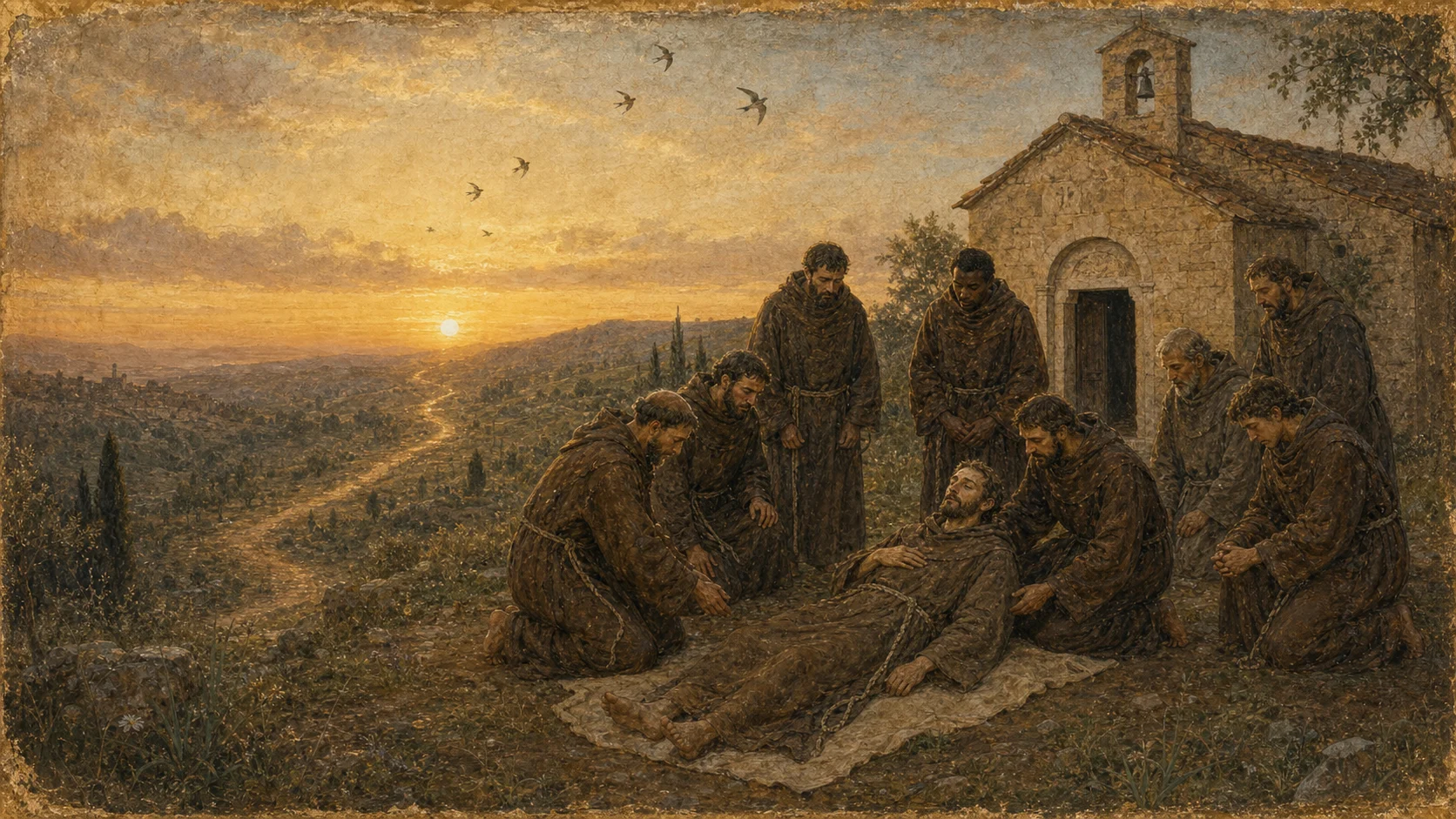
The title of this chapter preserves that symbol. In the page’s artwork, he appears covered with dignity on a simple cloth. What matters is not the exposure of the body. It is the freedom of a person who no longer needs to grasp anything.
Saint Francis came from the earth and trusted that he would return to it without ceasing to belong to God.
The blessing that chooses no favorites
The brothers wanted to hear his final words. Some had walked with him for many years. Others had arrived recently. The fraternity also knew tensions over its future.
Saint Francis blessed those present and those absent.
This choice matters. At the end, he did not create a short list of people who deserved love. His blessing tried to reach those who were far away too.
He knew the brothers would make mistakes. He knew the order would change. Even so, he entrusted the Gospel and mutual care to them.
To love a work is not to control it forever. A time comes when we must entrust it to other hands.
Parents experience this when their children grow up. Teachers experience it when students follow paths of their own. Friends experience it when a journey separates the group.
Letting go does not erase love. It can be love’s most difficult form.
The larks at dusk
Saint Francis loved larks. According to Thomas of Celano, on the evening of his death these birds flew over the place even though they usually appeared at another time. They circled and sang.
We cannot verify that day’s flight as we verify a modern record. The account was preserved because it seemed to fit the whole life of Saint Francis.
The man who had called creatures his sisters was departing while small birds crossed the sky.
It is a delicate image: below, his friends wept; above, creation continued to sing.
When someone dies, the world does not stop. The sun rises, birds fly, other people talk. This can seem harsh. With time, it can also console. The life received by that person continues to produce movements we cannot see in full.
The arrival of Sister Death
On the night of October 3, 1226, Saint Francis died at the Portiuncula.
Franciscans call this moment the Transitus, a word that means passage. For this reason, it is commemorated on the night of October 3, while the liturgical feast of Saint Francis is celebrated on October 4.
Saint Francis had included Sister Death in the Canticle. Now he met what he had sung about.
His companions felt sorrow. Faith did not turn them to stone. Weeping was not a lack of hope; it was proof of connection.
For Christians, death does not destroy the person or end God’s love. But it remains a farewell. We can hold hope and longing at the same time.
If you have lost someone, you do not need to hurry your heart. Each person grieves in a different way. Finding a trusted adult, talking, praying, drawing, or simply sitting in silence can help. Sadness also deserves company.
What remained on the ground
After Saint Francis died, the brothers looked at his body and the marks it bore. Soon the farewells and the journey to Assisi began.
Two years later, he would be declared a saint. A great basilica would be built. Artists would cover walls with scenes from his life. People in many countries would learn his name.
But that night there was no basilica.
There was a little church. Earth. A cloth. Shared bread. Friends. Larks.
The greatness Saint Francis had sought as a boy finally found him, but in a way Giovanni could never have imagined. It was not the greatness of possessing a kingdom. It was the greatness of reminding the world that every person can be a brother or sister and that no creature is too small to receive love.
The story does not end
This is the last chapter of this part of the life of Saint Francis, but it is not the end of his story.
It continued in Clare and the Poor Ladies, in the friars, in Secular Franciscans, in those who care for the sick, build peace, protect creation, and choose a simpler life.
It also continues when a twelve-year-old decides not to laugh at an excluded classmate. When a family wastes less. When someone asks for forgiveness. When a powerful person stoops to serve.
Saint Francis did not ask everyone to copy every detail of his medieval life. He asked the brothers to live the Gospel.
The ground on which he lay was not the full stop. It became a starting line for those who came after him.
Now that line reaches us.
The light that remains
Let go. Keep what gives light.
Every life gives some brightness to the world. Think of a teaching of Saint Francis that you wish to carry beyond this page.
The flame bids farewell to the horizon, but it still lives in your hands.
For those who wish to go deeper
Sources for this chapter
- Commission on the Franciscan Intellectual-Spiritual Tradition — TransitusBrings together the traditions about the return to the Portiuncula, the companions, Jacoba, and the death on October 3.
- Audience on the Life of Saint FrancisA biographical synthesis that places his death at the Portiuncula and recounts the tradition of resting upon the earth.
- Saint Francis, the Poor Man of AssisiProvides context for his death in 1226, twenty years after the beginning of his conversion.
The final days are recounted in different medieval biographies, which select details for spiritual purposes. This chapter preserves the central elements shared by the tradition and identifies as tradition the episodes that cannot be verified independently.
Historical note: Saint Francis died on the night of October 3, 1226, beside the Portiuncula. His feast is celebrated on October 4 because, in the liturgical tradition, the celebration begins after the vigil on the previous evening. The gesture of lying naked upon the earth appears in the biographies as a symbol of complete poverty; shortly afterward, he received a tunic lent by a brother.