
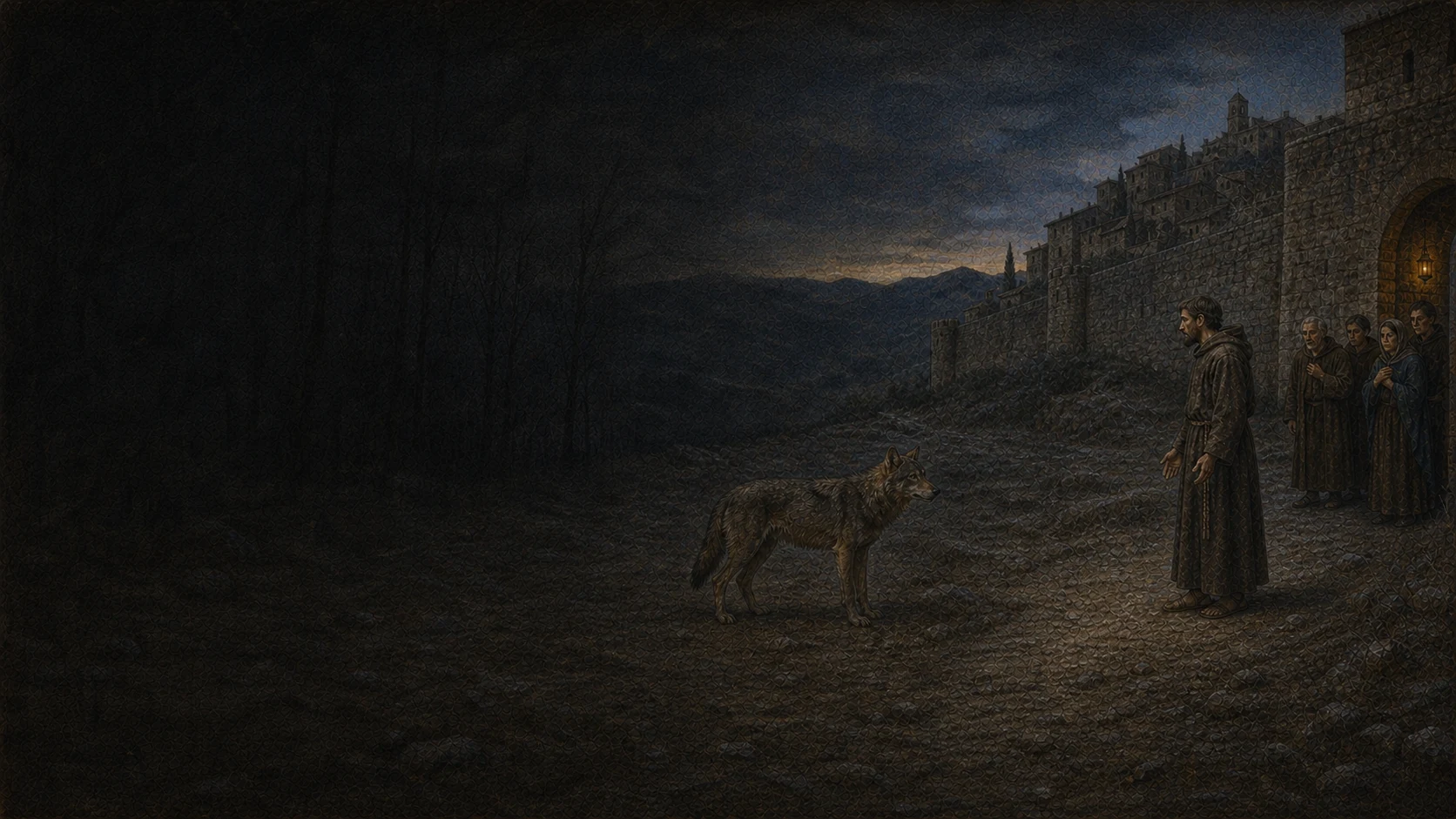
The gate of Gubbio closes before nightfall.
Inside the walls, the smell of firewood mingles with wet wool. Outside, the road disappears among bare trees. Someone claims to have heard a growl. Someone else swears that they saw two large pawprints beside the road. No one wants to cross the dark fields alone.
Then Francis walks out through the gate.
So begins one of the best-loved stories about him: his meeting with the wolf of Gubbio. Children have listened to it for centuries. Painters have placed the animal’s paw in the saint’s hand. Preachers have seen it as an image of peace.
But beneath those images lies a question: when was this story first told?
We do not know. That gap does not destroy the account. It makes it older, more human and more mysterious.
What we know
Gubbio is real. Its stone streets climb a hillside in Umbria, not far from Assisi. In Francis’s time, the town had walls, fields, flocks and surrounding woods. Wolves also lived in medieval Italy. For shepherds and travelers, they were not creatures in books: they could attack livestock and inspire fear.
Francis had a genuine connection with the town. Thomas of Celano, his first biographer, wrote in 1228 or 1229 that, early in his conversion, Francis reached Gubbio almost naked. An old friend gave him a simple tunic. That visit appears in a source written very close to Francis’s lifetime.
We also know that Francis treated animals as God’s creatures. His writings call the sun, wind and water brothers and sisters. The earliest biographies recount episodes involving birds, lambs and other creatures. A respectful encounter with an animal therefore does not sound strange within Franciscan memory.
Celano, however, does not tell the story of the wolf. Nor does it appear in the other major 13th-century biographies, such as Bonaventure’s Major Legend. No known document from Francis’s lifetime records a pact between him, a wolf and the people of Gubbio.
This is our first firm ground: the town and Francis’s presence there belong to documented history; the famous encounter belongs to a tradition written down later.
The account that reached us
According to the Little Flowers of Saint Francis, an enormous wolf was spreading terror around Gubbio. It attacked animals and people. The inhabitants went out armed as though going into battle, yet were still afraid to pass through the town gate.
Francis felt compassion. He set out with several brothers but continued alone when they hesitated. Many townspeople watched from a distance. The wolf ran toward him with its mouth open; Francis made the sign of the cross and called it “Brother Wolf.”
The saint did not pretend that nothing had happened. In the account, he rebukes the animal for the harm it has done. Then he recognises another part of the story: the wolf had acted out of hunger. He proposes an agreement. The animal will stop hurting others; the townspeople will feed it; neither men nor dogs will pursue it.
The text turns the agreement into a public ceremony. Before the people, the wolf bows its head and places its paw in Francis’s hand as a sign of its promise. It then lives among the houses for two years, fed by the inhabitants. When it dies of old age, the town mourns, because its presence had reminded everyone of the saint’s goodness.
It is a perfectly shaped short narrative: fear, departure, encounter, judgement, the discovery of hunger, a pact and remembrance. That perfection also reminds us that we are reading religious literature, not municipal minutes.
Where the story emerged
The earliest known written form appears in chapter 23 of the Deeds of Blessed Francis and His Companions, or Actus beati Francisci et sociorum eius. This Latin collection was prepared in the Italian Marches, probably between the 1320s and 1340s.
Francis had died in 1226. More than a hundred years therefore separate his death from the known writing of the episode. The text may preserve an earlier oral memory. But we cannot trace that memory from one speaker to the next all the way back to a witness.
Late in the 14th century, sometime between about 1370 and 1390, an anonymous Tuscan author translated and selected much of the Actus in the vernacular. This collection became known as the Little Flowers: a bouquet of short stories about Francis and his companions. The wolf appears in chapter 21.
The Little Flowers were not intended as a modern biography, with checked documents and a date for every scene. They were devotional accounts. They sought to show what kind of life blossoms when the Gospel is taken seriously. They blended old memories, teachings, biblical imagery and the way 14th-century Franciscans understood their founder.
A historian can love this book while still asking where each flower came from.
To understand the distance, imagine the story passing through many places before reaching parchment. A friar tells it in the refectory while rain beats against the roof tiles. A pilgrim carries it to another house. Years later, a preacher uses it before a town square and chooses the details that will help his listeners understand peace. When a copyist finally dips his pen into ink, he may be receiving not one voice but many.
That does not make the tradition useless. In the Middle Ages, much memory traveled through speech, sermons and worship. It does, however, make it impossible to retrace the route and determine with certainty which details were there at the beginning. The manuscript records the point at which the chain became visible to us—not necessarily the point at which it began.
What may have changed along the way
A story told through a hundred winters does not remain still. One voice adds the town gate. Another remembers the dogs. A preacher emphasises hunger. A copyist shapes the pact into a promise made before everyone.
Perhaps some animal really did frighten the surrounding area. Perhaps Francis calmed a smaller disturbance that memory later enlarged. Perhaps different stories—a visit by Francis, a dangerous wolf, a sermon about peace—merged. Perhaps the episode was born fully formed as a Franciscan parable.
All these possibilities are hypotheses. None has become proof.
It is sometimes claimed that “Wolf” was actually the nickname of a bandit or violent leader. The idea fits the message of reconciliation well, but no known medieval document identifies such a person. Repeating it as a historical solution would merely replace one mystery with an overly confident invention.
Nor can we treat later images, place-names or objects venerated in Gubbio as though they were contemporary records. They demonstrate the strength of the town’s memory. By themselves, they do not show how the account began.
There is also an important literary development. In the earliest animal stories, Francis recognises the Creator’s goodness in them. In the story of the wolf of Gubbio, the animal takes part in something like a human legal process: it is accused, heard, fed and welcomed into a community. The paw in the hand serves as a living seal.
A real wolf does not sign contracts. The gesture belongs to the language of story. That is precisely why it endures in memory.
What the story may mean
The wolf in the Little Flowers causes harm. The people also prepare to answer with weapons. Francis stands between two fears without calling either side a monster.
First he protects the people. Then he asks what the animal needs. Hunger does not erase the destruction, but it changes the response. Peace requires two promises: the wolf will not attack, and the town will neither leave it hungry nor hunt it.
For a medieval reader, the wolf might evoke dangers in the woods, enemies and even biblical images of evil. For us, it might evoke any fear to which we give a ferocious face. But no interpretation should lock the account inside a single cage.
It can speak about creation: human beings are not the world’s sole owners. It can speak about justice: asking someone to stop causing harm includes addressing the hunger that feeds violence. It can speak about politics: a frightened town needs courage to replace the hunt with a commitment. It can speak about the heart itself, where one part is sometimes afraid and another is ready to bite.
These readings explain why the story endured. They do not prove that the encounter happened exactly as it was written.
What remains a mystery
We do not know whether there was a particular wolf. We do not know who first told the story. We do not know whether a memory crossed the generations or whether a friar in the Marches created a narrative capable of gathering truths about Francis into a single scene.
Nor can we declare the miracle proven. The text is far too late for that. Neither can we confidently declare it false: its absence from early sources does not demonstrate that no event lay behind the tradition.
The road remains.
Francis walks without a weapon. The people watch from the walls. The wolf is not a demon with fiery eyes but a hungry, dangerous, living animal. Between them lies enough distance for fear and enough room for a choice.
Perhaps that is the story’s secret. It does not merely say that Francis tamed a wolf. It says that an entire town had to learn to feed what it had previously wanted only to destroy.
At nightfall, the gate of Gubbio closes again. Inside, no one knows whether another growl will be heard. But now fear has acquired a question:
is it possible to make peace without denying the wound—and without killing forever the one who caused it?
Tracks on parchment
Sources for this story
- Actus beati Francisci, chapter 23 — CapuchinsPortuguese translation of the earliest known Latin form of the wolf account.
- Little Flowers of Saint Francis, chapter 21 — WikisourceThe 14th-century Italian text that gave the episode its most widespread form.
- “Francesco d'Assisi” — Treccani Biographical DictionaryA critical overview of the dating of the biographies, the Actus and the Little Flowers.
- “Fioretti di san Francesco” — Italian EncyclopaediaAn introduction to the devotional genre, the translation of the Actus and the collection's legendary character.
- Thomas of Celano, First Life — Franciscanos.orgThe first biography records Francis's journey to Gubbio, but not his encounter with the wolf.
- The Wolf of Gubbio: or, How a Franciscan Legend Is Created — Ca' Foscari University of VeniceA collective study devoted to the gaps, transformations and memories that formed the legend.
How we read the sources: we distinguish Francis's documented presence in Gubbio from the later wolf narrative. Hypotheses remain hypotheses; the idea of a “bandit called Wolf” is not presented as fact, and the miracle is declared neither proven nor disproven.