
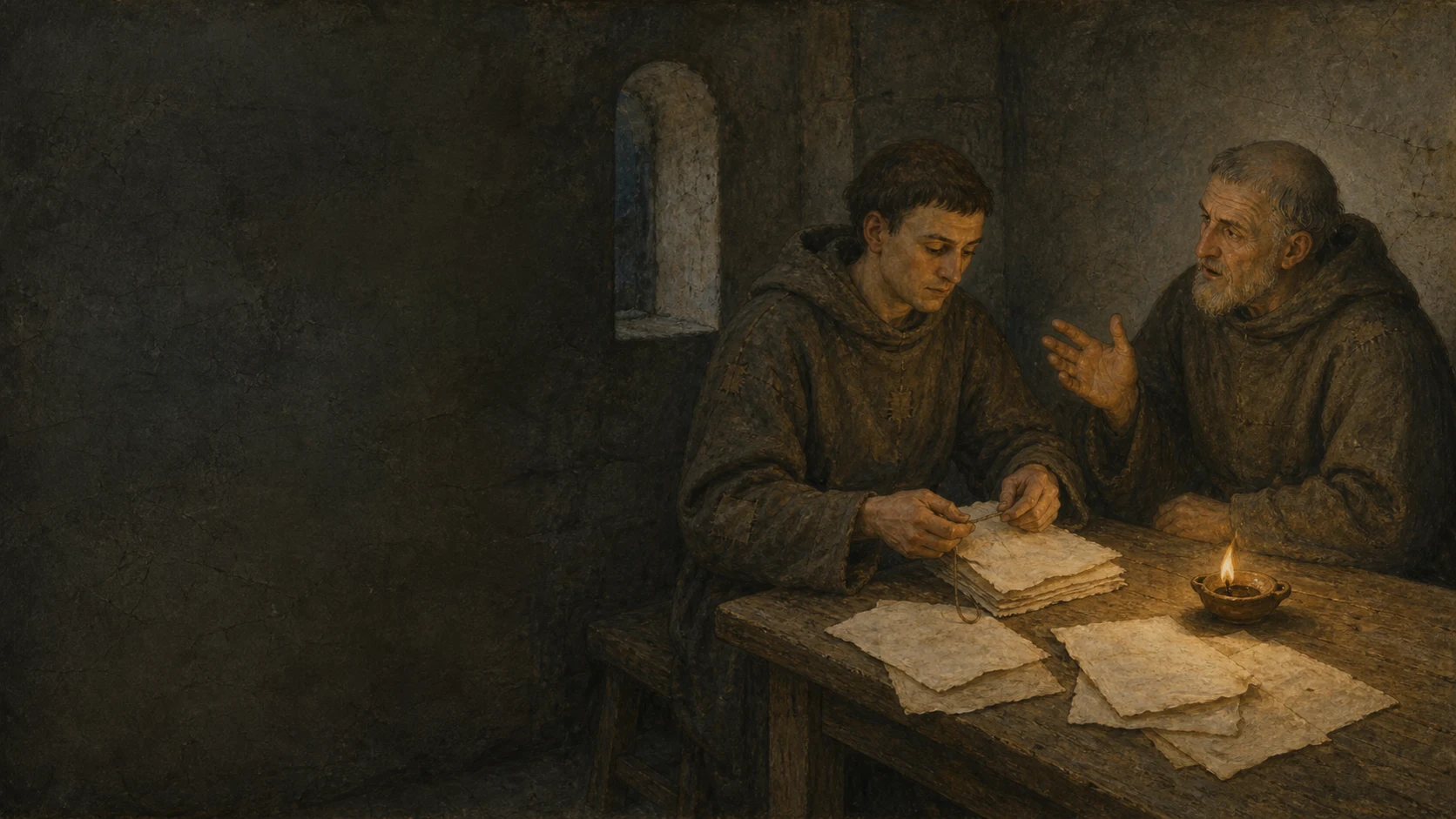
The voice beside the oil lamp
Night has already closed the friary’s windows. On the table, an oil lamp spills a small circle of light. An elderly friar speaks slowly. Perhaps he heard the story from another brother, who had heard it from someone older still. Before him, a scribe arranges parchment leaves and dips his quill into the ink.
This is how we can enter the world of the Little Flowers of Saint Francis. Not as someone opening a direct window onto 1220, but as someone listening to a story told many times over more than a hundred years. Each teller kept something, chose something and perhaps added a color.
Does this make the book useless for history? No. It makes it necessary to read with two eyes: one for the beauty and one for the distance.
What we know
Francis died in 1226. Thomas of Celano completed the First Life in 1228–1229. Other 13th-century texts preserved words and memories of the companions.
The Little Flowers, however, are later. They grew from a Latin collection called the Actus beati Francisci et sociorum eius—the Acts of Blessed Francis and His Companions. Current scholarship generally dates the composition of the Acts to approximately 1327–1341 in the March of Ancona, a region of central Italy whose Franciscan communities were deeply attached to the memory of the first brothers.
That is about a century after Francis’s death. A century is long enough for a child to become a grandmother, tell a story to a grandchild and for that grandchild to grow old as well.
Much of the Acts was later rendered in Tuscan, the language spoken by many people in the region. This anonymous version took shape in the late 14th century, probably between 1370 and 1390. It did not simply exchange each Latin word for an Italian one. The translator selected and adapted, gave the speech rhythm and brought the text closer to its listeners.
The earliest surviving manuscripts belong to the final years of that century; one copy is dated 1390 and the Mannelli Codex of Florence is dated 1396. Many copies differ. Before print, transmission could change a phrase, the order or the group of texts copied alongside the work.
Where the “flowers” came from
The name does not promise a real garden. In medieval language, a flower could be a passage selected because it was beautiful, useful or memorable. A florilegium was like a bouquet made of passages chosen from different flowerbeds.
The Little Flowers gather short episodes about Francis and his companions. Many function as exempla: brief narratives a preacher could tell to teach patience, humility, poverty or reconciliation. Instead of explaining a virtue through twenty difficult pages, the narrator showed someone before a closed door, a listening bird or a frightened town.
The fifty-three chapters of the best-known Tuscan form do not include every episode in the Acts. The Latin collection was larger. In many codices, scribes also added the Considerations on the Stigmata, the life of Brother Giles or stories about Brother Juniper. Books from different friaries were not necessarily identical.
First flower: perfect joy
One of the most famous stories places Francis and Brother Leo walking in the cold. Rain falls, the mud weighs them down and hunger bites. Francis lists extraordinary things that would not be perfect joy: working miracles, knowing every language, converting multitudes. Finally, he imagines the two of them reaching the friary only to be rejected, insulted and left outside. To endure this without hatred, united with Christ, would be perfect joy.
There is an older root. A short Latin text called On True and Perfect Joy, connected with the memory of Brother Leo and included among Francis’s writings, already contains the heart of the teaching: neither knowledge, preaching nor wonders; joy is revealed in patience when one is rejected.
In the Little Flowers, the core acquired a road, rain, conversation and a friary door. The scene became larger and easier to remember. We need not choose between “everything happened exactly this way” and “none of it is worth anything”. We can recognize an early teaching wrapped in a later narrative.
Second flower: the sermon to the birds
Francis preaching to the birds did not first appear in the Little Flowers. Thomas of Celano already tells the episode in the 1220s: near Bevagna, Francis approaches many birds, speaks to them of the Creator and blesses them. Bonaventure also includes it in his biography.
The Acts and the Little Flowers tell the scene with new cues, characters and details of the journey. The Tuscan version gives the words a spoken sweetness. The birds arrange themselves, listen and respond with movements. The early story receives a more colourful frame.
Here there is a core well documented in close sources, but we possess no recording of Francis’s words. Each biographer shaped the episode to teach that every creature should praise the Creator. The Little Flowers did not invent the sermon from nothing; they made it bloom according to the sensibility of another time.
Third flower: the wolf of Gubbio
Then the wolf appears.
In the Little Flowers, the town of Gubbio lives in terror of a fierce animal. Francis goes out to meet it, calls it brother and proposes peace: the wolf will stop attacking, and the townspeople will give it food. The animal lowers its head and offers its paw as a sign of the agreement.
This story is absent from Celano’s earliest biographies and Bonaventure’s Major Legend. It belongs to the later layer of the Acts-Fioretti. We have no 13th-century document recording a public pact with a wolf.
But the tale reveals a profound question from the 14th century, and from our own: is it possible to stop violence without destroying the enemy? In the narrative, Francis listens to the town’s fear, recognises the animal’s hunger and asks both sides to change. Its value as an example of reconciliation does not depend on treating it as municipal minutes.
The historical mystery remains: was there a real episode that was later transformed? A violent man called “the wolf”? A story created for preaching? The available sources do not choose for us.
How the stories changed
Between a voice and a manuscript lay many places where memory could change.
One brother told what he had heard. Another repeated it years later. A Latin compiler gathered episodes. A Tuscan translator sought living phrases. One scribe copied part of the collection; another added a cherished text.
This does not mean free invention. The medieval idea of fidelity, however, was not always ours. Preserving spiritual truth could seem more important than keeping every detail as in a judicial record.
There were also disputes within the Order. In the 14th century, friars debated how to obey the poverty Francis had taught. The Acts arose in a milieu close to the so-called Spirituals, advocates of a strict observance of the Rule and Testament. The book therefore highlights simple, poor and contemplative brothers who are sometimes wary of power and learning without humility.
The context does not prove that the stories are false. It explains why certain memories were selected and others forgotten.
When printing arrived, the leaves no longer depended solely on scribes. The first known printed edition appeared in Vicenza in 1476. Multiplication also fixed versions that had previously been more variable.
What a transformed memory still preserves
To read this book honestly, we can distinguish four layers:
- We know that the Acts are a 14th-century Latin compilation and that the Little Flowers are a later Tuscan selection and adaptation.
- We recognize that some episodes have cores present in earlier sources, such as perfect joy and the sermon to the birds.
- We notice changes when a scene acquires dialogues, places and gestures absent from earlier testimony.
- We accept the mystery when a famous story, such as the wolf’s, can neither be confirmed nor traced back to its origin.
A transformed memory bears witness to two eras at once. It may tell us something about Francis. It certainly tells us much about the brothers who still wanted to live close to him a hundred years later.
They remembered him finding God in poverty and overcoming violence without imitating it. That portrait does not replace historical research; it shows the moral force the memory had acquired.
The mystery that remains
The oil in the lamp is almost gone. The elderly friar finishes his story. The scribe blows gently to dry the ink and gathers the leaves. Perhaps tomorrow another brother will disagree with a word. Perhaps someone in another friary will tell the same episode differently.
We do not know which early voices arrived intact. We do not know how many details arose along the road between Assisi, the Marches and Tuscany. We do not know the name of the translator who gave the stories that simple language, capable of sounding like conversation beside a fire.
We know that the fragile leaves survived.
They are not a transparent glass window. They are stained glass: old pieces, colors added, lead joining everything and light passing through the whole. If we mistake the stained glass for the landscape, we will see wrongly. If we reject the light because the glass has color, we will lose something precious.
The Little Flowers ask for a reading mature enough to doubt and young enough to listen.
In the half-light, the quill touches the parchment once more.
Between voice and ink
Sources for this notebook
- Jacques Dalarun and collaborators — À l'origine des FiorettiAcademic presentation of the Acts. Dates the compilation probably to 1327–1337 in the Marches, about a century after Francis, and explains its direct relationship with the Little Flowers.
- Medieval Networks, University of Naples — introduction and text of the Little FlowersUniversity source for the Tuscan work. Explains the passage from the Acts into the vernacular, the selection of episodes and the texts added to the collection.
- Italian Encyclopaedia — Fioretti di san FrancescoLiterary reference. Defines the title as a medieval florilegium and describes the 53 chapters and their character as miracles and devotional examples.
- Sara Natale — study of the manuscript tradition of the Little FlowersPhilological study presented to the International Congress of Romance Linguistics and Philology. Records 98 witnesses in the census used by the author—expanded to 101 while the article was being prepared—and explains why transmission on this scale makes a critical edition difficult.
- Franciscan Intellectual Tradition — True and Perfect JoyEarly Franciscan text. Allows comparison of the short core connected with Brother Leo and the expanded narrative in the Little Flowers.
- Thomas of Celano — First LifeClose biography from 1228–1229. Preserves the sermon to the birds long before the colourful form the episode receives in the Acts-Fioretti.
- Catholic Encyclopedia — manuscripts and first printingAn older historical reference, used with caution. Records the manuscript dated 1390 and the printed edition published in Vicenza in 1476.
How to read this chapter: the opening and ending are literary reconstructions of the setting of transmission, not documented scenes. Dates and relationships between texts follow the cited studies. The examples were compared with earlier sources where they exist; the wolf of Gubbio is presented as a late tradition, without historical certainty.