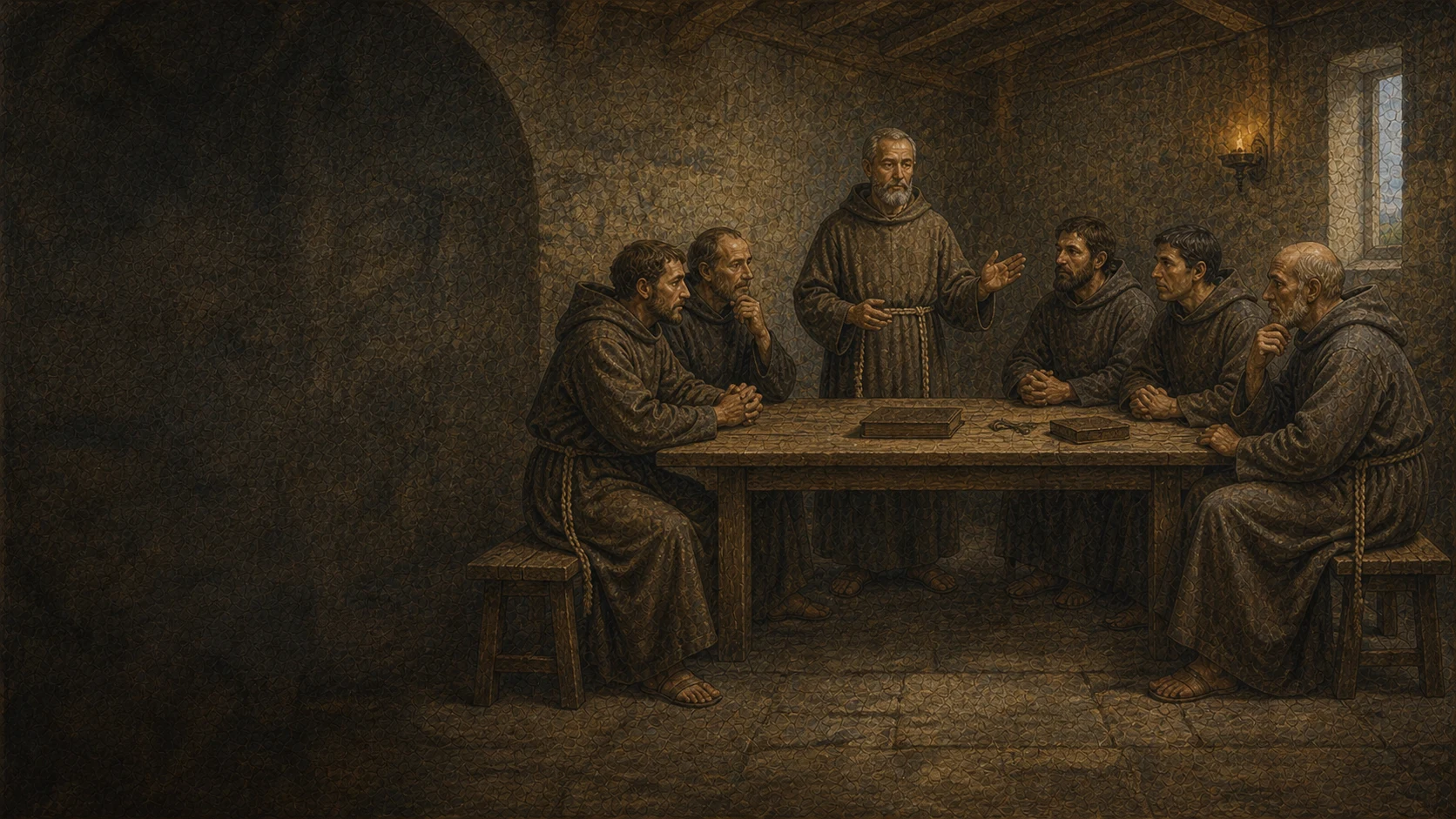
The book lies closed on the table.
Around it, the brothers speak quietly. One points to the stone wall: the roof needs repairing before the rain. Another recalls Francis’s words: the friars must not own a house, a place or anything at all. Near the door, a younger brother holds a volume needed for study. Who will pay for the parchment? To whom does that book belong?
None of them wants to abandon the Gospel. Even so, they disagree.
This is how poverty ceased to be only the luminous gesture of a man sharing his clothes. It also became a question about keys, contracts, libraries and authority. After Francis’s death, that question would cross generations. It would produce saints, lawyers, divisions and wounds.
When a few became thousands
At first, the brothers could sleep in simple shelters, work with their hands and walk along nearby roads. But the fraternity grew rapidly. Within a few years, friars lived beyond the Alps and across the sea. Some preached in towns; others served churches, traveled on missions or studied in order to teach.
A multitude needs to organize food, travel and care for the sick. A preacher needs to learn. A friar who celebrates the Church’s prayer needs a book. In the 13th century, however, a book was copied by hand, leaf by leaf, and could be very valuable.
The Rule approved by Pope Honorius III in 1223 retained the decisive phrase: the brothers were to appropriate neither house, nor place, nor anything. At the same time, it allowed clerics to have breviaries for prayer. This was not carelessness. The Rule itself set radical poverty beside the real needs of the mission.
Sources composed later recount arguments over buildings and comfort. They help us perceive the memory of the crisis, but they are not recordings of what every brother said. What we know with the greatest certainty is found in Francis’s writings and official documents.
The warning left at the end
In 1226, gravely ill and near death, Francis dictated his Testament. He recalled the earliest days, when the brothers were given to him and no one showed him what to do. He said that the Most High himself had revealed to him that he should live according to the Gospel.
Then he left specific warnings. The friars’ churches and dwellings should be poor. If a house did not accord with their promised poverty, they should not remain there. Those who could not read were not to desire learning merely to gain position. Francis also forbade the brothers to seek letters from the papal court to protect churches, places or activities.
He insisted that the Testament was not “another Rule,” but a memory and exhortation to observe the existing Rule better. He also asked that no one add explanations claiming that a passage should be understood in this way or that.
There is a quiet sadness in these lines. Francis knew that when words enter a large institution, interpreters appear. His attempt to prevent explanations would soon itself need to be explained.
The first official interpretation
Four years later, leaders of the Order presented their questions to Pope Gregory IX. He had known Francis as Cardinal Hugolino and had protected the movement. In 1230, he replied with the bull Quo elongati.
Gregory decided that the Testament did not bind the friars as a new law. His argument was legal: Francis could not impose an obligation without the ministers’ consent, just as a minister general could not make a rule binding by himself. This did not declare the Testament useless. It changed its force within the government of the Order.
The bull also offered a solution for goods and money. The friars would not be owners. Benefactors or representatives could buy necessities and administer them for their use. It was like saying, “you use the bowl, but it does not belong to you.”
This solution made it possible to feed the sick, maintain houses and continue missions without placing property directly in each friar’s hands. It also opened a dangerous door. If someone else paid for everything, how far could “use” go and still remain poor?
There were not two perfectly formed armies in 1230. There were brothers trying to remain faithful while life changed. Some feared that any accommodation would erase Francis’s insight. Others feared that a rule without administration would make caring for the fraternity impossible.
The basilica and the stone that does not answer
Soon after Francis’s death, construction began in Assisi on the great basilica intended to hold his body. Pope Gregory IX launched the project; the commune offered land; Brother Elias played an important role in the work.
The basilica is beautiful, built to welcome pilgrims and preserve a memory. To some brothers, it also seemed far removed from the huts of the Portiuncula. Stone cannot answer by itself whether it was tribute or contradiction. It may have been both in the eyes of different people.
It is easy to turn Elias into the villain of the story. That would be unjust. He administered a growing Order and a building project desired by the pope and the town. He also faced opposition and was removed from office. Narratives about him were written by groups with disputes of their own. We must read them carefully.
Owning, using, administering
Other popes refined the solution. In 1245, Innocent IV declared that certain goods given for the friars’ use would belong to the Roman Church unless the donor specified otherwise. Representatives could handle purchases and contracts.
In 1279, Nicholas III issued Exiit qui seminat. The bull praised Franciscan poverty and established a careful distinction: the Church would retain ownership; the friars would have simple use of the goods. The document sought to protect the ideal while also giving the Order a workable legal structure.
Imagine a key passed from hand to hand. The friar opens the door, sleeps in the house and looks after it, but legally someone else is the owner. To some, this defended the freedom of owning nothing. To others, it could become an elegant name for living like an owner without admitting ownership.
Books revealed the problem clearly. Study prepared good preachers and teachers. Francis did not hate knowledge; his Rule allowed liturgical books. But a library could require a building, tables, copyists and money. The book helped proclaim the Gospel and could also confer prestige. The question was not simply “good book” or “bad book.” It was: does study serve the lesser brothers, or does it begin to make them greater?
The Community and the Spirituals
By the end of the 13th century, the tension acquired names. The majority, often called the Community, accepted common government and papal interpretations. Among those known as the Spirituals, some brothers defended a much stricter observance of poverty and the Testament.
These groups were not uniform blocs. The Spirituals of Provence did not think exactly like all the Italians; the Community also contained differing opinions. Peter John Olivi, Angelo Clareno and others were connected in different ways with the search for greater rigour. Some remained obedient for a long time. Others eventually broke with the authorities.
The stricter brothers asked a necessary question: if every difficulty receives an exception, what will remain of the promise? The Community asked another necessary question: can an Order spread across the world live without common decisions, formation and stable houses?
When each side began to suspect the other’s faith, the fraternal table became a tribunal.
When the argument hurt people
Pope Clement V tried to clarify the Rule in 1312 with the bull Exivi de paradiso. The settlement did not end the crisis. Some groups refused to submit to the Order’s decisions; authorities began to treat them as disobedient or heretical.
In 1318, four Spirituals who refused to renounce their positions were handed over by the Inquisition to the civil power in Marseille and burned at the stake. We do not need to describe the violence to understand its gravity. A conversation about how to own nothing had ended with human beings deprived of life itself.
Then came another change. In 1322, John XXII refused to let the papacy continue appearing as the owner of goods used by the friars. The following year, he rejected as heretical the claim that Christ and the apostles owned nothing, either individually or in common. Part of the Franciscan leadership resisted. Minister General Michael of Cesena broke with the pope and fled Avignon in 1328.
By then, the debate was no longer only about a cell or a book. It concerned the pope’s authority, the interpretation of Jesus’s life and an Order’s right to explain its own promise.
The Rule remains on the table
Neither side fits wholly within the words “faithful” or “traitor.” The Community preserved schools, pastoral care and an international fraternity. It also ran the risk of comfort and power. The Spirituals kept the troubling question of poverty alive. Some, however, turned their interpretation into an absolute measure by which to judge everyone.
The documents do not allow us to hear every friar in the chapter room. They do let us see the choices: the Rule of 1223 and the Testament are close to Francis; the bulls show legal decisions; chronicles and later accounts bring memories shaped by the conflicts of their time.
In the stone hall, the book remains closed. Perhaps the mediator does not ask them to forget the difference. Perhaps he only reminds them why they began: not to win an argument, but to follow Jesus as lesser brothers.
Poverty without care can abandon a sick brother. Administration without vigilance can call privilege a necessity. The Franciscan path lives in this narrow passage: to use without grasping, to study without rising above others, to build without letting stone occupy the heart.
Touchstones
Sources for this story
- Testament of Saint Francis — Order of Friars MinorWritten near Francis's death, with his warnings about houses, study and letters from the curia.
- Rule of 1223 — historical translationThe text approved by Honorius III on poverty, liturgical books, work and the government of the brothers.
- Gregory IX, Quo elongati — CapDoxThe first extensive papal interpretation of the Rule and the Testament's legal force.
- Nicholas III, Exiit qui seminat — CapDoxThe 1279 document that organized the distinction between ownership and simple use.
- Papal documents on Franciscan poverty — British AcademyTranslations and texts of John XXII's constitutions in the controversy of 1322–1323.
- “Jacques Fournier and the Poverty Controversy” — Cambridge University PressAn academic study placing the dispute's different phases and its transformation under John XXII in context.
How we read the sources: Francis's writings and the bulls are contemporary documents for the decisions they describe. Scenes involving Brother Elias and other conflicts also come from later narratives marked by the Order's divisions; they have therefore not been treated as neutral transcripts.