
A name may seem merely a way of calling someone. In San Damiano’s history, names also reveal disputes about what that life should be.
Today we say Poor Clares and understand that these are religious women linked to Clare of Assisi. In the early years, however, that name did not yet organize their identity. The sources use different expressions: poor women, poor ladies, sisters, nuns, and women of San Damiano.
These words are not perfectly identical labels. Some indicate an affectionate relationship; others, a religious condition or legal classification. They also change according to who writes and when.
Asking why they were called Poor Ladies therefore means asking how different people saw them. It also means listening to how Clare wanted her community to be recognized. The answer cannot be reduced to a single origin of the name, recorded in a founding ceremony no one described.
Respected women, dependent women
Clare came from a noble family. Some companions also had ties to recognized families. This helps explain why respectful words such as lady appear in the sources. It does not allow us to imagine a community made up only of knights’ daughters.
The Portuguese word for lady can suggest precious clothes and distance from manual work. Applied to the women of San Damiano, it must lose that appearance. They sought a life of simplicity and took on tasks needed to care for the house.
They also depended on other people. Poverty meant receiving, asking for help, and living with the possibility of lacking necessities. Religious respect did not remove this material vulnerability.
The meeting of dignity and dependence is one of the name’s strengths. A woman did not cease to deserve consideration because she had no income. Clare’s decision made this claim visible, although the society around her remained deeply unequal.
Poor by choice, without representing all poor people
Clare gave up real possibilities of security. Poverty was part of her response to the Gospel and her desire to follow Christ. Her mature writings make this connection especially clear.
We must, however, distinguish chosen poverty from deprivation suffered without an alternative. A woman with noble connections, religious support, and a growing reputation did not live in exactly the same situation as someone going hungry without any protection.
This difference does not make her choice false. It simply prevents us from turning a particular religious experience into the measure of all medieval poverty. There were poorly paid workers, families affected by war, and homeless people who had taken no vow.
Clare and her sisters sought to live without owning things for themselves and without the security of large estates. In doing so, they became more exposed to need. Their religious intention had to be accompanied by practical attention to people whose destitution was not voluntary.
A family of words
Latin sources use terms that modern translations render in different ways. Women, ladies, sisters, and poor can appear in combinations that do not correspond to a permanent official name. Readers should avoid the impression that an identical sign always hung over the door.
Papal documents also classify communities. When an authority calls a group poor nuns or enclosed women, it is doing more than praising their spirituality. It is placing these women within rules, responsibilities, and systems of protection.
The word sister, in turn, can bring speaker and listener closer. Clare uses it within a network of relationships where care, obedience, and responsibility appear together. The language does not remove offices, but prevents an office from defining the whole person.
We do not know how each resident introduced herself in everyday conversation. Names preserved in official and religious writings do not provide every word used inside the house.
The importance of San Damiano
During Clare’s lifetime, the place’s name became especially important. Women linked to the experience of San Damiano could be recognized by that reference. Later, an organization bringing different houses together would also use this name.
A crucial distinction arises here: Clare’s actual community and a wider order are not automatically the same reality from the first day. Other houses had histories of their own, local ties, and different material conditions.
Researchers debate how the papacy brought together and regulated women’s communities and how Clare’s reputation became associated with this group. That history requires documents from different periods, rather than simply repeating that she founded everything alone.
A house could admire Clare without living every aspect of San Damiano’s poverty. A single institutional framework could cover different practices. The name brought communities closer, but could also hide differences that would reappear in negotiations over rules and property.
Sisters before becoming daughters of an image
In the Form of Life of 1253, the expression Poor Sisters carries particular weight. It links collective identity to the sisterhood and poverty Clare wanted to preserve. We need not treat the text as an isolated invention of every idea to recognize its intention.
The rule was built within earlier traditions, relationships, and consultations. Clare’s voice appears in this choice to guide a particular house and pass on a way of living. The document is not a poster paying tribute to the founder.
By calling one another sisters, the women affirmed a religious kinship. This kinship could welcome those of different origins. Even so, differences in literacy, function, and social position did not disappear through the power of a word.
The name set a demand. Being a sister meant responding to another’s need, sharing resources, and accepting that common life also limited individual wishes.
The danger of making poverty too beautiful
An image may show simple bowls, plain clothes, and soft light. All of this helps tell the story of a choice, but it can turn poverty into pleasant decoration. Reality involved supplies, illness, and worry about the next day.
We do not know how much food there was at every moment. Accounts of shortage and help appear mainly in testimonies and religious narratives, which interpret events through trust in God. They are not complete account books.
We should therefore avoid two shortcuts: assuming that nothing was ever lacking, or that all the women lived in constant hunger. The documents allow us to recognize insecurity and support networks without calculating the whole experience.
The words poor and sisters met their daily test in the distribution of what arrived. If one woman received something from relatives, the community had to address individual need and the common good. The name had consequences at the table.
When Clare’s name spread
After Clare’s death and canonization, her memory reached ever further. The saint’s name increasingly identified communities linked to her heritage. Urban IV’s legislation in 1263 forms part of this institutional process.
We should not use this outcome to imagine that all the women at the beginning already called themselves Poor Clares in the later sense. Nor should we conclude that a common name made the rules followed by every house identical.
Tradition preserved Clare as a reference point. At the same time, her image could bring together experiences she had not personally directed. Understanding this helps us respect both the founder and the other women, whose choices were not simple copies of hers.
Names preserve memory, but they also simplify. The reader’s task is to let them point toward a larger history without replacing that history with a familiar word.
Being recognized for the life one lives
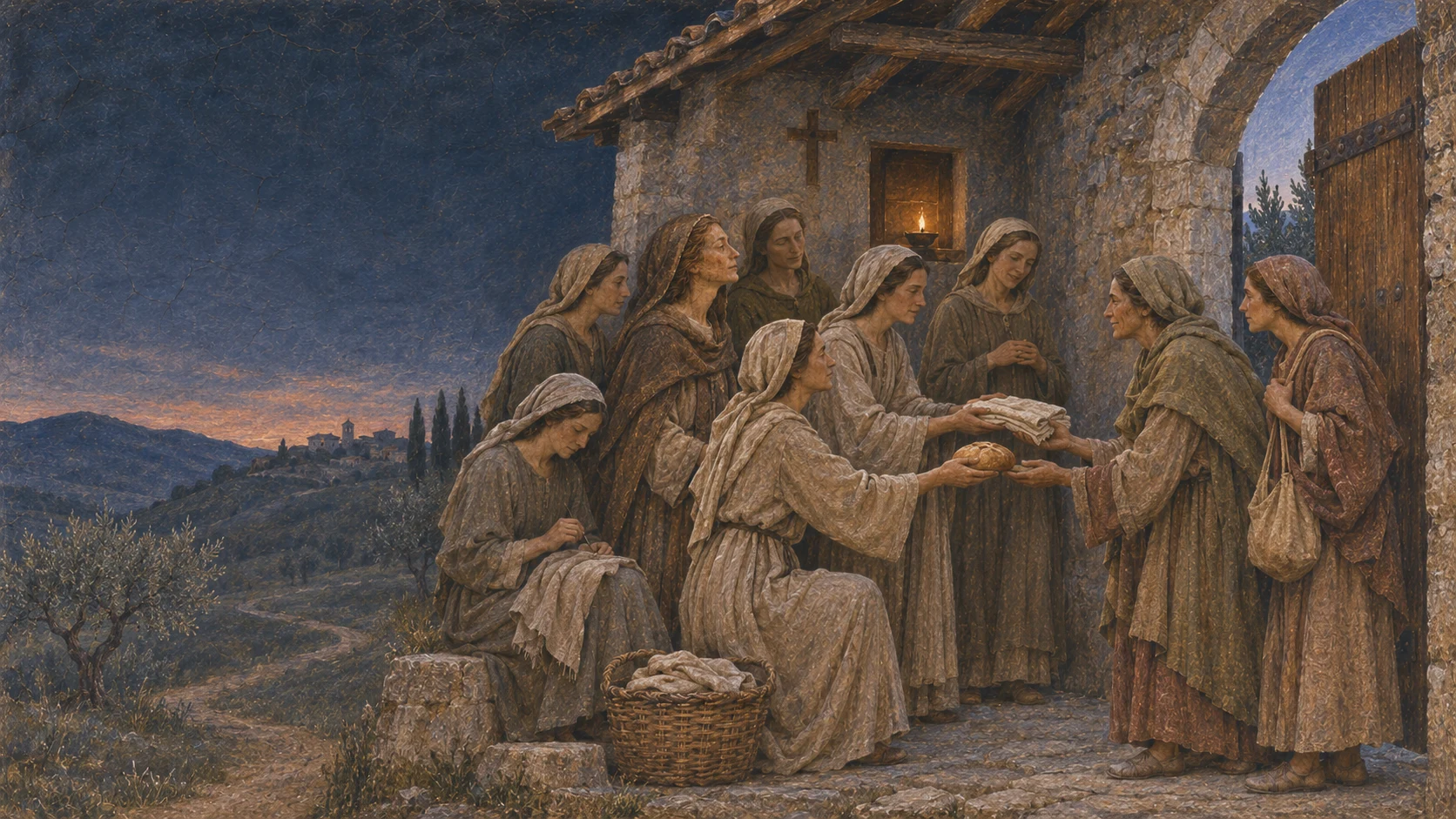
Let us return to the house. One woman works, another needs rest, another arrives with a need she finds hard to express. None of these individual scenes was recorded as a portrait of a certain day. They are possible situations in a community, useful for understanding the practical reach of its names.
Calling them ladies recalls the dignity recognized in them. Calling them poor points to a material and spiritual choice. Calling them sisters brings the relationship they had to build to the foreground.
Clare would not control every way she was remembered. She could, however, defend a form of life and ask her companions to preserve it. Her concern extended to women who would arrive later, when she could no longer explain the beginning in person.
Before there was a name known in many countries, there was a house learning to live its words. The strength of Poor Ladies remains there: in the attempt to unite respect, simplicity, and belonging without allowing one of these dimensions to erase the others.
Preserved voices
Sources for this chapter
- Clare of Assisi: The Lady — Early DocumentsCritical corpus. Collects Clare's and papal vocabulary, allowing changes in names and institutional status to be followed.
- Clare — Form of Life, chapters I, II, and VIIIRule. Presents the Poor Sisters and regulates entry, goods, and needs in the community of 1253.
- Process of CanonizationTestimony and institutional language. Preserves names, origins, and expressions used for the house and its abbess.
- Legend of Saint ClareHagiography. Interprets the growth of the poor women around Clare's holiness.
- Catherine M. Mooney — Clare of Assisi and the Thirteenth-Century ChurchAcademic research. Distinguishes Clare's community from the papal organization of women's houses; its arguments should be compared with the documents.
- Jeryldene M. Wood — Women, Art, and SpiritualityHistory and reception. Places the transition from early descriptions to the name associated with Clare, and the later diversity of houses, in context.
- Benedict XVI — audience on Saint ClareEcclesial reception. Explains the Gospel meaning of poverty; it is not a technical study of the evolution of names.
How we read this chapter: the names are documented, but vary by period and author. Later tradition established the name Poor Clares. The small scenes of common life are general reconstructions, not attributed to a particular day or specific women.