
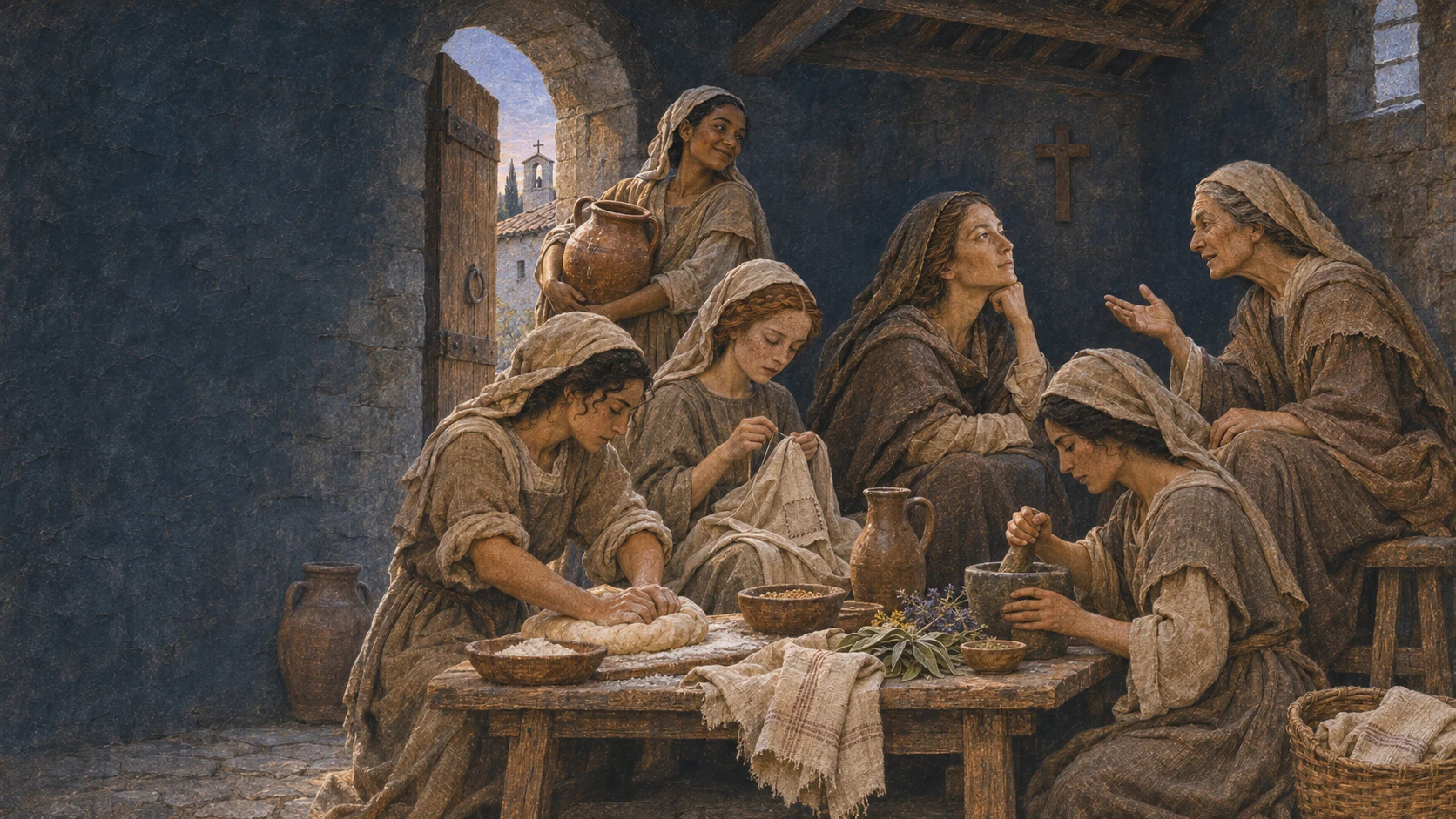
One woman says she knew Clare before San Damiano. Another remembers when she entered. A third tells how she was cared for during an illness. As we listen to them, the house begins to fill with names.
These voices have reached us mainly through the Process of Canonization, held in 1253 after Clare’s death. The investigators wanted to examine her life and the signs of holiness attributed to her. To do so, they had to hear women who had accompanied her for years.
The aim was not to tell each sister’s individual story. Even so, their statements preserved relationships, tasks, places of origin, and experiences. Thanks to them, San Damiano need not appear as one exceptional woman surrounded by faceless figures.
We have no perfect list of all the first residents, arranged by date of entry. We have a community remembered in fragments. Bringing these fragments together requires care so that we do not confuse the first companions with all the witnesses present forty years later.
Pacifica, the neighbor
Pacifica of Guelfuccio appears as the first witness. She had known Clare in the family home, was her neighbor, and had some family relationship with her. According to her testimony, the square separated their homes. She also recalled journeys made with Ortolana, Clare’s mother.
Her presence links two stages that summaries often separate: the world of the noble family and the life of the poor women. Clare did not enter a place where all earlier bonds were erased. Some relationships crossed the change of life and acquired a new meaning.
Pacifica stated that she had entered religious life with Clare and had served her closely. This makes her an especially important voice for the beginnings. It does not mean that every piece of information in her testimony is a direct observation of every event.
When investigators ask how she knew something, she often points to their life together. The value of this answer lies in its concrete closeness: days, nights, tasks, and the repetition of recognizable gestures.
Benvenuta, from Perugia
Benvenuta of Perugia also belongs to the memory of the early days. Her testimony connects their shared religious life with an earlier knowledge of Clare. The city in her name reminds us that the community did not bring together only women born within Assisi’s walls.
The Process gives information about her entry and the years she lived with Clare. These numbers help researchers build chronologies, but they need not be forced into a precision the memories do not possess.
There is also another Benvenuta among the witnesses, identified by different family ties. Repeating only the first name can mix up people and assign to one an experience belonging to another.
This care may seem small, but it is a form of respect. If we want to give the women faces again, we must allow them to remain different from one another. It is not enough to gather all accounts under the generic name of a sister who saw everything.
Philippa and the weight of shared life
Philippa, daughter of Leonardo of Gislerio, speaks of many years at San Damiano. Her testimony contains memories of humility, prayer, and service. The family names used in the record show how women were identified in a society of recognized kinship ties.
This alone does not tell us all her earlier privileges, her education, or her tasks in the community. A family name can open questions, but it cannot answer a whole biography by itself.
Philippa also matters because, in some episodes, her words resemble those of other sisters. Comparison reveals a shared memory and differences in detail. Agreements need not be treated as copies, nor differences as automatic proof of falsehood.
People who live together for decades can remember the same event in different ways. The inquiry records part of that very effort to remember, ask, and clarify.
Family within the community
Agnes of Assisi followed her sister early. Beatrice, another of Clare’s sisters, also entered religious life and testified in 1253. Ortolana, their mother, would become part of the house. Blood kinship did not disappear: it came to exist within wider religious bonds.
It is important not to turn all these arrivals into a single day. Sources and traditions offer different degrees of precision. The coming together of mother and daughters belongs to a story unfolding over time, not a photograph of the beginning.
Beatrice brings valuable family information, but acknowledges that she saw some things and heard others. This explanation prevents us from assuming she was present at all Clare’s first shelters.
There is also a risk in imagining San Damiano as a private house of the Offreduccio. Other women, with different origins and paths, helped build the community. The family group mattered without accounting for everyone’s identity.
Amata, Cecilia, Balvina, and others
Amata, Cristiana, Cecilia, Balvina, Lucia, Francesca, Agnes of Oportulo, and Angeluccia appear among the preserved names. Some descriptions vary according to the edition and the way the sequence of witnesses is presented. Names and numbers should therefore be checked together.
Cecilia is associated with Spello; Lucia with Rome; Angeluccia with Spoleto. These indications offer glimpses of a horizon wider than a single street in Assisi. They do not, however, allow us to reconstruct automatically each woman’s journeys or personal reasons for entering.
A list can create the impression that we know them all equally. We do not. Some speak at length; others leave a few lines. Certain memories are intimate, while others repeat a general assessment of Clare’s life.
It is more honest to preserve these differences than to fill them out with invented personalities. No source allows us to assign them fixed roles as shy, cheerful, brave, or strict merely to make the group easier to imagine.
The women who went out
Not all tasks took place inside the house. Early sources and the Form of Life recognize sisters who served outside the monastery. They crossed spaces from which other residents remained more distant.
These women were necessary to the community’s survival. The division of functions also raises questions about social differences within the house. Affectionate language does not prove that all medieval inequalities disappeared on crossing the threshold.
The text of 1253 calls those who serve outside sisters. This is significant. Their religious recognition should be taken seriously, as should the differences in discipline and work that the rule itself preserves.
We do not have the name of every woman who performed these services over the years. The absence of names does not allow us to erase their presence. The community we remember also depended on work the written record left at the margins.
What the oath changes
The women were heard in a procedure conducted by Church authority and recorded in writing. This distinguishes their testimonies from a story with no identifiable origin. We know who spoke, in what context, and with what general intention.
The oath, however, does not turn human memory into flawless knowledge. The witnesses wanted to honor Clare and believed in her holiness. The process asked them about virtues and miracles, not every aspect of life.
The text also reached us through a history of copying and transmission. We do not hear the medieval voice directly, as though a sound had been stored. We read words organized by a procedure and preserved in manuscripts.
These limits do not diminish the document. They show why it is so valuable: it allows us to work with identified people, compare information, and recognize what each could know.
A house made by many
When a witness describes Clare caring for someone, another woman appears too: the one who was ill, the one who brought water, the one who watched, the one who helped continue the task. The founder’s narrative carries within it the story of an entire house.
We do not need to remove Clare from the center to see her companions. We need to understand that leadership and shared life were built between people. Without the sisters, there would be no daily life to govern or community memory to pass on.
The first names do not resolve every silence. They do, however, allow us to change how we look. Instead of a luminous figure before an indistinct row, we find women who arrived at different times and learned to live together.
After Clare’s death, they opened the house’s memory to the investigators. By saying how they knew, what they had seen, and how long they had been there, they helped preserve something no wall can hold alone: the experience of a shared life.
Preserved voices
Sources for this chapter
- Clare of Assisi: The Lady — Early DocumentsCritical corpus. The translation and introductions help identify witnesses and distinguish forms of transmission.
- Process of Canonization — Pacifica, Benvenuta, and PhilippaTestimony. Main source for the earlier ties, entries, and shared life of the first companions.
- Clare — Form of Life, chapters III, V, and VIIIRule. Recognizes different needs and sisters who serve outside; it does not provide a list of the first residents.
- Legend of Saint ClareHagiography. Portrays the community's growth with a focus on the founder, requiring attention to women left in the background.
- Catherine M. Mooney — The Early San DamianoAcademic research. Examines community formation without assuming a complete institution from the beginning.
- Assisi Santa Chiara — synthesis by Ugolino NicoliniHistorical reference. Guides the relationship between documents, family, and first companions.
- Benedict XVI — audience on ClareReception. Offers a spiritual reading of common life; it does not replace the documentary identification of the sisters.
How we read this chapter: names and ties come mainly from testimonies. The Rule describes the mature community's project; the Legend interprets it as a holy life. No biographies or speeches have been invented to fill gaps left by tradition.