
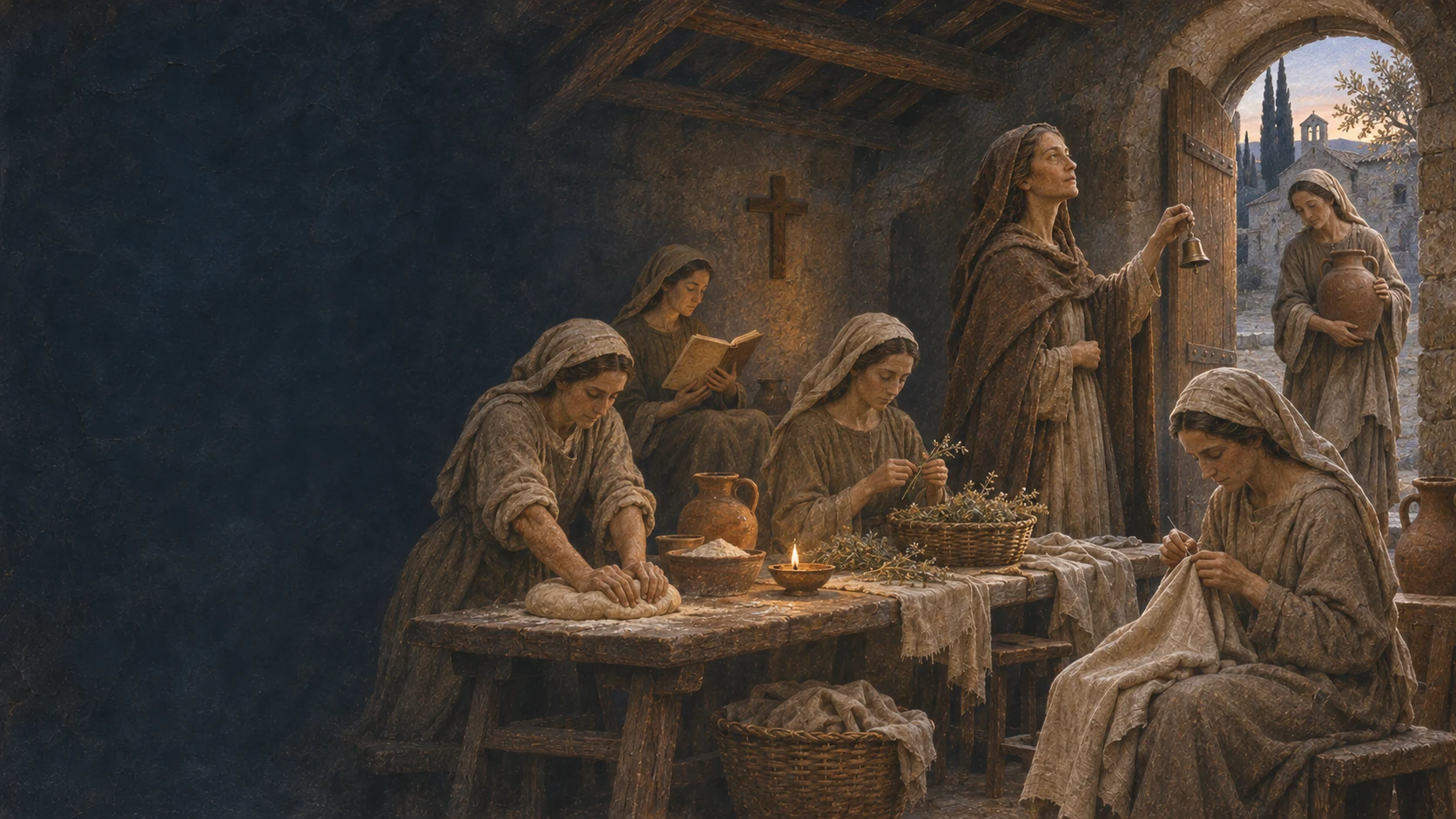
The light changes before all the tasks are finished. Inside a house of poor women, the day does not wait for each person to be ready to begin again.
This opening is a reconstruction. We have no diary of a Tuesday at San Damiano with every activity written down. We have something different: the Form of Life confirmed in 1253 and memories of those who lived with Clare. These texts allow us to recognize rhythms, duties, and exceptions.
We will explore one possible day in the mature community, without assigning invented minutes. The first year’s routine should not be confused with the organization four decades later. Nor does a written rule prove that every day passed without change.
What it shows is how the sisters sought to organize a life: praying together, working, eating, keeping silence, and caring for those in need. None of these activities existed entirely apart from the others.
The night also held prayer
For us, a day usually begins after a full night’s sleep. In the monastic tradition, prayer could interrupt rest. The night too was part of the time offered to God, with an office bringing together psalms and other prayers.
The Form of Life instructs sisters who can read to celebrate the office according to the custom of the Friars Minor. For those who cannot read, it sets a sequence of Our Fathers. This difference reveals varied abilities within the community, without allowing us to conclude that women unable to read were excluded from common prayer.
We do not know how each voice sounded or where everyone stood at each celebration. The existence of the rule is certain; the complete scene must be imagined with restraint.
The testimonies also recall Clare praying during the night. These are memories of her personal practice, not proof that all her companions followed exactly the same pattern of keeping vigil.
The morning’s silence
Between Compline and Terce, the Rule establishes silence, except for the sisters who serve outside. It also protects silence in certain places and situations. This does not mean that the whole house was forbidden to communicate any need.
The rule allows necessary things to be said briefly and quietly. In the infirmary, it makes room for measured words that help in serving and comforting the sick. Precision matters: religious silence was not permission to leave someone unable to ask for water or explain a pain.
We can imagine a task settled by a gesture and a question asked discreetly. We do not know the exact gesture of a particular woman. Reconstruction helps us understand a rule that has to work among bodies, objects, and needs.
Silence also created difficulty. Not everyone easily finds a balance between inward reflection and communication. A rule exists because life needs guidance, not because it already happens without effort.
After Terce, busy hands
Chapter VII places work after Terce. Sisters able to work should devote themselves to honest activities of common use, preserving the spirit of prayer. Work and contemplation appear connected, without either being allowed to swallow the other.
The document does not provide a complete list of tasks for each season. Testimonies mention spinning and making liturgical cloths; domestic life also required preparing, cleaning, mending, and organizing what was needed.
We should not imagine everyone doing the same sewing for the same number of hours. Age, skill, health, and responsibilities could require differences. The Rule provides for the abbess or her vicar to distribute work before the community.
This shared character has consequences. A task was not valuable only when it produced something for outside. Washing a vessel, helping a sick woman, or preparing a space also sustained everyone’s ability to remain there.
The table and what arrived
Food depended on provisions and assistance. We have no complete daily menus. Any meal pictured with specific foods should be understood as a likely reconstruction, never as a certain record of that day.
The Rule provides for fasting and exceptions. Sick women, younger and weaker sisters, and sisters serving outside receive different treatment according to the text’s provisions. Bodily need cannot be erased by a uniform image of austerity.
During meals, silence in the refectory has its own function. This also does not prove an absolute absence of sound: objects are moved, people rise, someone needs to be served. Discipline governs human conduct; it does not turn the house into a lifeless setting.
The food received linked San Damiano to people outside. Even a simple meal carried a network of work, donations, and journeys that the plate alone does not show.
Not everyone passed through the same day
A sister who went out to serve had different duties from one who stayed in the house. The rule recognizes these situations. This prevents us from treating enclosure and routine as absolutely identical experiences for everyone.
There were also women who were ill. The time of a woman with fever or weakness might be measured by the arrival of water, a change of position in bed, or the presence of someone who listened to her need. The infirmary had a rhythm within the community’s rhythm.
We need not invent a diagnosis to see this difference. The legislation itself allows straw mattresses, head supports, and other resources for those in need. Daily life was also made of adaptations.
Clare spent many years ill. A day inside San Damiano therefore cannot be told simply by following her steps along a corridor. For much of her life, other people walked to her.
Gathering to decide
At certain times, the community gathered in chapter. The Form of Life provides for a meeting at least weekly, with acknowledgment of common faults and consultation on household matters. It is not correct to insert this meeting into every imagined morning.
The gathering matters because it shows that routine also involved words and decisions. The abbess had authority, but had to consult. Important questions were not reduced to orders given in the corridor.
The document recalls that a younger sister’s advice may bring something useful. This openness does not turn the monastery into a modern political institution. Within its own period, it shows a demand for listening that does not depend only on age or office.
A house needs to distribute work and resources. It also needs to deal with mistakes, needs, and tensions. Chapter offered a regulated way of bringing some of this into common life.
The afternoon was not an empty space
The liturgical hours continued to mark the day. Between them, tasks, care, and preparations continued. We have no basis for filling every interval with an activity fixed and identical throughout the year.
A donation received might require organization. An authorized visit might alter the routine. Someone’s illness might call for more hands. The rule offered a structure for responding without individually predicting everything that would happen.
Rules about outside contact also show that the house received people and news. There were conditions for speaking and allowing entry. Religious life did not mean the complete disappearance of human relationships.
By late afternoon, the light faded over the objects being worked on. This image is our reconstruction, grounded in the material reality of a medieval house. We do not know who left a piece unfinished or what worry accompanied a sister to the next prayer.
Resting in order to continue
Compline closed one stage of the day and opened the period of silence. Night came over women who had not all lived the same experience. Some were tired from work; others from illness; others perhaps needed support they had found hard to ask for.
We do not know their individual thoughts. We know Clare’s concern for a community where needs could be expressed and met. This guidance also extended to rest and care of the body.
The possible day we have explored ends without an extraordinary scene. Continuing already demands enough: rising, praying, working, eating, listening, repairing a relationship, and allowing another person to help.
San Damiano was not sustained only by moments a biographer judged memorable. It was sustained by the repetition of these actions, with failures and fresh starts. The Rule outlines the desired rhythm; the testimonies offer glimpses of women trying to inhabit it over the years.
Preserved voices
Sources for this chapter
- Clare of Assisi: The Lady — Early DocumentsCritical corpus. Allows the mature rule to be related to memories of community practice.
- Clare — Form of Life, chapters III–VIIIRule. Basis for prayer, silence, chapter, work, fasting, and care; it prescribes conduct without recording each actual day.
- Process of Canonization — Pacifica and AngelucciaTestimony. Preserves memories of prayer, work, and life during Clare's illness.
- Legend of Saint ClareHagiography. Emphasizes practices of prayer and service; it does not provide a complete daily timetable.
- Catherine M. Mooney — The 1253 Forma VitaeAcademic research. Places the writing and approval of the rule used in this reconstruction in context.
- Assisi Santa Chiara — Chiara d’AssisiHistorical reference. Helps place the routine within the wider course of Clare's life and her community.
- Benedict XVI — audience on Saint ClareSpiritual reception. Connects prayer and Gospel life without describing a specific day.
How we read this day: this is a reconstruction of the mature community, supported by a rule and testimonies. Hagiography offers interpretations of holiness; modern traditions and timetables have not been automatically projected onto 1212 or 1253.