
Imagine a house with many women, some elderly, some sick, none earning a salary and almost none allowed to leave. Where would bread come from in winter?
For most medieval authorities, the answer seemed obvious: the house needed to own land.
Fields produced grain. Vineyards supplied wine. Olive trees gave oil. Leases brought income. A well-stocked granary offered protection against poor harvests. That is why Clare’s refusal was no small matter of devotion. It removed the economic foundation almost everyone considered necessary.
How land fed those who stayed inside
Old monasteries were more than churches and dormitories. They could be economic centers. They owned fields, mills, woods, houses and rights to harvests. Peasants cultivated plots and handed over part of the produce or paid rent.
For enclosed women’s communities, this system seemed especially important. The women could not travel freely to preach or beg for alms. Property guaranteed food without requiring their constant presence in the streets.
It also protected the future. A gift from a family could support daughters and relatives who entered the monastery. In times of famine or war, a regular income could mean the difference between surviving and scattering.
When popes and cardinals insisted on lasting assets, they were not always acting out of greed. They were thinking about responsibility.
The risk hidden within security
Clare saw another side. Those who own fields must defend them, mark their boundaries and collect what they are owed. A monastery can become the lord of poor people.
This created distance between the community and the Gospel it wanted to follow. The sisters might speak of poverty while receiving produce from families with less security than their own.
Property also brought internal differences. Noblewomen could enter with larger dowries. Rich families gained influence. The house risked reproducing the hierarchies Clare had left behind.
Her answer was “most high poverty”: not simply having no personal objects, but the community’s refusal of properties capable of producing a fixed income.
Poverty did not mean a lack of organization
It is important not to confuse chosen poverty with carelessness. Clare governed San Damiano for decades. The community needed to plan for food, clothing, repairs and care of the sick.
The Rule provides for work, alms and people responsible for tasks. The choice did not remove administration; it changed its foundation. Instead of guaranteed income, the sisters depended on whatever work was possible, on gifts and on the friars who sought help.
This life held real risks. Spiritual language did not fill a plate. That is why authorities questioned whether the proposal could last.
A harder choice for women
The Friars Minor could move around and beg for alms. They could preach, travel in pairs and change location. The sisters remained in one house.
Applying the same poverty to traveling men and enclosed women created different problems. Clare did not ignore this. Her text adapts Franciscan life to a settled community without accepting the usual solution of property.
This is one reason her story deserves to be told in its own right. She did not simply copy the friars’ Rule. She had to create a structure for women who did not have the same mobility or sacramental authority as they did.
The relatives’ view
Noble families usually provided assets when a daughter entered a monastery. A religious dowry might be smaller than the cost of an aristocratic marriage, but it was still wealth.
Refusing assets also disturbed this system. According to the Rule, a candidate should distribute her possessions to the poor, prudently and without allowing the community to absorb them as property.
This protected equality, but could frighten relatives. If the woman fell ill, who would support her? If the house went hungry, would the family be called upon again? Clare’s poverty had social consequences beyond the walls.
The field in our artwork
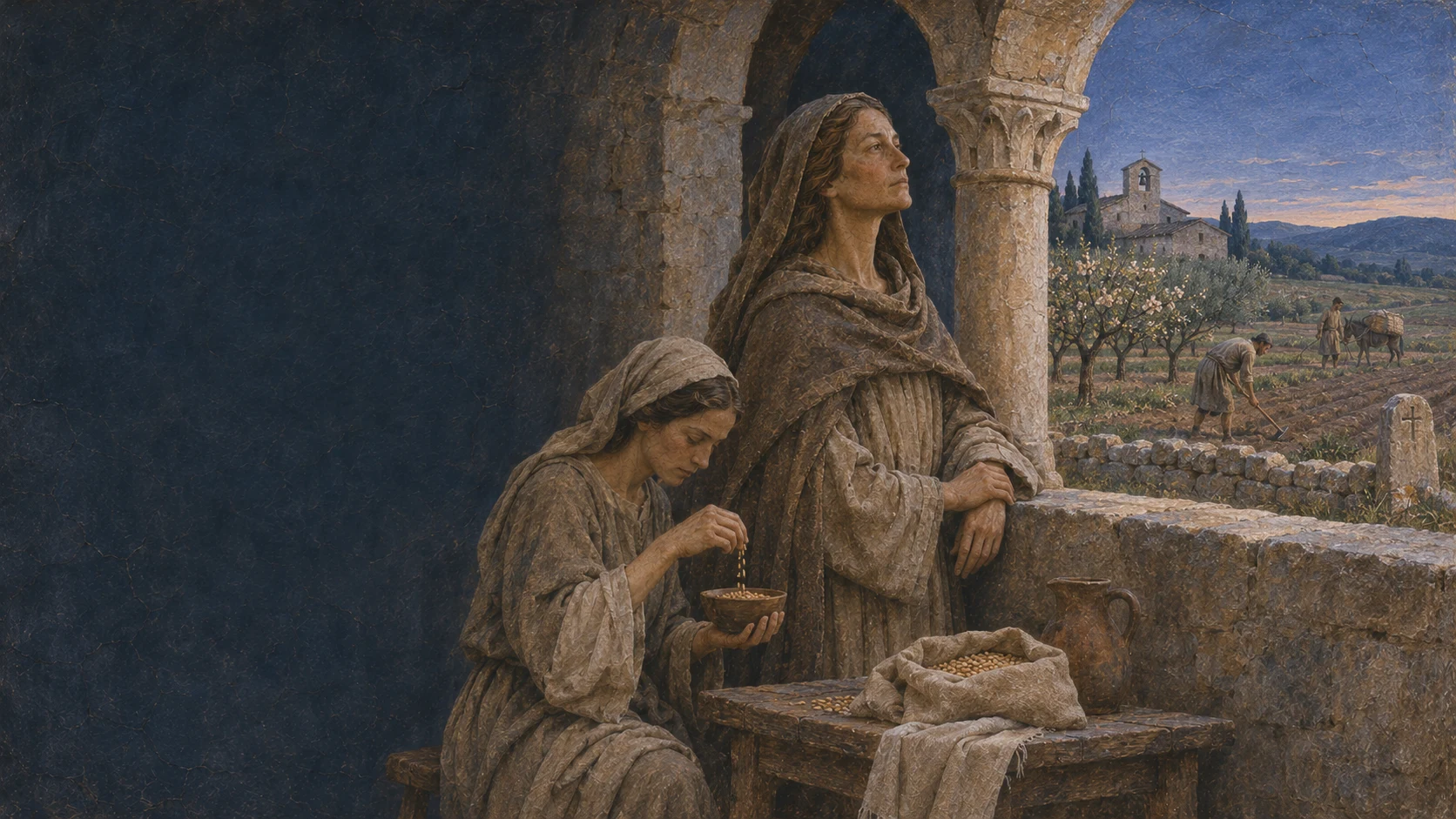
This chapter’s image shows Clare looking at land outside, while a sister measures the little grain available. No landowner is offering a document. There is no dramatic gesture of refusal.
We want to show the question before the decision. The field is beautiful, fertile and sensible. Owning it would solve problems. The radical nature of Clare’s choice only appears when the alternative is truly appealing.
The scene is an educational reconstruction. We know of no specific day when Clare gazed at that granary. We do know, however, that assets and income were central to the legal negotiations.
When protection can imprison
For Clare, property offered protection, but could bind the community to obligations incompatible with its vocation. She wanted to depend on others without dominating them.
This choice should not be used to condemn communities that owned land. Other women’s houses served the poor, educated girls and welcomed the sick thanks to their assets. The 13th century itself knew different legitimate forms of religious life.
The point is more precise: San Damiano believed it had received a particular vocation. Forcing that community to own property would remove the very thing that defined its experience.
The question that reached the pope
That is why Clare did not ask only for informal permission. She wanted a written privilege preventing anyone from forcing the sisters to accept property.
Calling poverty a “privilege” sounds strange. Usually, privileges allow people to possess something. Here, the right requested was the right not to own.
The request reveals legal intelligence. Clare did not simply place herself outside the Church. She sought protection within it for a way of life that went against conventional caution.
In the next chapter we will meet Cardinal Hugolino trying to offer unity and security to women’s communities. He was no villain. Clare was not naive. Between them stood a difficult question: how could they secure the future without losing the beginning?
Who worked the land
A monastic estate was more than a line in a document. Someone plowed, pruned, harvested, transported and handed over part of the produce. There might be tenants, dependent peasants, managers and paid workers. When a community received a field, it also received social relationships.
This helps us understand Clare. Her refusal did not mean wheat grew without work or that the monastery could live on air. The sisters still depended on other people’s labor, on alms and on the vegetable garden. But they did not want to become mistresses of a structure that guaranteed them income through land.
We have no account book from San Damiano capable of tracing every loaf. Any description of daily life is therefore an economic reconstruction based on medieval practices and the surviving rules. The firm documentary evidence is the legal insistence on not owning.
A poverty that needed neighbors
Without large estates, the community did not become independent; it made its interdependence explicit. Assisi needed to recognize these women and decide to support them. The friars needed to seek help. Families and benefactors could offer food without turning the gift into control.
This model could fail. A war, a poor harvest or a change in goodwill threatened the table. Clare did not ignore the danger: she chose to live with it because she believed that the security of property would create another danger, less visible and deeper.
The vegetable garden did not contradict poverty
Clare’s own Rule allows a little land beside the monastery, needed for seclusion and growing vegetables. This prevents an exaggerated reading. The goal was not to make land something impure, or to forbid every tool or food produced by the community.
There was a difference between using a small space to live and accumulating properties that generated income. The vegetable garden brought work and need close together; a distant estate could introduce rent collection, administration and power over the families living there.
The exact limits were not measured by a formula. How much land was “necessary”? When did a modest donation become an estate? These questions required discernment and could cause disputes. Clare’s poverty was not the absence of economic decisions. It was a demanding way to make them.
Fields and documents
Sources with commentary
- Cambridge Companion — the emergence of the Second OrderContext. Explains the particular challenges of a women’s community connected to the Franciscan movement.
- The Medieval Review — Clare and the 13th-century ChurchInstitutional history. Discusses property, papal regulation and Clare’s ability to act.
- Cambridge — a study of Saint ClareRules and documents. Summarizes the legal sequence of women’s forms of life.
- Gregory IX — Privilege of Poverty, 1228Primary document. Confirms that nobody could force the community to accept property.
- Oxford Academic — The Privilege of PovertyResearch. Reviews a specialist study of Clare, Agnes of Prague and the struggle for a rule.
- Vatican — poverty and Clare’s RuleTheological reading. Connects poverty, the incarnation and faithfulness to the Gospel.
How we read the economy: the importance of land to monasteries and the refusal of property are documented. The granary and the measuring of grain in the artwork reconstruct the material problem; they are not an episode described in the sources.