
Cardinal Hugolino was looking at a movement growing too quickly to fit simple names.
Women wanted to live in poverty, prayer and seclusion. Some drew inspiration from Francis and the Friars Minor. Others came from different penitential movements. Houses were appearing in various cities. Who would protect them? What rule would they follow? How would they survive?
Hugolino tried to build an answer. Clare lived within it — and spent decades seeking something more faithful to the beginning.
A cardinal close to Francis
Hugolino of Ostia knew Francis and became the fraternity’s protector. He was a churchman, an experienced legal expert and the future Pope Gregory IX. He understood the enthusiasm of the new movements and the risks authorities saw in them.
The 13th century saw many women seeking intense forms of religious life. Not all belonged to old orders. To Rome, communities without a structure could be vulnerable to abuse, suspicion or hunger.
Hugolino visited regions of Italy as a papal legate and worked to organize some of these houses. The form of life associated with him, composed around 1218–1219, used the Rule of Saint Benedict as its legal foundation and added strict regulations on enclosure, fasting, silence and discipline.
Why use Benedict’s Rule
The Lateran Council of 1215 had limited the creation of new religious rules. This did not mean that all new developments stopped, but it made it useful to base new communities on rules already recognized.
The Rule of Saint Benedict carried centuries of authority. It served as a foundation in Church law. Yet having Benedict as a legal foundation did not automatically make the women of San Damiano Benedictines in a simple sense.
Their actual inspiration came from the Gospel poverty they shared with Francis. Hugolino’s form offered structure, but did not fully express that bond.
Severity was not poverty
A rule can demand a great deal without demanding the same thing. Hugolino’s form was austere: strict enclosure, fasts and bodily discipline. Yet austerity is not identical to community poverty.
A house could fast strictly and still own fields. It could keep silence and receive income. For Clare, the central point was not to pile up hardships; it was to follow the poor Christ without property.
This distinction is essential. We should not imagine Clare simply asking for “a harsher rule.” In some respects, she would ease fasting for the sick and the young. What she defended most firmly was poverty.
Many houses, different stories
Hugolino sought an organization that could serve various communities. This brought advantages: recognition, papal protection and a shared identity.
But San Damiano had its own memory. Clare remembered Francis’s words and the beginnings she had lived alongside the first sisters. A general formula could erase that particular history.
Furthermore, calling all the houses a single order connected to San Damiano can project backward a unity that developed gradually. Researchers warn that the women’s movement was varied.
Clare did not break away
It would be easy to turn the relationship into a theatrical battle: a powerful cardinal against a resisting woman. The documents show something more complex.
Clare remained within the Church, welcomed Hugolino and lived within the structure he established. When he became Gregory IX, she continued to write and negotiate. He admired the community and confirmed its Privilege of Poverty in 1228.
Protection and disagreement could exist together. Clare did not need to consider Hugolino an enemy to understand that his form of life still did not say everything.
The parchment in the artwork
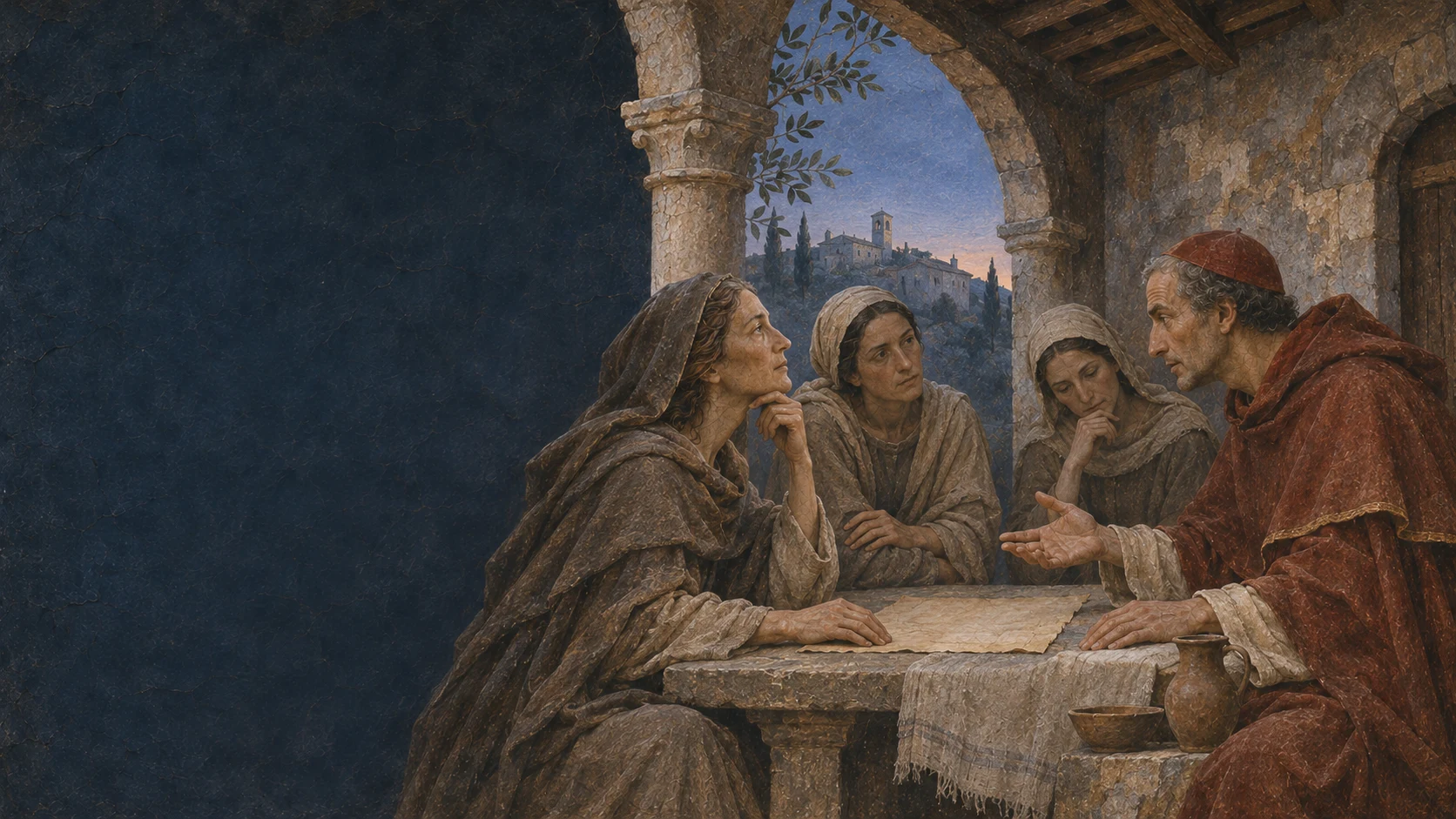
Our image presents Hugolino under San Damiano’s portico, speaking with Clare and two sisters. Between them lies a parchment without legible text.
We know of no meeting exactly like this, nor the moment when each regulation was explained. The scene is a visual reconstruction of the ongoing negotiation between experience and authority.
Clare is shown neither kneeling nor defying him with a modern gesture. She listens carefully and holds the edge of the document. Hugolino does not point like a ruler giving orders. Both are trying to meet a real responsibility, but they do not occupy equal positions.
Enclosure as a solution
For authorities, enclosure protected reputation, safety and religious focus. For families, it ensured that consecrated women did not move about without supervision. For the sisters themselves, it could create a space for prayer and community.
It also increased dependence. The less they could go out, the more they needed property or outside helpers. Strict enclosure thus made refusing property even harder.
Hugolino tried to combine enclosure and economic security. Clare accepted the first within her vocation, but fought the second when it meant owning sources of income.
A temporary text that lasted decades
Legal frameworks rarely change all at once. For years the community lived under received regulations, special privileges and Franciscan memories that did not always fit together perfectly.
This layering explains why the history of Clare’s Rule seems complicated. There was no single text handed over on the first night and kept unchanged. There were experiences, promises, recognized rules, corrections, privileges and negotiations.
Clare learned to speak this language. Her holiness did not draw her away from documents; it led her to understand that documents would shape the sisters’ lives after her death.
The value of an unresolved tension
Hugolino wanted to protect. Clare wanted to preserve. Sometimes the two intentions met; at other times they produced conflict.
Without legal protection, San Damiano might have been dissolved or abandoned. Without Clare’s resistance, it might have become a respectable religious house, but a different one from the house the sisters believed they had been called to build.
The cardinal’s form was a stage, not the end. It gave shape to a movement and forced Clare to name more precisely what she did not want to lose.
In the next chapter, we will see an almost impossible expression emerge within this debate: the “Privilege of Poverty,” a right granted so that nobody could force the sisters to own property.
The same text did not produce the same life
Hugolino sought to offer a common framework to houses that had begun in different ways. Some had wealthy founders; others were connected to preachers; others wanted closeness to the Friars Minor. Applying the same discipline to all made legal protection easier, but could erase local histories.
San Damiano received this framework without forgetting its origins. Benedict’s Rule provided recognized language; Hugolino’s constitutions ordered enclosure and religious practices; Francis’s memory preserved poverty. For years these layers lived together imperfectly.
That is why we should not imagine an instant exchange of rules, like replacing a book on a shelf. A regulation could be issued while old customs continued, exemptions were requested and new solutions were prepared. Real life walked between the texts.
Protection and standardization
Hugolino had reasons to create firm regulations. A women’s community without recognition could be taken over by local interests, lose its assets, face pressure from relatives or depend on an unreliable cleric. Enclosure and papal authority offered protection against some of these dangers.
But protecting also means defining. When Rome recognized a house, it said who would inspect it, which rule it would follow and how it would relate to the outside. A protected woman could see her room for decision shrink.
Clare worked within this ambiguity. She accepted Hugolino’s protection, cultivated a respectful relationship with him and appealed to papal authority to defend poverty. At the same time, she did not let gratitude force her to call everything the protector proposed Franciscan.
This mature position is harder than a narrative of submission or rebellion. It recognizes the good received while still preserving the right to discern.
It also explains why the solution took time. Clare did not want to lose communion to gain freedom, or lose her vocation to keep protection. She had to learn to hold both together until a more faithful text could emerge.
Rule and experience
Sources with commentary
- Cambridge — a study of Saint ClareHistory of the rules. Summarizes the texts of Hugolino, Gregory IX and Innocent IV.
- The Medieval Review — Clare and the 13th-century ChurchAcademic debate. Examines how the form of life was built by various participants.
- Fictive Orders and Feminine Religious IdentitiesInstitutional context. Places Benedict’s Rule and the form composed by Hugolino in context.
- Cambridge Companion — Francis, Clare and the Second OrderA varied movement. Avoids projecting a uniform order onto the early years.
- Epistolae — Clare of AssisiDocumentary network. Brings together communications from Hugolino, popes, Francis and Clare.
- Vatican — Saint Clare of AssisiOverview. Highlights determination, connection to the Church and defense of the Franciscan way of life.
How we read Hugolino: his activities and the form of life are documented. The painted conversation is a reconstruction. We avoid reducing him to an opponent, since protection, regulation and conflict coexisted.