
San Damiano’s wall did not separate two complete worlds. Every day, something had to cross it.
Bread came from outside. News came from outside. A priest had to enter to celebrate worship. Brothers begged for alms and carried messages. The women lived in seclusion, but they were not an island.
The relationship between the sisters and the Friars Minor was one of the most delicate questions in Clare’s history. There was affection and a promise. There was also fear, distance and disagreement over responsibilities.
A house that needed to eat
The Poor Ladies did not manage large fields or receive a steady income. That choice was central to Clare. Yet flour, oil, firewood and cloth were still necessary.
Some sisters could work inside the monastery. The Rule mentions work performed faithfully and for the common good. But enclosure and social rules restricted women’s movements. Begging for alms along the roads was not simple for them.
Friars connected with the community helped obtain food and maintain contact with the outside. The image of an entirely self-sufficient poverty would be false. San Damiano lived thanks to a network of donors, workers, clergy and brothers.
Voluntary poverty never removed dependence; it made it visible.
The care Francis promised
In her Testament, Clare recalls Francis’s care for the sisters. Her Rule preserves a short Form of Life and a last wish attributed to him. These words connected the women’s vocation to the Franciscan beginnings.
For Clare, Francis’s memory was not decoration. It served as a guarantee: the friars should neither abandon the sisters nor turn their poverty into a monastic model based on property.
But Francis died in 1226. The male fraternity grew throughout Europe, taking on studies, missions and pastoral responsibilities. Ministers could fear that caring for numerous women’s monasteries would require too many people and resources.
A promise made within the small world of Assisi had to survive within an international Order.
Who could enter
Medieval enclosure did not work like a door that was simply locked. There were rules about who entered, for what reason and with whose permission.
Priests needed to celebrate worship and attend to spiritual needs. Workers could carry out repairs. People carried the sick or the dead. Visitors appointed to inspect the community examined its life. Clare’s Rule sets limits, but recognizes these necessary entries.
It also provides for brothers associated with the monastery: some to seek alms, another as chaplain. These connections did not turn San Damiano into a community governed daily by men. Clare and the sisters had their own internal structure. Their sacramental and material life, however, involved ministers from outside.
Dependence can become control
Whoever controls food or access to the sacraments holds power, even without intending to use it. Clare knew that the relationship needed a lasting framework.
Papal documents tried to organize the friars’ assistance to women’s communities. Throughout the 13th century, those responsible for the Order of Friars Minor debated how far that obligation went. The question was not simply one of personal friendship.
If the friars withdrew, the sisters would be vulnerable. If they assumed excessive authority, the community would lose autonomy. Between abandonment and control lay a narrow space for mutual care.
It is important not to tell this story as a simple struggle between “free women” and “oppressive men.” Some friars supported Clare faithfully; some institutional decisions reduced real risks. The conflict took place within a network of goodwill, limits, fear and unequal power.
Messengers between Assisi and Prague
Clare’s letters to Agnes of Prague show the importance of the friars as travelers. In the 13th century, a letter crossed mountains in someone’s hands. In the Fourth Letter, Clare mentions brothers entrusted with carrying it.
These messengers carried more than parchment. They brought news, legal questions, guidance and friendship. Clare’s enclosure did not prevent her from taking part in a European network; it simply made that presence depend on human journeys.
The same system could fail. Clare explains that she had not written often because of a lack of messengers and the dangers of the roads. Silence between two women did not mean a lack of affection. It could mean snow, war, illness or nobody available to carry the sheet.
The liturgy behind the wall
The sisters prayed the hours, heard the Word and participated in sacramental life according to what was possible at the time. They did not celebrate Mass themselves, since priestly ordination was reserved for men.
This made the chaplain essential. At the same time, Clare did not want San Damiano’s spiritual life reduced to the presence of a priest. The sisters had their own prayer, fasts, community chapters, work and ways of caring.
The community was female; access to certain services and decisions under Church law was not.
The painted encounter
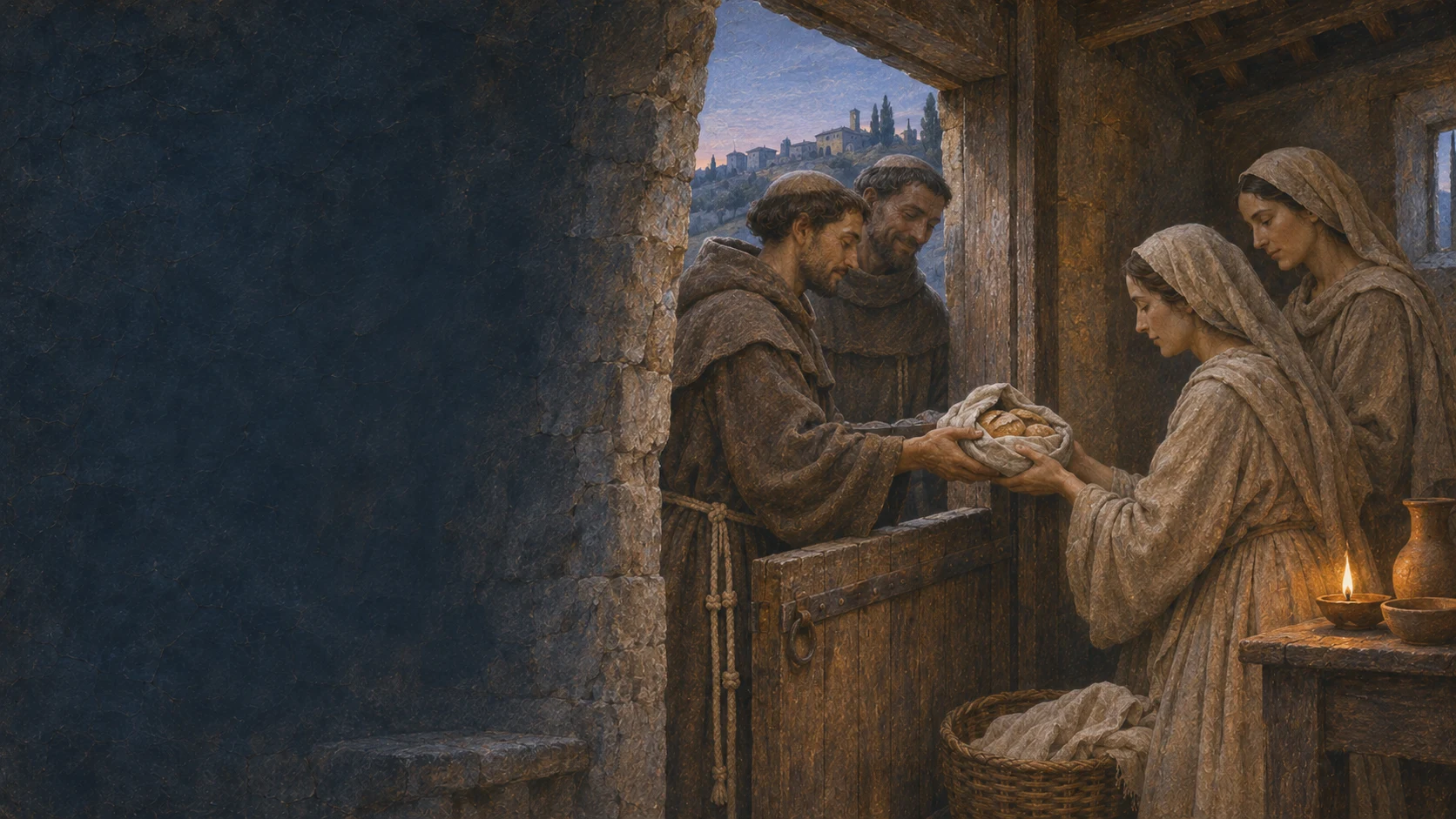
Our artwork shows two sisters receiving bread from two friars at the outer door. No one dominates the center. There is a respectful distance, and the baskets remain visible.
We know of no specific dawn like this. The scene brings together documented practices: brothers serving outside, the search for alms, enclosure and material need. It is a historical reconstruction, not a miracle or an individual episode.
We avoided putting Clare into every exchange. A community does not survive solely through the actions of its most famous figure. Unnamed sisters and little-remembered friars kept daily life going.
A wall full of passages
San Damiano teaches us that seclusion never meant the absence of relationships. The wall protected, focused and limited. The door negotiated life with the outside.
Clare wanted a poverty that depended on God, but that trust took concrete form in people. Someone grew the wheat. Someone delivered the bread. Someone walked with the letter. Someone cared for the road.
Recognizing this network does not diminish the sisters’ courage. It shows that their choice was not a fantasy of isolation. They built a way of life in which giving and receiving had to remain free from ownership and domination.
Between brothers outside and sisters inside, San Damiano’s door remained a question: how can we care without possessing another person?
A dependence made up of names
The words “friars” and “sisters” can hide actual people. The brothers who served walked to markets, friendly households and churches; they knew the roads and their dangers. The sisters who kept the door heard voices without always seeing faces. Chaplains crossed boundaries that other men could not cross. Each role required trust.
Clare’s Rule tries to prevent that trust from depending solely on personal friendship. By asking the minister general for chaplains and lay brothers, she seeks to give institutional continuity to the care Francis promised. A friend can die or be transferred; a written commitment can cross generations.
Even so, no text removed the unequal power. Whoever brings food can impose conditions. Whoever controls the sacraments can silence others. That is why the history of this relationship must hold on to both truths: the friars made much of San Damiano’s life possible, and that need also left the women exposed to decisions from outside.
The door as a place of discernment
The doorkeeper was not simply a guard. She needed to recognize needs, receive messages and protect seclusion without treating every visitor as a threat. News about a sick sister, bread offered by a neighbor and an order from an authority arrived through the same opening, but did not carry the same weight.
The rules about doors and the parlor show that enclosure never meant an absence of the world. It meant managing encounters. Each passage needed to answer two questions: does this serve the community’s life? Does it respect the sisters’ freedom and safety?
We have no diary from a doorkeeper at San Damiano. Her routine is reconstructed from the Rule and monastic practices. The document does, however, confirm that a sister held this office and that her maturity mattered. Even a stone boundary needed human intelligence.
Crossing the doorway
Sources with commentary
- Poor Clares of Stary Sącz — Clare’s writingsPrimary texts. Brings together the Rule, Testament, Blessing and letters, essential for understanding relations with the friars.
- Epistolae — Clare’s correspondenceDocumentary network. Organizes letters by Clare, popes, Francis and others connected with the community.
- Fourth Letter to Agnes of PragueMessengers. Names brothers carrying the letter and explains the difficulty of communication.
- Cambridge Companion — Clare and the Second OrderInstitutional history. Analyzes the relationship between women, friars and Church structures.
- The Medieval Review — Clare and the 13th-century ChurchResearch. Summarizes the community’s complex legal formation and the disputed responsibilities.
- Vatican — 750 years since Clare’s deathChurch interpretation. Highlights unity, poverty and community life in her writings.
How we read this relationship: regulations concerning chaplains, brothers serving outside, messengers and enclosure come from texts and documents. The delivery of bread in the artwork is a visual synthesis of recurring practices, not a dated event.