
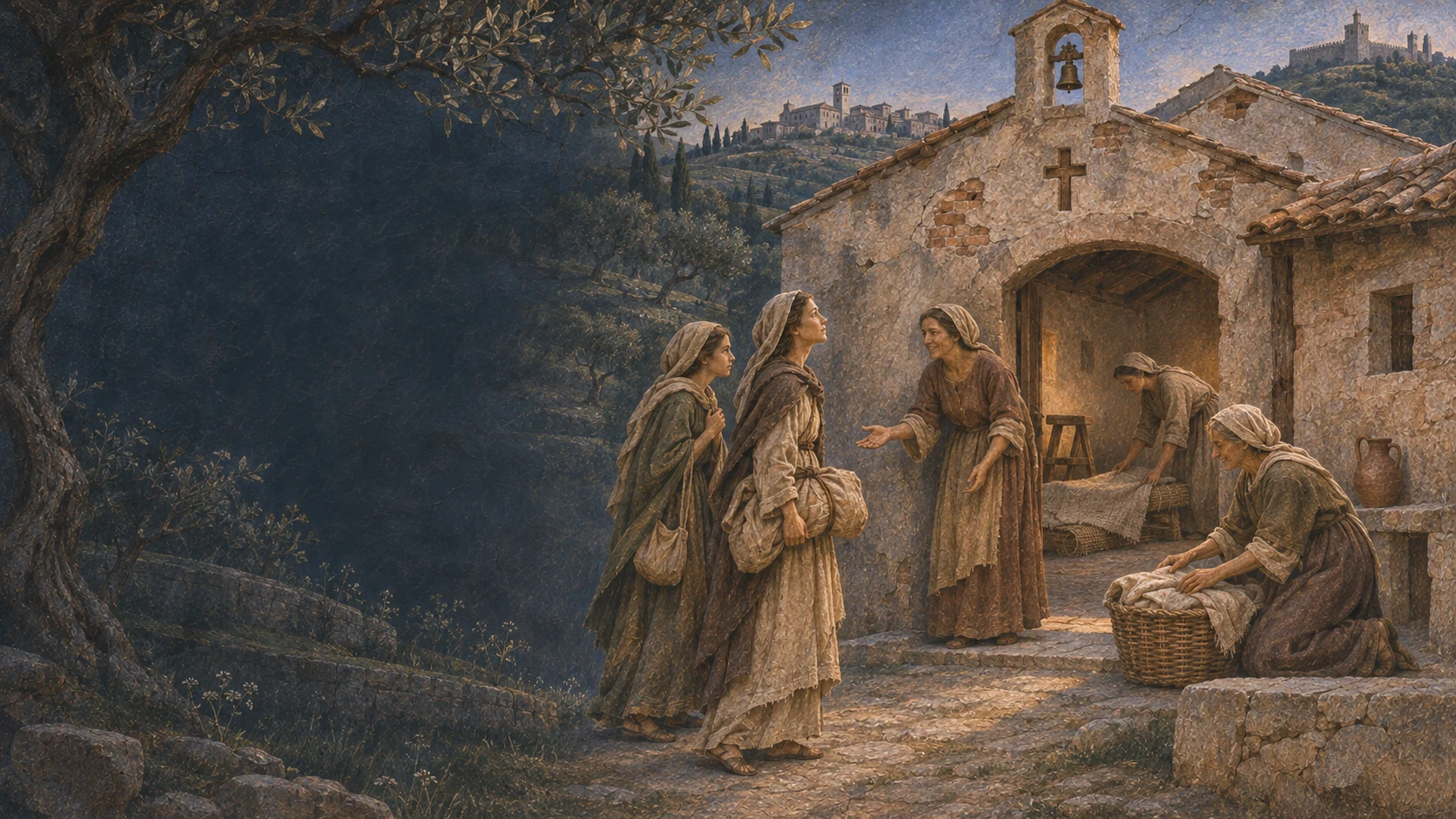
After two stays as a guest, Clare reached the place she would not leave to make another foundation.
San Damiano stood outside Assisi’s walls, below the city. It was a small church associated with the beginning of Francis’s path: he had repaired it before the women’s arrival. For Clare and her companions, however, it would become more than a place connected with his memory. It would become the center of a history of their own.
The move often fits into one sentence: Francis placed Clare at San Damiano. The life that began there does not. Shelter had to become a home, resources had to be shared, and the women had to learn to remain together. The religious space existed; the community still had to grow within it.
We do not know the first morning in detail. We can imagine women exploring a room and looking for somewhere to keep their few belongings, but that would be reconstruction. The sources preserve the place and the commitment, not an inventory of the day they arrived.
A church older than the sisters’ arrival
Before Clare, San Damiano already had a religious history. Franciscan tradition links the place to Francis’s prayer before the crucifix and his work rebuilding the church. These episodes belong to the sources about Francis and must be recognized as such.
In the Testament handed down under Clare’s name, the repairs are recalled alongside the announcement that women would live there whose lives would glorify God. This is a memory of foundation that looks back at the beginning from an already mature community.
Reading this text requires attention. Scholars debate its transmission and authorship to varying degrees. Even when accepted as testimony from Clare, it is not equivalent to a record written while Francis worked on the stones.
The place thus acquired accumulated meanings: a repaired church, a remembered promise, a house of poor women. Clare’s story does not erase the earlier one, but neither is it entirely contained within it.
Staying had consequences
A settled community had to face questions that travelers could answer differently. Who would provide food? How could cloth be obtained? Who would fetch what was needed outside the house? How could prayer be maintained when a sister fell ill?
We have no complete answers for the first year. We later have rules and testimonies showing the importance of these needs. Using them carefully allows us to recognize lasting problems without pretending the final solution was ready at the beginning.
The women would not simply be friars living within walls. Being women, expectations of protection, and Church rules made their path different. At the same time, they sought to share the commitment to poverty that linked them to Francis.
This combination produced tension and creativity. Stability did not remove material uncertainty. Enclosure, whose form developed over time, did not cut off every relationship with the city and the friars either.
What Clare would remember
In chapter VI of the Form of Life of 1253, Clare recalls the beginnings and Francis’s promise of care. According to this text, her community had embraced poverty, work, hardship, and contempt without turning back from its choice.
Here we hear a voice closer to Clare herself than in a later biographer’s narrative. Even so, it is a memory written at the end of her life, within a rule intended to protect the future. She selects the past to explain the commitment she wants to pass on.
There is no necessary contradiction between memory and intention. A person can remember sincerely and choose what to tell. Readers need to see that the document answers an important question: what beginning should the sisters recognize as their own?
The answer emphasizes faithfulness and care. The house had not begun simply because someone gave them walls. It began because women accepted a demanding choice and tried to sustain it together.
A house does not begin complete
Today, the word monastery may suggest a complete institution: a defined rule, fixed schedules, offices, and organized buildings. Applied to early San Damiano, that image can mislead. The passage from a small experience of religious women to a more regulated monastic structure happened in stages.
Historical research debates when certain rules became binding on the sisters and how their relationship with the authorities changed. Not every document has reached us, and scholars do not interpret them all in the same way.
It is therefore better to follow the growth than to anticipate the result. A community was emerging beside the church. Later would come forms of government, institutional protection, and disputes over property. The approval of the Rule in 1253 would be a late achievement, not the opening formality of an unchanging plan.
Clare stayed in the same place while the house’s legal status changed. Continuity of walls did not mean that history stood still.
Women who made the place work
A church can be repaired with stones. A home requires repeated gestures: preparing food, washing vessels, caring for clothes, cleaning spaces, and attending to those who need help. We do not know the first group’s schedule of tasks, but we know that no community survives on intentions alone.
The testimonies of 1253 show Clare involved in humble services and attentive to the sick. These are memories from different periods, not proven descriptions of the first week. They reveal, however, the value everyday work acquired in the sisters’ memory.
There were also women who served outside the monastery. Their presence, recognized in the mature legislation, prevents us from imagining a house without contact with streets and roads. Other people brought alms, news, guidance, and religious assistance.
San Damiano had boundaries, but it depended on relationships that crossed them. Chosen poverty made this dependence visible rather than allowing it to hide behind substantial income of its own.
Near Assisi, beyond its walls
Being outside the city did not mean being outside its life. Assisi remained close: families, authorities, churches, and material needs formed part of the women’s horizon. Some sisters came from there; others would arrive from different places.
We can imagine the city seen from the slope without attributing to Clare a particular moment of reflection at a certain window. Today’s landscape helps readers understand the places’ relative positions. It does not automatically preserve medieval vegetation and paths.
This closeness allows us to think of San Damiano as a house rooted in a place. It was not an abstract setting where women without origins prayed outside time. Living there meant facing cold, supplies, news, and dangers in the territory of Assisi.
The choice to stay did not erase the world. It created another way of responding to it through prayer, work, and the ties the community could maintain.
Poverty needs people
It is easy to admire the absence of wealth and forget who makes that choice possible. Someone needed to bring food or help obtain it. Someone needed to accept that a community did not offer the usual economic security of monasteries with land.
Later conflicts over property show how serious the problem was. Authorities might consider a steady income the best protection for the women. Clare would insist on defending a particular form of poverty. We need not anticipate all these negotiations here to see their practical roots.
Early San Damiano should not be painted as always cheerful destitution or as a comfortable institution disguised in simplicity. The documentation is uneven. It allows us to recognize commitment, difficulties, and support without calculating precisely everything on the table.
A poor house especially needed trust among its residents. Sharing little required learning to express needs and listen to different needs.
The place becomes theirs
As new women arrived, San Damiano had to become more than Clare’s address. Each sister brought a history, abilities, and limits. Common life grew when these differences found a place, even without disappearing.
Religious sources speak of unity. We need not translate that as an absence of tiredness or disagreement. The mature Rule provides for correction, consultation, and forgiveness precisely because a community is made of real people.
Clare would pass there from youth to illness and old age. The place would witness work, letters, visits, and decisions. Her stay was not a wait for a greater life at another address. It was the patient building of that life.
San Damiano became home because women kept choosing one another in everyday life. The beginning offered no guarantee of forty years. It offered a possible place and a commitment that, to last, needed hands, a voice, food, and care.
Preserved voices
Sources for this chapter
- Clare of Assisi: The Lady — Early DocumentsCritical corpus. Collects Clare's writings, institutional documents, and foundation accounts that need to be compared.
- Clare — Form of Life, chapter VIRule and memory. Preserves recollections of the beginnings and the Franciscan promise, included in the legislation of 1253.
- Testament handed down under Clare's nameWriting with a debated transmission. Links San Damiano to Francis's repairs and the memory of the women's vocation; it is not a contemporary record of the building work.
- Process of Canonization — Pacifica and BeatriceTestimony. Provides information about the arrival and community life, with memories from various periods.
- Legend of Saint ClareHagiography. Presents San Damiano as a place of spiritual fulfillment; its narrative unity does not remove the historical stages.
- Catherine M. Mooney — The House of Penitents Becomes a MonasteryAcademic research. Discusses institutional change and the risks of anticipating later structures.
- Jeryldene M. Wood — Women, Art, and SpiritualityAcademic context. Places the settlement at San Damiano and the later history of women's communities in context.
How we read this episode: the residence is documented. The foundation's memory has distinct forms in rules and hagiography. Rooms, first tasks, and arrival scenes have no complete description; they are presented only as possibilities for reconstruction.