
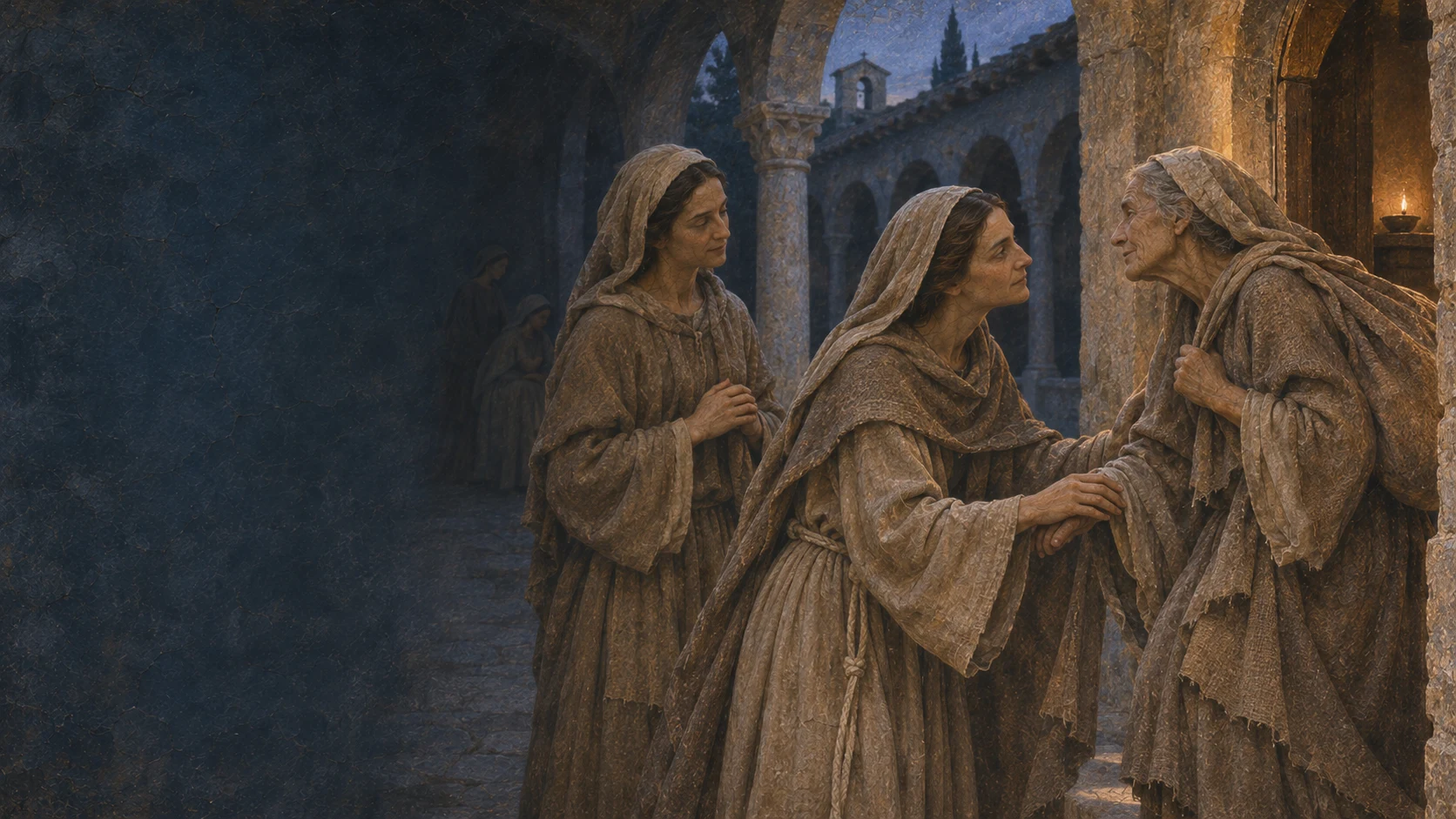
One day, many years after that nighttime escape, Clare’s mother also passed through the entrance to San Damiano.
Ortolana already knew the way. Outside, the road led down from Assisi among olive trees and stone. Inside lived two of her daughters: Clare and Catherine, now called Agnes. The woman who may have feared losing them entered to stay.
The early sources state that Ortolana ended her life in the community. They do not give the day or month, or say how she was welcomed. They did not preserve the conversation between mother and daughter. The silence of the documents makes us tread carefully — but it also allows us to sense the human importance of that step.
The woman who came before
Almost everything we know about Ortolana comes through texts written after the events. The early Legend of Clare and the Canonization Process present a devout, generous woman connected with pilgrimages. Accounts say that she visited distant holy places, including Rome and the shrine of Saint Michael on Mount Gargano; tradition also links her to a journey to the Holy Land.
These reports belong to the family’s religious memory. Going on pilgrimage in the 13th century required money, protection, months of travel and a willingness to face danger. A noblewoman could travel with companions, but it was no pleasure trip. If the accounts preserve a core of truth, Clare grew up hearing stories of roads, churches, seas and hospitality.
We should not turn Ortolana into a modern character who planned her daughter’s vocation. The Process does not record that she helped Clare escape. Nor do we know how she reacted that night. The early narrative focuses the conflict on the men of the family, especially the relatives who tried to bring back Clare and, later, Agnes.
The silence about the mother could mean many things. Perhaps Ortolana felt torn. Perhaps she understood more than she could say. Perhaps she feared for her daughters’ safety. Historical honesty means not choosing an answer just because it is beautiful.
The house that grew empty
When Clare left her family, she left more than walls behind. A noble household was a network: relatives, servants, alliances, property and marriage expectations. Her departure affected many people’s honor and plans.
Soon afterward, Catherine followed her sister. Tradition describes the violence of the attempt to make her return. Beatrice, another sister, would also enter San Damiano. Ortolana thus watched the map of her family change. Her daughters did not disappear, but they began living within another form of kinship.
In the monastery, they called one another sisters. The word did not erase blood ties; it placed them within a larger community. Clare was Agnes’s and Beatrice’s sister, but she was also a sister to, and responsible for, women from other families.
When Ortolana arrived, she found her daughters within relationships that no longer depended on her alone.
When a mother becomes a sister
It is easy to imagine the scene as a reunion without conflict. The source, however, gives us no such certainty. Living together after so many years required a delicate change.
Clare was the abbess. Ortolana was her mother. Within the family, the mother held precedence; within the community, Clare had responsibility for governing. How did they balance those positions? We do not know. What we can say is that San Damiano’s way of life sought to prevent privileges based on background.
A noblewoman should not receive better food because she had been born rich. The abbess’s mother could not take center stage simply because of their relationship. The language of fraternity — or, here, sisterhood — called for an equality that was hard to practice.
Ortolana’s arrival did not turn Clare back into a child. Nor did it stop her from being a daughter. Both identities remained.
A later choice is no lesser choice
Saints’ biographies often admire decisions made in youth. Clare was about eighteen when she left home. Ortolana arrived at a different stage, probably after her husband’s death and when family responsibilities had changed.
Choosing later in life requires another kind of courage. A widow could keep her position, her home and a degree of authority within the household. Entering San Damiano meant accepting material poverty, limited space and obedience to a community’s way of life.
We do not know whether Ortolana observed the same fasts or which tasks she performed. The sources offer no diary. We must resist the urge to fill every gap. Her documented presence is enough to show that the movement Clare began reached the generation before her.
What the sisters remembered
The Canonization Process opened shortly after Clare’s death. Women who had lived at San Damiano answered questions under oath about her life and reputation for holiness. Some were relatives; others had known her for decades.
These statements are an extraordinary source, but not a neutral one. The questions sought signs of holiness: prayer, poverty, miracles, virtues. The sisters were not recording an open conversation about any subject they wished. Even so, their names and memories let rare details of household life come through.
It is within this world of testimony that Clare’s family appears. Ortolana left no known writing of her own. Her voice reaches us reflected through other women.
The courtyard in our artwork
The artwork for this chapter shows Ortolana at the entrance to San Damiano. Clare holds out her hands, but does not sit on a throne. Sisters work in the background, and a simple basket rests near the wall.
This arrival is a visual reconstruction. We do not know the season, the clothing or the number of people present. We chose a quiet meeting because the main fact comes from early sources: Ortolana joined the community.
We also avoided painting her as a lady bringing trunks. Moving to San Damiano was not a move to a comfortable new residence. It meant leaving behind the signs of social position.
A family transformed, not erased
Clare did not have to hate her family to choose another path. Her life shows something more complex: bonds can pass through conflict, distance and, later, renewed closeness.
Ortolana did not regain her daughter by taking her home. She drew closer by entering the world Clare had helped build. The mother did not overturn the young woman’s decision; she allowed that decision to question her own life as well.
At San Damiano, noble ancestry lost importance at a poor table. Yet the family did not disappear. Mother and daughters prayed, fell ill and grew older in the same space. The stone house became a place where blood ties and vocation could live together without being the same thing.
Perhaps this is the tender insight held in this chapter: Clare left to be free, and years later her freedom opened a door through which her mother could also pass.
Ortolana’s time
When Ortolana arrived, Clare was no longer the young woman who had fled home. She had governed San Damiano for years, and her way of life was known far beyond Assisi. Her mother therefore entered a community shaped by her daughter. The family order was gently reversed: the woman who had once fed and guided her would now receive from Clare a rule, a timetable and an abbess.
Nothing suggests that this reversal humiliated Ortolana. The sisters’ testimony presents her as a religious woman with her own history of pilgrimage and charity. She did not come only because she was a saint’s mother; she brought earlier choices of her own and became a sister among sisters.
Her arrival reminds us that in a religious house, kinship did not disappear: it was taught a new way of being. Mother and daughters learned to welcome one another without ownership, with the same respect offered to every sister. We do not know what private conversations they had. The perfect peace that tradition might imagine cannot be proved. What the source allows us to see is a family transformed by adult decisions, rather than dissolved by the original break.
Voices from the house
Sources with commentary
- Franciscan Institute — early sourcesCorpus. Presents Clare’s writings and the early witnesses used in research on Clare.
- Cambridge University Press — Clare and the ProcessAcademic context. Places Ortolana, the Offreduccio family and the sisters’ testimony in context.
- Epistolae — Clare of AssisiDocuments and relationships. Brings together letters and a documentary profile of her family and religious network.
- Council of Major Superiors of Women Religious — Assisi, part IIIBiographical tradition. Summarizes the later entry of Ortolana, Beatrice and other relatives.
- Vatican — audience on Saint ClareChurch overview. Presents family, decision and community within the framework of traditional sources.
- Cambridge Companion — the emergence of Clare’s communityHistorical study. Examines the social and religious conditions of the women’s group.
How we read this story: Ortolana’s later membership in San Damiano belongs to early Clarean tradition. The date, welcome and conversations were not preserved. The arrival scene is a visual reconstruction identified as such.