
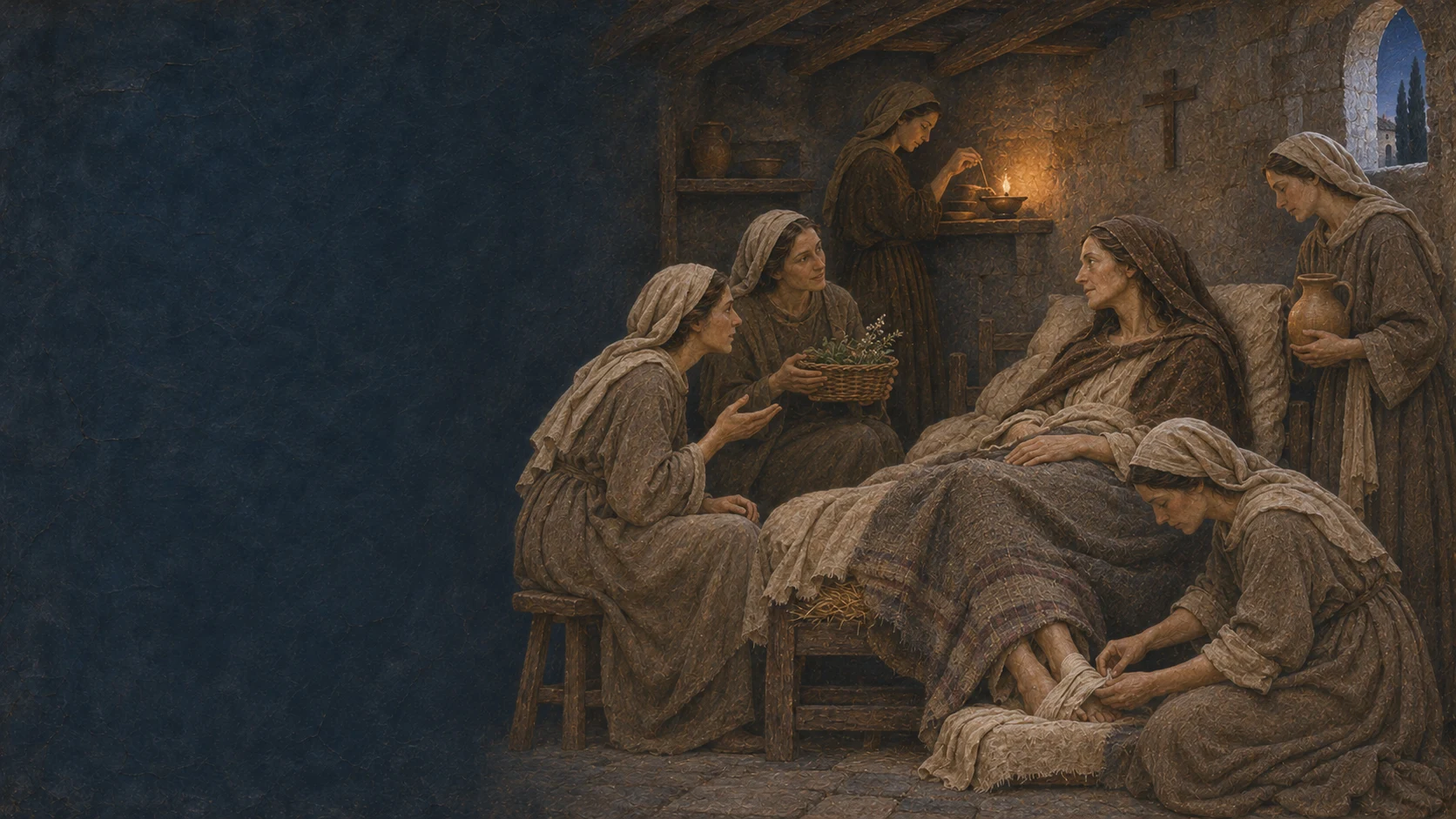
When some sisters arrived at San Damiano, Clare was already ill. For them, the woman leading the house never belonged only to the memory of someone moving freely among all the tasks.
Angeluccia stated in the Process that she had lived in the community for twenty-eight years and had found Clare ill when she entered. Pacifica also recalled a very long illness. The early Legend speaks of twenty-eight years; Pacifica’s testimony allows us to count approximately twenty-nine.
These indications point to a beginning around 1224 or 1225 without establishing an exact day. They also do not mean Clare spent every instant of almost three decades motionless in the same bed. The sources show serious limitations and moments of activity without allowing us to chart every variation in her health.
What we can affirm is considerable: illness ran through much of her adult life and became a lasting condition of community life.
The body changes distance
A healthy woman can approach a companion, reach an object, and complete a task without asking. When the body loses strength, the distance to a jug or the door grows. The change seems small to someone watching from outside, but it reorganizes the day.
We do not know every difficulty Clare faced. Pacifica describes a concrete situation: she was helped to sit up and given cloths behind her back for support so she could spin. The work depended on preparation by other people.
This detail lets us see illness outside the most famous scenes. Before letters, visits, and decisions, there were position, support, and time. The body needed assistance so that a simple activity could remain possible.
We do not know who gave this help on every occasion. The record preserves the community’s gesture more clearly than the identity of every caregiver. The absence of names does not diminish the importance of their hands.
A medieval infirmary
Infirmary here should not make readers imagine a present-day hospital. The house had limited resources, medical knowledge belonging to its period, and religious and domestic ways of responding to suffering.
The Form of Life mentions needs for food, advice, and other measures. It also allows adaptations of bedding and clothing for those in need. These provisions show material attention without revealing which treatments were used in every case.
We have no complete list of remedies given to Clare. It would be unwise to fill the scene with particular herbs, instruments, or procedures merely because they were possible in the thirteenth century. General possibility is not individual proof.
The space of care also had a life of words. The Rule allows measured speech in the infirmary for the relief and service of sick women. A need should not disappear because the rest of the house kept silence. Discipline adapted to care rather than preventing all communication.
The written obligation
In chapter VIII, Clare requires the abbess to find out what each sick sister needs, both herself and through others. She must provide advice, food, and necessities according to the place’s resources.
The wording matters because it does not merely wait for a sick woman to manage to insist. The person who governs has a duty to ask. Care requires initiative from those able to act.
The text also invites sisters to express their needs with confidence. This confidence does not arise automatically. Someone may feel ashamed to ask, fear being a bother, or struggle to explain what she feels. We do not know how each woman experienced this, but the rule recognizes that need must find a voice.
These are prescriptions, not proof of consistently perfect practice. Even so, they show care’s place in the community’s project: more than an occasional favor granted to someone deserving, it is a responsibility tied to the bond of sisterhood.
The caregiver receives care
Pacifica recalls Clare serving sick women while healthy. Later, other women had to serve her. This passage does not turn a useful person into someone without value. It changes the way she participates.
This change could be difficult. We have no complete confession from Clare about how dependence felt. It would be inappropriate to claim that she never became upset or immediately accepted everything with serenity.
Sources about holiness tend to emphasize patience. Readers can welcome this memory without assuming an absence of effort. A virtue repeated for years need not be understood as natural ease.
Care also wears down those who offer it. The sources leave no diary of the sisters’ tiredness, but the illness’s duration prevents us from imagining brief assistance followed by a final return to normality. For that house, accompanying an ill abbess was part of the very normality built over time.
Remaining abbess
Illness did not remove Clare from the government of San Damiano. Her participation came to depend more visibly on other people, on news brought to her, and on the cooperation of those able to perform tasks.
We cannot reconstruct every decision taken in bed. The documents of the final years and the companions’ memory show, however, a woman still involved in the community’s future. The confirmation of the Form of Life in 1253 was not the act of someone who had disappeared from relationships decades earlier.
The office had to coexist with limits. Leadership depending on helpers can remain firm, provided it is not confused with an ability to control everything personally. The vicar and counselors formed part of the house’s organization.
The bed made this network more evident. When someone approached with information or helped Clare work, authority appeared sustained by bonds. Its continuation was also an achievement of the other women.
Prayer with a fragile body
Angeluccia remembers Clare rising in bed to pray at night and at other times. The testimony preserves a religious practice adapted to illness. It does not show a body that ceased to exist in the presence of prayer.
Accounts of extraordinary experiences during illness belong to specific episodes and will be treated in their place. Here, it is enough to recognize that spiritual life continued without requiring Clare always to be where the others were.
The community could bring news, prayer, and presence to someone unable to reach every space. Physical distance did not need to become exclusion. At the same time, we should not presume that no absence or loneliness was felt.
Hagiographic tradition emphasizes comfort and patience. Historical reconstruction needs to leave room for the limitation that gives these themes meaning. If illness cost nothing, care and perseverance would lose precisely what they seek to recognize.
Possible work and necessary rest
The testimony about spinning shows concrete participation during illness. Other sisters turned the thread into pieces and helped distribute them. It was neither solitary production nor an obligation demonstrated for every day.
The same care should guide our reading of the letters and the Rule. Writing could involve dictation, collaboration, and the circulation of texts. Clare’s voice does not depend on imagining her carrying out every material gesture of writing alone.
None of this means she had to work without rest to justify the food she received. The Form of Life allows adaptations because bodily need has value in itself. Being unable to produce does not expel someone from common life.
The house needed to learn to distinguish what was possible from what would be an excessive demand. We do not have every decision taken about this. We have a rule of care and memories showing its urgency in the founder’s own experience.
The sisters remain in the memory
Clare is the best-known name, but prolonged illness reveals a collective history. Someone adjusted the support. Someone received a question. Someone brought what was needed. These general actions belong to a caring relationship; they were not all recorded for the same day.
The witnesses speak from close by because they were there. In recalling Clare’s prayer and work, they also leave signs of the life they shared with her. The memory does not come from a distant observer looking at a bed through a window.
When investigators heard the sisters, months after the death, the house still knew illness. One witness was heard in the infirmary itself. The place existed as more than a setting for the founder: it continued to answer other women’s needs.
This restores duration to care. It began before many famous episodes and continued beyond them, crossing names, generations of companions, and changes in the community’s life.
A life that was not put on hold
It is common to speak of years of illness as though they were an interval before death. For Clare, they were years of life: relationships, possible work, prayer, negotiations, and dependence. Her story did not happen only when she could get up.
Nor was it a victory that eliminated fragility. The limit remained, and other women had to respond to it many times. The long duration makes visible the patience of a community with finite resources and concrete responsibilities.
San Damiano preserved more than the memory of an abbess who cared. It preserved the experience of caring for her. The woman who had defended a common life needed to receive it in the form of support, food, and presence. In the narrow space of a bed, a whole house continued to exist.
Preserved voices
Sources for this chapter
- Clare of Assisi: The Lady — Early DocumentsCritical corpus. Collects the texts allowing comparison of the illness's duration, activity, and community care.
- Process of Canonization — Pacifica and AngelucciaTestimony. Basis for the long duration, support in bed, and prayer during illness; it does not offer a continuous clinical history.
- Process — Balvina's testimony in the infirmaryProcedural document. The hearing's location reminds us that the infirmary belonged to the community's life beyond Clare's presence.
- Clare — Form of Life, chapters V and VIIIRule. Allows communication for care, requires needs to be investigated, and provides for material adaptations.
- Legend of Saint Clare, 39Hagiography. Presents the long illness through the theme of patience and provides an approximate duration, distinct from clinical precision.
- Catherine M. Mooney — The 1253 Forma VitaeAcademic research. Places the institutional work of the final years in context, preventing illness from being treated as an absence of action.
- Assisi Santa Chiara — historical synthesis of Clare's lifeChronological reference. Helps place illness, leadership, and death within the whole biography without filling medical gaps.
How we read this illness: duration and care come from testimonies and rules; the Legend interprets them religiously. Later traditions do not justify a diagnosis or total immobility. The room's exact arrangement, treatments, and unpreserved everyday scenes remain limits of reconstruction.