
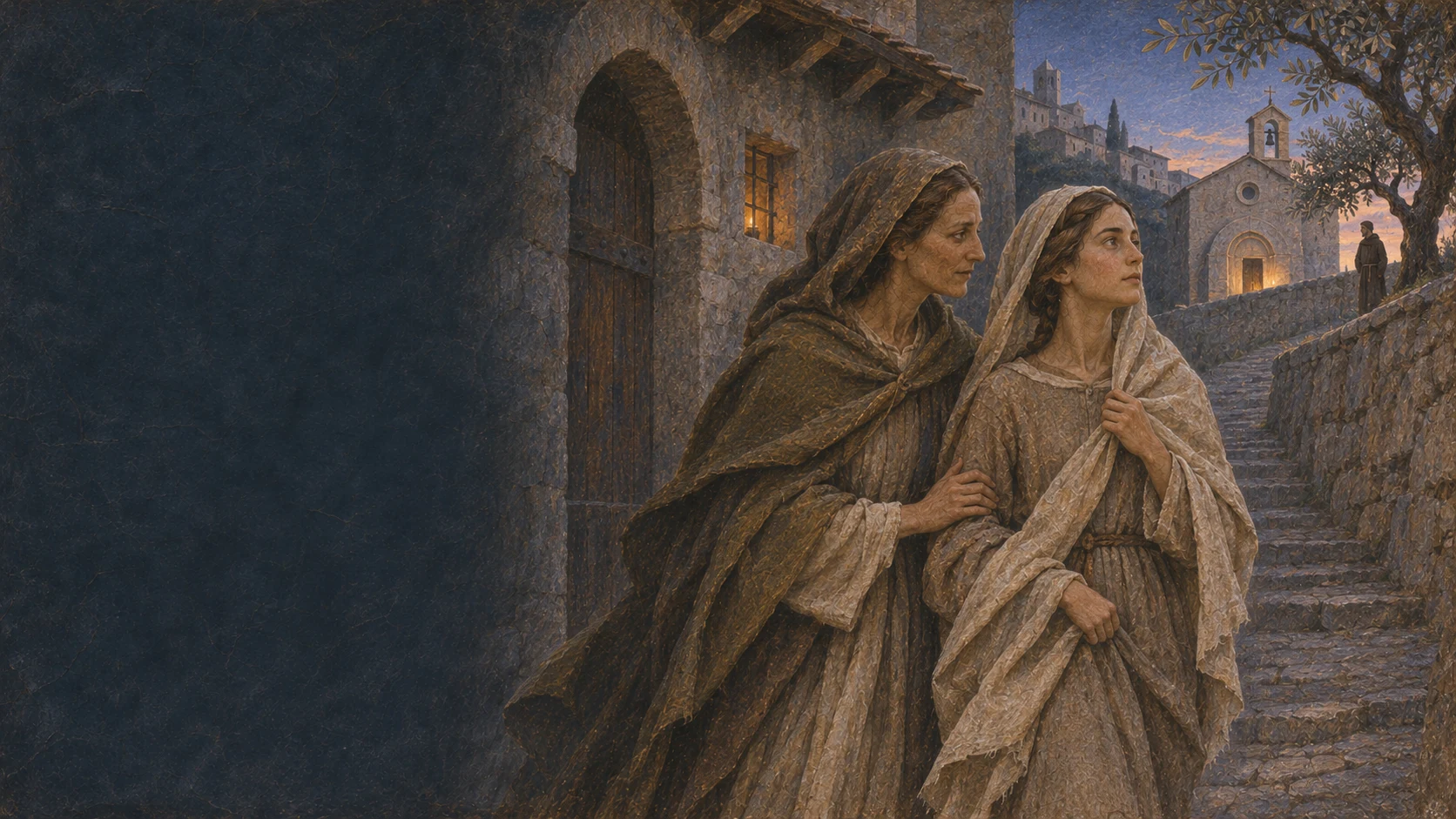
Forty years later, Bona of Guelfuccio still remembered.
In front of the men in charge of the Process of Canonization, she responded under oath. She had known Clare since childhood. She had taken to the poor foods that the young woman separated, and had accompanied her when Clare would discreetly meet Francis.
Without Bona, we would have a a lonelier and probably less true story. Big decisions are rarely made by an isolated person. Some people walk beside us, wait by a door and keep a word until the time comes to say it.
A voice with a name
Many medieval women appear in the sources only as “wife of” or “daughter of”. Bona has a name, kinship and action. She was from Assisi and linked to Clare’s family circle. The expression “of Guelfuccio” identifies a household or ancestry, not a modern surname used as it would be today.
In the Process, witnesses were questioned about what they knew, how they knew and who had been present. The objective was to verify Clare’s fame of holiness. This guided questions and answers. A judicial testimony is not neutral recording, but has special weight because it preserves named voices and declares the basis of knowledge.
Bona does not tell us everything we would like to know. Her silence is not a flaw; it forces us to look at what she actually said.
Bread hidden for the poor
According to her testimony, Clare reserved some of the food and sent it to the poor through Bona. The Legend narrates a similar attitude, adding edifying details.
The gesture reveals a hierarchical house. Clare had access to the table; people outside it were in need. To help without causing conflict or ostentatiousness, she depended on someone crossing the border between the noble interior and the street.
We do not know how many times this occurred or what food was carried. Tradition even speaks of hidden meat, but details must be evaluated in each text. The core is firm: Bona associated Clare’s youth with secret charity and participated in it.
The secrecy here was not a lie for personal gain. It protected a vulnerable person and a decision still taking shape. Yet secrets carried risks, and if discovered, Bona could face the family’s condemnation.
Accompanying Clare to Francis
Bona stated that Clare took her with her when she talked to Francis. This information corrects images in which the two are alone as characters in a novel. The presence of a companion was prudent in a world in which the a woman’s reputation had serious consequences.
The Legend insists on the rarity and discretion of the encounters, precisely to remove suspicions. This care belongs to the social and hagiographic language of the time. It also shows that the authors knew how a relationship between a noble young woman and a poor preacher could be interpreted.
It is not possible to determine whether Bona heard all the conversations or waited a certain distance. “Following” can cover different situations. Art chooses a shared walk and keeps Francis in the background, because the chapter belongs to the friendship of the two women.
Secrecy does not mean impulse
Clare did not leave home unprepared. There were meetings, guidance, choice of liturgical date and people ready to receive her. Bona is part of that period.
This allows us to remove two caricatures. Clare was not kidnapped by Francis. Nor did she act as a teenager who flees after a sudden emotion. Her decision matured within difficult limits, with advice and a small network.
At the same time, we should not turn Francis and Bona into authors of the plan while Clare only obeys. The Process attributes the will to her. The witnesses admire her constancy before the family. The network supported a decision that was Clare’s.
The value of a near witness
When Bona spoke in 1253, Clare had died only a few months earlier. The process took place quickly, on papal initiative, and brought together sisters from San Damiano and people from Assisi. Some knew community life; others remembered youth.
A four-decade memory can condense events and adopt repeated forms. Furthermore, Clare’s reputation already influenced the way of telling the past. Historians do not treat each phrase as a photograph. They compare testimonies, texts, documents and context.
Still, Bona offers something that a papal bull cannot: the memory of walking beside someone. Institutional documents record privileges and rules. A friend remembers food carried and meetings accompanied.
Friendship in a world of kinship
The modern word “friend” may suggest free choice without family obligations. In medieval Assisi, kinship, neighborhood, service and friendship mingled. Bona belonged to Clare’s social circle and perhaps had duties we did not know about.
This does not make the bond less real. Trust is born many times within the available structures. Clare needed someone who could go out with her without immediately raising suspicion, understanding her desire and not betraying her confidence.
The women around Clare are not scenery. Ortolana went on pilgrimage. Bona accompanied. Pacifica testified. Catherine followed her sister and received the name of Agnes. Then, the sisters of San Damiano preserved stories and texts. Clarian memory is a choral work.
The danger of calling everything a legend
Because Clare’s story is religious, some readers treat everything as legend. It erases important differences. Bona is an identified witness of an ecclesiastical legal procedure. The Legend is a hagiographic narrative written later, based on previous materials, with literary construction. Late traditions add places and details. Contemporary art rebuilds.
Neither of these layers should pretend to be another. The Process also has religious intent; the Legend can preserve facts; a tradition can be born of local memory; art can express historical truth without documenting an instant. Serious work consists in naming the type of evidence.
In this chapter, Bona’s companionship is testimony. The street and the touch on the arm are reconstruction. The atmosphere of risk is inference from the social norms and the family conflict narrated later.
What it may have cost
Bona knew that Clare could lose inheritance and protection. Perhaps she predicted the reaction of relatives; perhaps she did not imagine their strength. The source records no fear or doubt. We should not put modern discourses in her mouth.
We can, however, recognize the objective cost. Helping a noble girl to seek religious life against family plans involved reputation. Bona does not appear as an armed heroine. Her courage was to walk, wait, carry, and keep silent.
There is one form of power that draws attention. There is another that makes possible the freedom of someone without occupying the center. Bona belongs to the second.
When the secret became public memory
For years, what the two did remained in a small circle. After Clare’s death, Bona spoke before notaries and authorities. The secret was no longer necessary. The guarded word became evidence.
When she testified, she did not just talk about Clare. She inscribed her own presence in the story. She said, in essence: I was there; I saw; I went with her.
This phrase went through centuries because someone recorded it. How many other women helped and had no preserved name? The Process is rich and incomplete. Remembering Bona also remembers the absent ones.
In the art, the two pause before climbing. Clare looks at the way; Bona looks at Clare. The scene does not say that one knew everything and the other just followed. It shows a shared decision to continue a few more steps.
Before the palm, the door and the cut hair, there was this discreet fidelity. Clare’s night began long before dark, and Bona carried part of her light.
The faithfulness of small details
Official histories favor founders, popes and documents. Bona remembers what fits in a hand: food carried, a path walked together, trust received. These details are not minor. Without them, Clare’s great decision would seem to fall ready from heaven.
Bona’s memory teaches that a vocation is also the work of those who help without signing the foundation. Her presence restores to history the size of two women walking together.
A voice under oath
Sources for this chapter
- Process of CanonizationMain source. Preserves Bona's sworn testimony about charity and meetings.
- Clarian SourcesTextual Comparison. Puts the Process and the Legend side by side.
- Guide to St. ClareDocumentary corpus. Gathers versions and references from old sources.
- The Process of Canonization of St Clare of AssisiAcademic research. Analyzes legal form, memory and production of the process.
- A Companion to Clare of AssisiClarian studies. Contextualizes witnesses and women's agency.
- Letter for the Year of ClareOfficial reception. Summarizes the relationship between Clare and Francis.
Level of certainty: Bona accompanied Clare according to her own oath; paths, words, gestures and emotions remain unknown.