
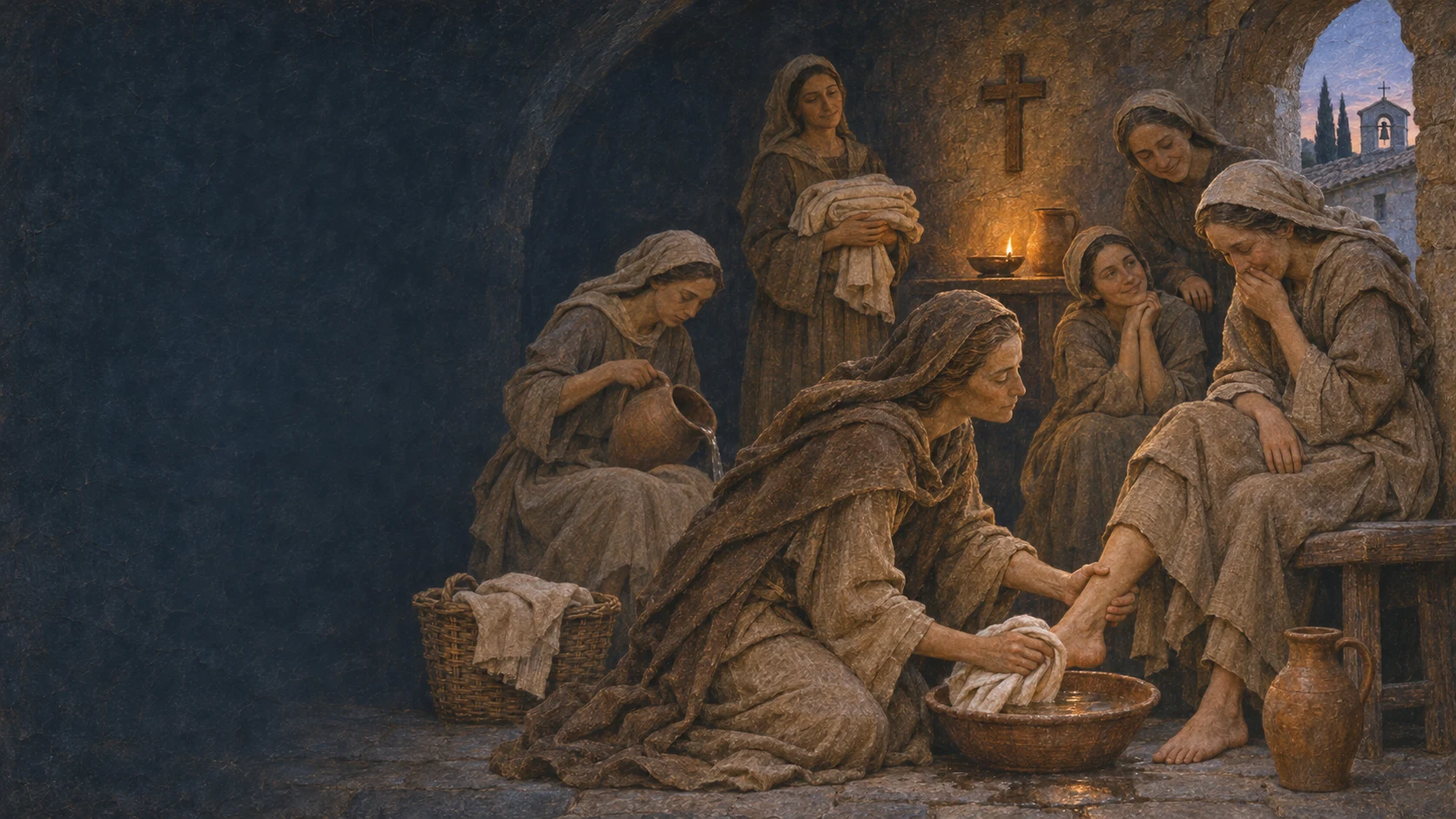
Before recognizing a symbol, we need to see the water.
Washing someone’s feet involves a vessel, willing hands, and attention to the body before us. At San Damiano, the sisters remembered Clare performing this service. The gesture was humble, but it was not empty: feet needed cleaning, people needed care.
The Process of Canonization preserves more than one reference to this practice. Pacifica mentions care of the sick. Other witnesses remember the feet of the sisters and of women who served the community. It is a bodily memory, linked to tasks that the position of abbess might have allowed her to delegate.
At the same time, those recounting it saw an imitation of Christ. The story therefore has more than one layer: a service remembered by identified people, a religious interpretation, and the way a holy life was shaped in writing. None needs to erase the others.
What Pacifica saw
Pacifica stated that Clare was kind to the sisters and had compassion for the sick. While healthy, she served them, washed their feet, and offered water for their hands. She also mentions cleaning seats used by sick women.
These details hardly fit an image of holiness without contact with dirt. They show a woman attending to needs that other people might consider unpleasant. The witness herself explains that she saw this service more than once.
This does not provide a daily care schedule. We do not know how many sick women there were on each occasion or which objects were used. The testimony’s precision lies in the kind of action and its repetition, not in a complete scene ready to be painted.
The time limit also matters: while she was healthy. Illness would change Clare’s ability to perform tasks. The woman who cared for others would come to depend on their care, without her life losing value.
A foot moves away
Other sisters recount a more particular episode. Clare was washing the feet of a woman who served the community and bent down to kiss them. The woman pulled her foot back and accidentally struck the abbess’s mouth. According to the account, Clare did not become angry and continued to express humility.
The core appears in testimonies by Benvenuta, Philippa, and Agnes of Oportulo, with differences in wording. The accident is presented as unintentional. It is not a story of a servant attacking Clare out of malice.
We also need to keep the name straight. The Agnes testifying about this episode should not automatically be confused with Clare’s blood sister. Family identification in the Process allows women with the same name to be distinguished.
The agreement among memories makes the episode significant. Even so, it does not give us access to all the participants’ feelings. The movement of withdrawing a foot can be described; the thought that caused it was not fully preserved.
The woman receiving care
We almost always look at Clare kneeling. It is worth looking too at the woman seated before her. Receiving such an intense gesture from someone in authority could cause surprise and discomfort. This is a human possibility, not a proven emotion for that person.
The descriptions of servant and sister raise questions about different positions within the house. San Damiano existed in an unequal society, and outside or service tasks should not be hidden beneath an image of equality without differences.
Washing these feet brought the abbess close to work and a body that a social hierarchy might place beneath her. The gesture had force precisely because there were recognized positions to cross.
We do not know the name of the woman who received Clare’s attention on that occasion. It is important not to turn her into a mere object used to prove a virtue. She too had a will, a reaction, and a place in the community’s life.
The Gospel behind the basin
In the Gospel of John, Jesus washes the disciples’ feet and presents the gesture as an example of service. For women shaped by prayer and listening to Scripture, this memory was not an ornament added afterward to a domestic task.
The action had an available religious language. When the superior bent down to serve, she could be understood in the light of the master who takes a servant’s position. The relationship between body and meaning was part of the sisters’ world.
We cannot claim that Clare spoke a particular Gospel sentence each time. The source does not record these words on every occasion. We can recognize the biblical horizon without writing a dialogue to fill the silence.
The service also existed in earlier monastic traditions. Clare did not invent Christian foot washing. Its importance lies in how her companions recognized this gesture within a particular life, with its responsibilities and social differences.
When memory becomes an example
The Process investigates virtues. That is why the scene of the foot striking the mouth is told as more than a household accident. It demonstrates humility: Clare does not demand that her honor be restored or turn the event into grounds for punishment.
The Legend gathers and arranges gestures of this kind into a coherent presentation of the saint. This is the work of hagiography. It selects events, brings them close to the Gospel, and offers readers conduct to admire and imitate.
Recognizing this shaping does not mean concluding that nothing happened. It means asking how a memory of shared life came to teach a virtue. The same fact can be observed, remembered, and interpreted at different times.
It would also be wrong to use the account to demand that anyone endure humiliation or violence without reacting. The episode concerns an accident and how Clare is remembered responding. It does not establish that mistreatment must be accepted by those who need protection.
The care that gets no painting
A basin of water is easy to depict. Less visible are the tasks around it: preparing what is needed, seeking help, cleaning afterward, noticing whether the person is comfortable. No testimony lists this entire sequence for the same occasion.
We can recognize it as part of the material reality of care without attributing every stage to Clare. A community needs many hands. Its abbess’s fame should not make everyone else’s work disappear.
Pacifica’s own testimony mentions services less solemn than kissing feet. Cleaning associated with the sick shows attention that did not depend on a beautiful scene. A body in need exists even when it cannot become a symbol.
This dimension helps us avoid a holiness always depicted with clean clothes and spotless objects. The sisters’ lives included wear, illness, and repeated tasks that no account could record in full.
Serving without appearing weak
Clare remained abbess when she bent down. Her position did not disappear; it was placed at the service of a need. The gesture did not replace the responsibility to organize the house, just as a good administrative decision did not replace all personal attention.
It is tempting to separate those who give orders from those who care. The testimonies about Clare bring these functions together. Authority became recognizable also through a willingness to perform a task that could have been left to someone of lower standing.
This does not prove the community never had inequalities or that every relationship was easy. It shows a moral demand within those relationships: the other woman’s dignity had to be recognized through the body and through work.
At the end of Clare’s life, the direction of care would often be reversed. The sisters would lift, support, and serve her. What she had done did not give her independence; it helped build a way of depending on one another.
Water returns to common life
After the gesture, life did not end. There were other tasks, prayer, and new needs. The basin became a household object again, and the woman who had received care continued her own story.
We do not know whether the participants thought then that someone would recount the event decades later. The Process preserves the memory because the sisters considered it significant for understanding Clare.
We can receive this memory without enlarging it until it fills everything. Washing feet does not sum up her leadership or turn all the women of San Damiano into identical figures. It illuminates a concrete relationship between authority, service, and dignity.
The scene’s strength lies in closeness. Before the written example, there was a body reached by another person’s hands. Religious interpretation arose on this ground: water offered, work performed, and a superior who, according to her companions, knew how to bend down.
Preserved voices
Sources for this chapter
- Clare of Assisi: The Lady — Early DocumentsCritical corpus. Allows comparison of testimonies about service with their arrangement in the Legend.
- Process of Canonization — Pacifica, Benvenuta, Philippa, and Agnes of OportuloTestimony. Distinguishes repeated care of the sick from the episode of the withdrawn foot, recounted as an accident.
- Legend of Saint Clare — humility and serviceHagiography. Turns memories into coherent examples of holiness; it is not independent testimony for each action.
- Clare — Form of Life, chapters IV and VIIIRule. Connects government and care, especially the obligation to serve those who fall ill.
- Gospel of John, chapter 13Biblical source. Christian horizon of foot washing, distinct from historical proof of the episodes concerning Clare.
- Catherine M. Mooney — Clare of Assisi and the Thirteenth-Century ChurchAcademic research. Helps examine relationships and differences among the community's women without idealizing its social structure.
- Assisi Santa Chiara — biographical reference for ClareContext. Places these gestures within the abbess's leadership, health, and shared life.
How we read this gesture: the service is remembered by named witnesses. Its Gospel and hagiographic interpretation belongs to religious memory. The vessel, setting, and emotions in an image would be reconstructions; liturgical tradition does not provide the date of every episode.