
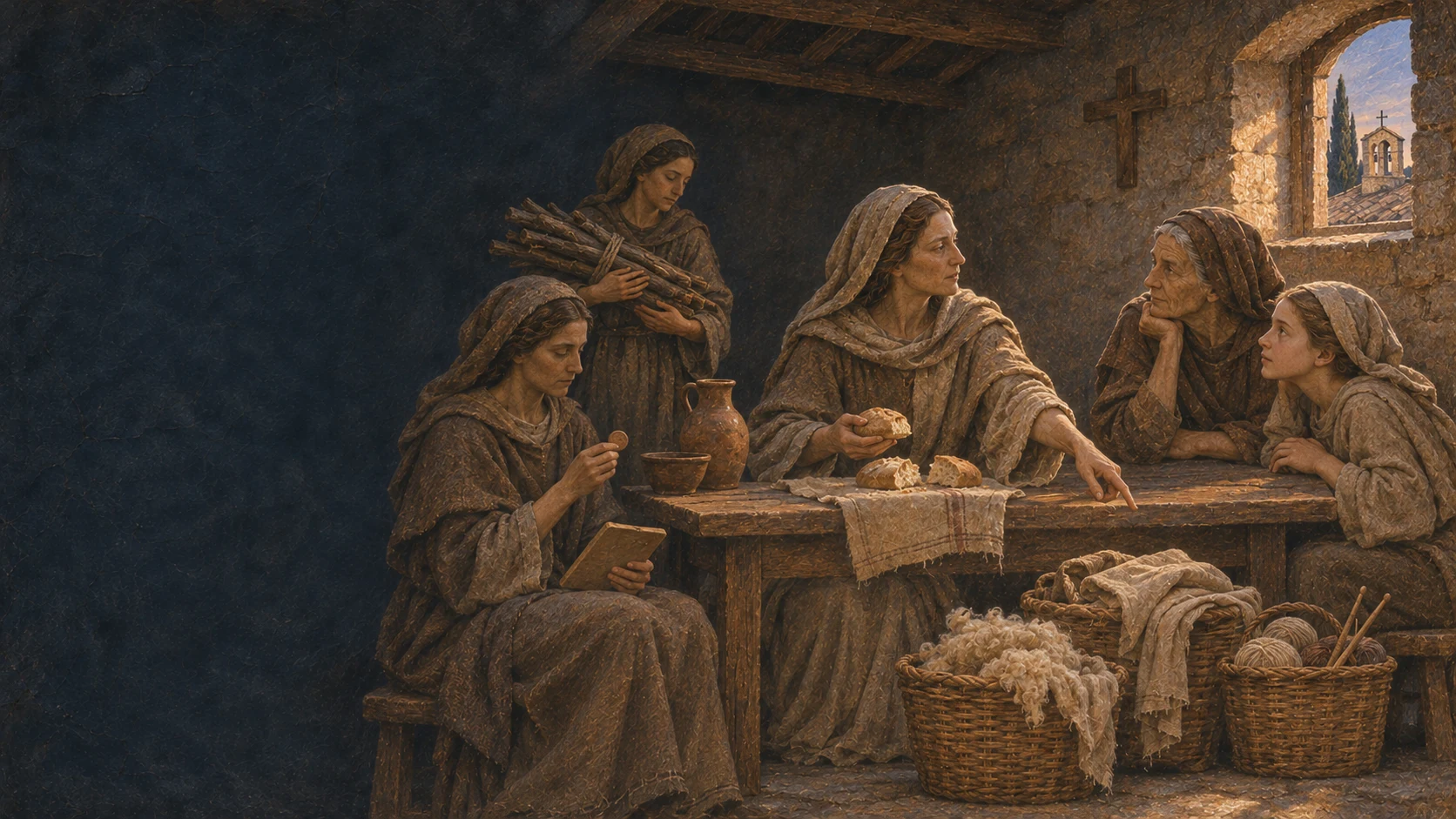
Clare wanted to serve. The community also needed someone answerable for decisions.
The early Legend recounts that, about three years after her conversion, she still refused the name and office of abbess. She preferred obedience to the position of someone who governs. According to the account, Francis’s insistence led her to accept the responsibility.
This refusal belongs to hagiography. Showing a person who fears power is a familiar way of presenting a saint’s humility. This does not necessarily make the episode invented. It simply requires us to distinguish the certainty of the office, which is very well documented, from the narrative explaining how it was accepted.
The date also deserves caution. Different chronologies connect the beginning of formal leadership to stages in the house’s organization. We have no complete record of the first election. We have Clare’s long presence as a guiding figure and leader of San Damiano.
The name of a responsibility
Abbess was the title of the superior of a women’s monastic community. The office had institutional recognition and involved duties. It was more than an affectionate way to address the most respected woman in the house.
At San Damiano, taking this position meant dealing with people inside and outside. Common life had to be organized, religious authorities dealt with, and potentially disputed decisions defended. Poverty also required government: receiving, distributing, and discerning how to meet needs without abandoning the community’s commitment.
We do not know each week’s list of problems. The legislation and testimonies show, however, that the office reached very concrete questions. A sick sister could not wait for a discussion of principles to finish before receiving suitable food.
Clare’s responsibility joined a spiritual horizon with practical attention. Saying she wanted to serve does not mean that she avoided difficult choices or that all the women decided everything without any direction.
Refusal in the language of saints
The Legend presents the acceptance of leadership as obedience and fear. The author of a saint’s life seeks to show that a high position did not arise from ambition. The account leads readers to see authority as service.
This literary intention must accompany our reading. We have no direct access to Clare’s thoughts at the moment of acceptance. Nor can we conclude that she never felt satisfaction in carrying out a task well or defending an achievement.
Medieval humility does not simply mean shyness. A woman could reject vanity and speak firmly. She could consider herself a servant while insisting on her position before a powerful authority.
Clare would demonstrate exactly this combination. Her resistance over questions of poverty does not fit the image of someone unable to decide. The refusal of office, as recounted, helps us understand the desired way of governing without erasing the actual strength of the woman who governed.
The words of those who lived close by
Pacifica stated in the Process that Clare gave orders humbly and often preferred to perform a task rather than order it done. This testimony offers a memory of everyday behavior, close to the experience of living together.
Even so, it is a memory selected for an investigation of holiness. It is not a report of every order given over forty years. The repetition of a quality does not allow us to imagine an entire life without impatience, learning, or difficulty.
What the testimony preserves is significant: Clare’s authority was remembered alongside a willingness to work. Other sisters recall care, necessary correction, and words of encouragement.
These dimensions do not cancel one another out. Correction could be part of service, provided it did not become humiliation. How someone was treated mattered as much as the decision taken about her conduct.
A community that had to be consulted
Chapter IV of the Form of Life concerns the election and office of the abbess. The rule provides for community participation and consultation on household matters. It also requires the choice of discerning sisters, counselors who assist in government.
Discreet, in this context, does not simply mean a quiet person. The word points to an ability to discern, weigh matters, and offer advice. The abbess’s office did not excuse her from listening to those who could help her understand a problem.
The text also recalls that a younger sister may offer useful advice. This sentence makes room for a voice that age or prestige might push aside. It does not turn the community into a modern democracy, but limits the idea that only a higher position produces good judgment.
A rule of consultation exists because listening is a task. It requires time, willingness, and a real possibility of receiving an answer different from the one expected.
Governing without owning the house
For Clare, defending poverty also meant defending a community identity. This did not mean she could ignore material concerns. Authorities offered solutions based on property precisely because they considered the women’s economic insecurity dangerous.
The abbess had to answer these proposals on behalf of a house made up of people with different strengths. It was not enough to declare her own desire for austerity and demand that everyone bear any consequence without speaking.
The Form of Life links poverty to care. It allows needs to be expressed and requires necessities to be sought for the sick. The law protecting the commitment also protects the person unable to follow a common practice.
This is where leadership becomes demanding. A principle loses meaning when it stops recognizing the bodies that live it. Clare had to consider the continuation of poverty alongside the continuation of the community, rather than as though either could exist without the other.
The place of correction
A religious house was not a group without duties. The Rule addresses faults, penance, and reconciliation. It also warns the abbess about how to correct, avoiding anger and disturbance that harm charity.
To a reader today, certain disciplinary practices may seem distant. They must be placed within medieval religious life without pretending every problem was resolved in a way we would consider suitable now.
At the same time, the text places limits on the person who governs. The superior is not licensed to act according to her mood. Her conduct too must be examined in the light of the common form of life.
We have no records of every conflict at San Damiano. Their absence does not prove perfect harmony. The presence of rules for correction and forgiveness shows that Clare imagined a community able to face failures, rather than depending on the impossible image of people who never make mistakes.
Authority continued during illness
Clare spent much of her adult life ill. Illness changed her movements without erasing her position as abbess. Other sisters had to approach her bed, pass on news, and help carry out what she could no longer do alone.
This government should not be imagined as constant control of every object in the house. It depended on collaborators, the vicar, and relationships of trust. A woman lying in bed could still take part in decisions, but she needed information and help.
Fragility made visible a truth that also exists when no one notices it: no leader governs alone. The community did more than receive Clare’s care. It cared for her and sustained the possibility of her participation.
The texts of the final years show that her voice remained active. The approval of the Form of Life, near her death, belongs to a history of work and negotiation that was not simply interrupted by the loss of physical strength.
The house after her
Governing included thinking about the time when Clare would no longer be present. The Form of Life speaks of electing successors and the obligation to maintain the commitment received. Its horizon extends beyond one person’s lifetime.
After Clare’s death, Benedetta appears as abbess in the Process. The community still had leadership, named women, and responsibility for its own history. This prevents us from closing San Damiano’s story as though the house lost all ability to act along with its founder.
This chapter’s title preserves the refusal recounted by the Legend. The life that followed shows the other side: Clare undertook the office for decades. The humility the sisters remembered was not a continuous escape from responsibility.
She wanted to serve and had to learn to give orders, consult, correct, and receive help. The strength of her authority appears in this combination, when the woman answerable for the house also accepted dependence on the women living in it.
Preserved voices
Sources for this chapter
- Clare of Assisi: The Lady — Early DocumentsCritical corpus. Collects documents of leadership and accounts interpreting its acceptance.
- Clare — Form of Life, chapters IV, VIII–XRule. Regulates election, consultation, care of the sick, and correction, allowing authority to be examined beyond a devotional portrait.
- Process of Canonization — Pacifica and the final community declarationTestimony. Recalls Clare's manner of giving orders and records the community already led by Benedetta.
- Legend of Saint Clare, section on humilityHagiography. Recounts the initial refusal and Francis's intervention, interpreting the office as service.
- Catherine M. Mooney — The House of Penitents Becomes a MonasteryAcademic research. Places leadership within institutional development and the chronological uncertainties of the beginnings.
- Assisi Santa Chiara — Chiara e il papatoHistorical study. Provides context for relations between Clare's leadership and papal authorities.
- Benedict XVI — audience of September 15, 2010Spiritual reception. Presents the strength of Clare's choice; it does not by itself settle the date of her appointment.
How we read this chapter: the office is documented; initial resistance comes through hagiography. The Rule expresses desired duties, and the testimonies recall her practice. No elections, meetings, or private conversations have been reconstructed as known facts.