
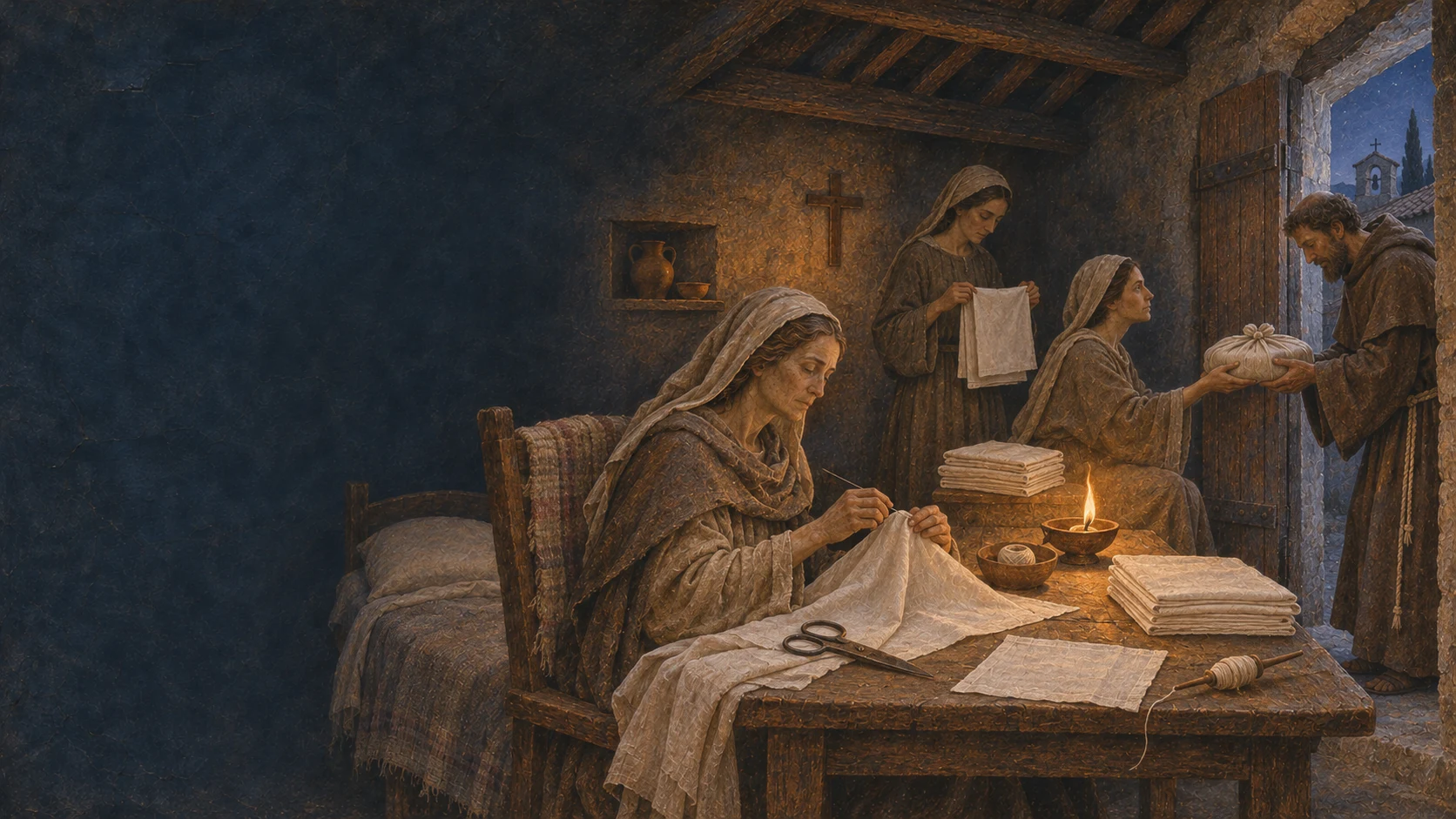
Before Clare could work, she needed help to sit up.
Pacifica recalls this detail in the Process of Canonization: when illness prevented her from rising, they supported her back with cloths. That allowed her to spin. The work therefore began before her hands reached the thread. It began in the hands of other women, who helped her find a manageable position.
The thread produced became fine cloth, then corporals, cloths used on the altar in the celebration of the Eucharist. The sisters took part in making them. Friars and priests helped these pieces reach churches in Assisi and its territory.
The memory is small and far-reaching at once. It shows a sick woman inside a room and a network reaching the city, the plain, and the mountains. Enclosure did not prevent the work from passing through the door.
What was a corporal?
Corporal is the name of a small liturgical cloth spread on the altar for the elements of the Eucharistic celebration. The term relates to the body of Christ. It is more than any cloth used in a church.
For the women of San Damiano, producing this cloth had a specific religious meaning. Care for the material and its destination expressed reverence for the Eucharist. A modest piece could receive attention that did not depend on being large or showy.
It is important not to imagine automatically the size and finish of modern pieces. The testimonies speak of work and use without offering full measurements or a technical drawing of every object sent.
The witnesses do not identify the fibre that was used. What they preserve is a material passing through many transformations before reaching the altar. The story focuses on the sisters’ participation without allowing us to reconstruct the origin of each thread or the routes by which it reached the house.
The effort of a posture
The image of Clare working in bed often seems serene. The detail of the cloths behind her back reminds us that her position required adaptation. This was not a healthy woman choosing to work lying down for comfort.
We do not know how long she could remain seated or on which days she had strength. The testimony provides no measure of productivity. Repeated work does not allow us to conclude that she did it continuously, without pain or interruption.
Nor do we need to turn every gesture into a heroic victory. Being helped to find a manageable position already shows a community trying to adapt activity to the body. Her participation was sustained by care, rather than achieved despite care being useless.
This distinction protects the sick person from an unfair demand. The memory of Clare spinning does not mean someone must produce during illness to retain dignity. The value of her life did not depend on the amount of thread obtained.
A chain of work
Spinning turns fibers into thread. Producing cloth requires another stage. Preparing pieces for liturgical use also involves cutting, finishing, and organization. The Process allows us to recognize this chain without assigning every task to a named worker.
Pacifica says she saw Clare spin and the sisters sew. Other witnesses add information about quantities and the containers used to keep the corporals. The final object brings together a collective effort.
It is easy to erase this effort by saying only that Clare made many corporals. The sentence may be acceptable as a summary, but becomes misleading if it suggests entirely solitary production. Leadership itself could include having things made, coordinating, and arranging distribution.
The house thus appears as more than a workshop devoted to highlighting a single maker. It appears as a community of work. Some tasks left names and others did not, but the absence of a signature does not mean an absence of skill.
Boxes for safekeeping
Benvenuta mentions containers prepared for the corporals, lined with silk, and the bishop’s blessing. Other memories also describe care for the pieces and their presentation. The community’s simplicity did not require carelessness in everything it offered.
The contrast deserves patient understanding. Women who refused wealth for themselves could devote materials and effort to objects for religious use. This corresponds to a medieval hierarchy of values, in which reverence for the sacrament justified special attention.
We do not know the origin of each fabric used in the lining. Nor can we calculate the cost of these containers or invent a particular purchase. The testimony tells us about care; it leaves part of the material organization open.
The cloth was not sent as a leftover with no destination. It was prepared to reach someone and fulfill a function. The container helped preserve the piece and indicated the meaning the community gave it.
Counting without turning memory into an inventory
Beatrice stated that she had counted fifty pairs of corporals. It is a concrete memory, with a striking quantity. It should be presented as what a witness said she counted, not as the final balance of Clare’s entire lifetime production.
It would also be wrong to multiply this number by years and imagine a workshop with calculable output. We have no series of deliveries, dates, and recipients allowing that kind of calculation.
Numbers in testimonies often serve to communicate the force of a memory. They may be precise for one occasion and incomplete for the whole. Caution does not require erasing the quantity; it requires preserving its scope.
The same care applies to the broad distribution Pacifica describes. The expression reaching churches on the plain and in the mountains shows an extensive network within Assisi’s horizon. It does not give us a list of all those churches.
Who crossed the doorway
The pieces reached the outside through people. Pacifica mentions friars and priests. These intermediaries are not minor details: without someone to carry the objects, the work would remain inside the house.
The bishop also appears in connection with the blessing. Production therefore involves relationships among religious women, friars, local clergy, and communities receiving the pieces. The cloth makes visible a network that the image of absolute enclosure can hide.
We should not conclude that every relationship was simple or free of tension. San Damiano’s history includes difficult negotiations with authorities and with the friars themselves. A well-remembered delivery does not erase those conflicts.
Even so, the work shows possible cooperation. The women did more than receive assistance. They also sent something outward, offering time, skill, and religious attention. Material dependence coexisted with an ability to contribute to the life of nearby churches.
The churches of Assisi and shared care
In describing the shipments, the Process speaks of churches in the city, valley, hills, and territory of Assisi. It does not report each recipient’s economic situation. The title therefore remains close to what the witnesses actually said.
We therefore cannot prove that all were equally needy or that every shipment answered the lack of a corporal. The intention to serve the celebration is more certain than a complete map of these churches’ poverty.
This difference does not empty the gesture of meaning. A community living with limited resources devoted work to other communities. The contribution did not have to be enormous to link places and people.
Eucharistic care also helps us understand Clare without reducing her to later images of the monstrance. Here, her relationship with the sacrament appears through fiber, thread, sewing, and distribution: patient work, almost invisible during the celebration.
The thread continues beyond the bed
The Form of Life presents work as grace and service to the common good, without allowing it to destroy the spirit of prayer. The corporals offer a remembered example of this union. The rule and the testimony come close, although they are different kinds of source.
The Legend arranges this care within a portrait of holiness. Later traditions and images may concentrate all production in Clare’s hands. Careful reading restores the companions, the supports, and the routes to the scene.
In the end, we see more than a sick woman refusing to remain idle. We see a house finding ways to allow participation, divide tasks, and reach other people.
The finished corporal seemed a small piece. Its history brought together Clare’s supported body, the sisters’ skill, and the steps of those carrying it. Before resting on an altar, that cloth had already passed through a very concrete form of communion.
Preserved voices
Sources for this chapter
- Clare of Assisi: The Lady — Early DocumentsCritical corpus. Collects textile testimonies and legislation on work, avoiding the merging of all stages into one person's action.
- Process of Canonization — Pacifica, I, 11Declared direct testimony. Describes support in bed, spinning, sewing by the sisters, and distribution by friars and priests.
- Process — Benvenuta, Cecilia, and BeatriceComplementary testimonies. Add containers, the bishop's blessing, and the count of fifty pairs, without constituting an annual inventory.
- Clare — Form of Life, chapter VIIRule. Places work within common service and subordinates it to the life of prayer, without describing the workshop in detail.
- Legend of Saint Clare — reverence for the EucharistHagiography. Interprets liturgical care as an expression of holiness; it should be compared with the voices in the Process.
- Catherine M. Mooney — The 1253 Forma VitaeAcademic research. Provides context for the mature rule and its relationship with an earlier community experience.
- Assisi Santa Chiara — Chiara d’AssisiHistorical reference. Places illness, activity, and local relationships within Clare's life without providing destinations for every piece.
How we read this work: supported spinning, collaboration, and shipments have a basis in testimony. The Legend gives them a religious interpretation; visual tradition may simplify them. Specific shapes, tools, and rooms would be reconstructions. The title does not turn every receiving church into a documented poor church.