
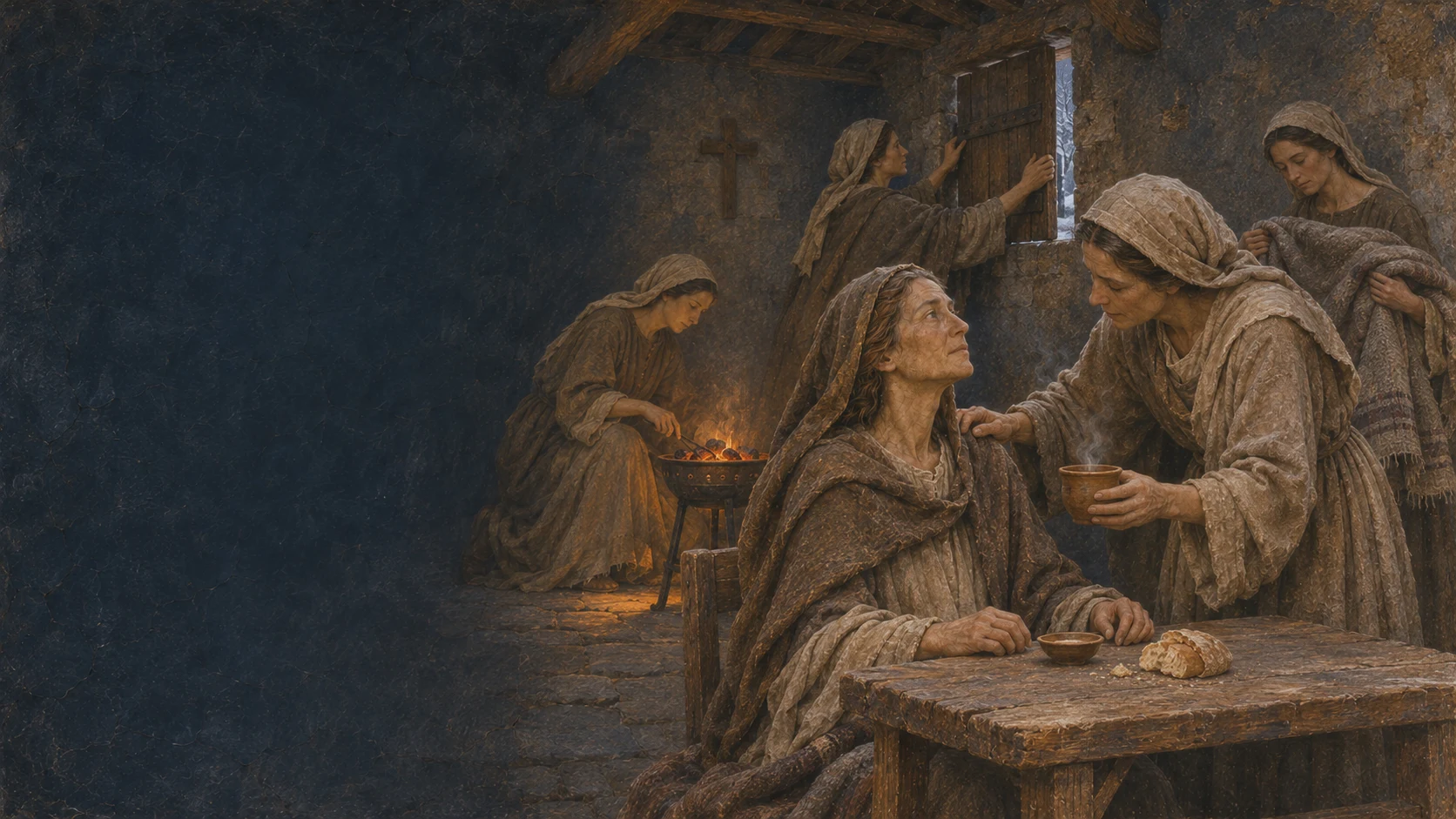
The women who admired Clare also worried about her body.
The Process of Canonization and the early Legend remember very strict fasts, austere rest, and penitential practices that caused suffering. The texts seek to show the intensity of her religious dedication. They also preserve signs that this intensity needed to be restrained.
Francis and the bishop of Assisi intervened so that she would eat. This fact changes how we read the story. Not every refusal of comfort was automatically considered good, and even a respected woman’s decision was not above the need for correction.
To understand Clare, we need to recognize the world in which she lived. To tell her story honestly, we also need to recognize the bodily cost. Suffering should not disappear beneath a beautiful word, just as medieval faith should not be reduced to a diagnosis we do not possess.
What penance meant
In medieval religious life, penance could bring together prayer, renunciation, changed conduct, and bodily practices. A person sought to turn away from sin, guide desires, and bring life closer to Christ’s. The body took part in this path.
Fasting also belonged to the Christian calendar and monastic discipline. It was not Clare’s personal invention. There were familiar periods and customs within which some people took on additional austerities.
This helps us understand without making everything acceptable by definition. A common practice can have different degrees and produce serious consequences when taken beyond someone’s strength. Context explains why a choice made sense without removing its risks and effects.
Accounts of Clare emphasize precisely an exceptional intensity. When we read that emphasis as a competition to discover who suffered most, we lose both the religious complexity and the reality of the woman who needed to go on living.
Pacifica’s testimony
Pacifica describes Clare’s abstinence and states that she became so weak that she fell ill. She then recalls the order from Francis and the bishop that she should eat on days when she abstained completely.
This is close testimony from someone who served her for many years. Her perception of the connection between food and weakness deserves serious attention. It is not, however, a medical examination able to explain every later illness.
The witness was speaking within an investigation of holiness. She selected events that helped present Clare’s virtues and life. This does not erase the concern: the intervention appears in the very documents that praise her.
We do not need to reproduce quantities and patterns of abstinence as though they were instructions for religious practice. The historical point lies in the severity that worried others and the recognition that the body needed food.
How the Legend tells it
The Legend intensifies its description of austerity. It speaks of rough clothing, hard beds, and fasts that consumed strength. Its author uses powerful images to present a woman devoted entirely to God.
This is hagiographic language. It can preserve earlier information while also arranging it to inspire admiration. Readers need to distinguish the memory of a practice from the literary way of making it seem extraordinary.
The text itself recognizes that severity weakened Clare and led to correction. This prevents a simple reading in which everything that hurts the body receives approval. The narrative preserves a tension between admiration for renunciation and the need to keep her alive.
We do not know whether every detail described corresponds to a practice maintained for long periods or to particular occasions. Nor can we turn the sum of the episodes into a uniform daily routine for Clare’s entire religious life.
The sisters noticed too
The companions appear as more than silent admirers. Tradition recounts their distress at the abbess’s weakening. This concern is part of the story and deserves as much space as the gestures of austerity.
Living together allows people to notice changes someone may try to minimize in herself. Someone sees the tiredness, has to help her rise, or notices difficulty continuing a task. We do not know all these particular observations at San Damiano, but the accounts show a community attentive to the bodily cost.
This does not mean the sisters possessed today’s medical knowledge. It means that recognizing a need did not depend on naming its cause precisely. A weakened body required a response.
Care could include going against a wish. Asking Clare to eat was not necessarily disrespect for her vocation. It could be the very way to protect the person whose life and presence they valued.
Francis and the bishop correct her
The intervention of Francis and the bishop reveals an authority that limited personal austerity. Clare, remembered as firm before proposals she believed threatened poverty, also needed to accept guidance about her own conduct.
We do not have the complete conversation. It would be inappropriate to write an argument with exact phrases, tears, or final resistance if the document does not record that sequence. What has reached us is the memory of the order to eat.
It would also be unfair to depict these men as the only ones capable of seeing the problem. The sisters’ concern appears in the sources, and their shared life sustained everyday care. The order needed to be accompanied by prepared food, support, and attention.
A formal decision and a network of service acted together. Correction did not end the instant someone said what should be done. It had to take shape in a real person’s body and habits.
Clare’s voice asks for moderation
In the Third Letter to Agnes of Prague, Clare discusses food and discourages unwise austerities. Her concern includes the recipient’s health and the possibility of praising God with her life. Here we hear guidance from the author herself, rather than only a biographer’s account.
It is important to distinguish this Agnes from Clare’s sister. The letter crosses a distance and addresses a woman with her own community and responsibilities. Friendship allows advice, clarification of customs, and a request for caution.
We cannot claim that every sentence arose directly from the memory of an episode in her youth. The connection between experience and advice is plausible, but Clare did not explain it that way. What the letter allows us to affirm is her concern that devotion should not destroy the ability to live.
This voice needs to accompany the fame of the fasts. Without it, Clare remains trapped in a portrait of austerity that her own writings broaden.
The rule makes exceptions
The Form of Life of 1253 provides for fasting, but also recognizes different situations. Age, fragility, illness, and outside service enter into consideration of what can be required. Discipline is not applied as though all bodies were the same.
Chapter VIII requires the abbess to seek what sick women need, including food and other care. It allows material comforts for those who need them. Poverty does not appear as a justification for refusing every adaptation.
A rule remains a prescribed ideal, not proof of perfect care on every occasion. Even so, its provisions show that the community’s experience had tools for recognizing limits.
A body unable to meet a common austerity is not automatically placed outside sisterhood. Need must be allowed a voice. This principle has particular force in a house where the founder, for years, needed to receive services she had once performed for other women.
The diagnosis we do not have
The sources describe a prolonged illness. They do not preserve examinations, sufficient clinical observations, or a complete history of symptoms. Naming a specific disease with certainty would go beyond what we know.
Nor is it possible to reduce all Clare’s fragility to a single dietary decision. Deprivation could weaken the body; the full set of causes remains open. A connection perceived by witnesses does not answer every question of a retrospective diagnosis.
This caution prevents the figure from being used to confirm a ready-made idea. Clare is neither a transparent clinical case nor a body that ceased to obey human needs because it was holy.
She was a medieval woman whose religious search included harsh practices and whose path also included correction. The documents from her mature years allow us to recognize care, adaptations, and a responsibility extending to other women’s health.
Staying alive was also a response
The body’s limit did not end her participation at San Damiano. It changed tasks and positions. Clare needed to allow other women to help her and find ways to remain in the life of the house.
This story does not end with a victory over the need to eat or rest. In this chapter, it ends with need recognized as part of life. The community needed more than an admirable abbess. It needed Clare alive, accompanied, and able to receive care.
In remembering her fasts, the sources also preserved those who interrupted them and those who worried. These voices prevent austerity from filling the memory alone. The body pushed to its limit remained a body deserving protection, food, and presence.
Preserved voices
Sources for this chapter
- Clare of Assisi: The Lady — Early DocumentsCritical corpus. Collects Clare's advice in letters and accounts of austerity, allowing different perspectives to be heard.
- Process of Canonization — Pacifica, I, 7–8Testimony. Connects abstinence, weakness, and the intervention of Francis and the bishop; it is not a modern diagnosis.
- Legend of Saint Clare, 17–18Hagiography. Praises penance and preserves concern over its effects; the literary images need to be recognized.
- Clare — Third Letter to Agnes of Prague, 29–41, in Early DocumentsClare's own writing. Clarifies dietary customs and recommends caution to the recipient; the link leads to the corpus edition.
- Clare — Form of Life, chapters III and VIIIRule. Provides exceptions to fasting and duties concerning food and care of the sick.
- Catherine M. Mooney — Clare’s Letters to Agnes of PragueAcademic research. Places the correspondence in context and helps preserve its difference from hagiographic memory.
- Benedict XVI — Saint Clare of AssisiSpiritual reception. Offers the Gospel horizon of the vocation; it is not clinical evidence about her illnesses.
How we read this body: testimony, letter, rule, and hagiography have different functions. Devotional traditions do not provide a diagnosis. No symptoms, single causes, or dialogues have been invented; the practices described belong to history without becoming instructions for readers.