
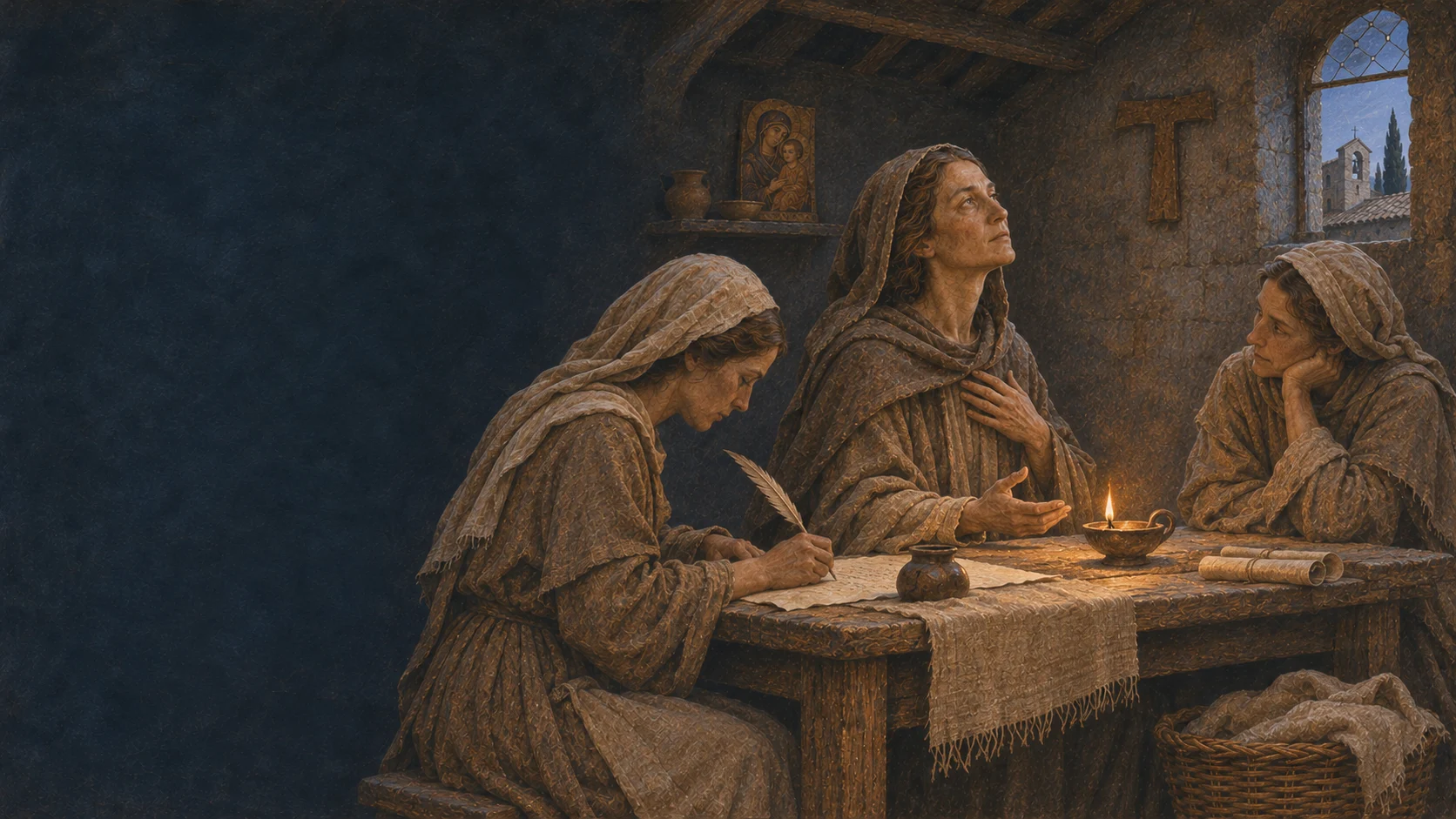
A woman living in a small house wrote to another that the human heart could receive the One whom the whole of heaven could not contain. The sentence seems to push the walls outward. Yet Clare was not describing a room enlarged by a miracle, nor claiming that Agnes of Prague possessed a secret power. She was looking for words with which to speak about love, God, and the dignity of a human person.
The Third Letter preserved between the two women is usually dated to about 1238. Agnes had already begun her community in Prague; Clare had long experience at San Damiano. Separated by difficult roads, they discussed choices involving the sisters’ food, the authority of the Church, and what it meant to live without property.
Amid these concrete concerns, Clare opens an immense window. A woman’s body, so often treated as a source of weakness or a reason for surveillance, appears as a place of encounter with God.
Joy comes before explanation
The letter begins in gladness. Clare has received good news about Agnes and rejoices in her perseverance. Joy is not decoration added to stern advice. It shows that the recipient’s life matters to the writer. A choice made in Prague can strengthen women who have never crossed the mountains to reach it.
We do not possess the message that prompted this reply. We can infer questions and news from Clare’s answers, but we cannot recover Agnes’s words. It is like hearing one side of a conversation: some things become clear, while others remain open. Writing the lost letter on the princess’s behalf would go beyond the evidence.
The document does, however, reveal a relationship of support. Clare does not present herself as someone who possesses everything and dispenses wisdom to an empty pupil. She says that Agnes’s faithfulness helps supply what is lacking in Clare herself and in her sisters.
A collaborator, not a spectator
Clare calls her friend God’s co-worker and a support for the weakened members of Christ’s body. The image comes from Christian language about the Church. It does not mean that God needs an administrator to finish creation. It means that one person’s life can participate in caring for many others.
Remember Agnes’s position. She was a king’s daughter who had chosen a community of women. She did not occupy a bishop’s pulpit or command armies. Clare gives public and spiritual value to a life that others might have dismissed as withdrawal.
Even so, she does not turn Agnes into a solitary heroine. She also speaks of the sisters. The body being supported has many members, and Agnes herself lives among other people. Her importance does not require everyone else to disappear.
What it means to contain
The word can mislead anyone who imagines God as an object kept in a box. In Clare’s faith, the Creator cannot be confined by a measure. No one could imprison, divide, or own God as one owns a jewel.
The letter works through a paradox: two apparently incompatible statements help express a larger reality. God cannot be limited by the universe, yet chooses to be welcomed in a human life. Love allows a nearness that size, wealth, and prestige cannot buy.
This is a theological claim, not a discovery about physical space. We can study it as part of medieval belief without pretending that it can be measured in inches. Nor should we empty it into a general slogan about self-esteem. For Clare, the one dwelling within the person is the Christian God made known in Jesus.
Mary enters the letter
To make the idea understandable, Clare recalls Mary. The woman who carried Jesus offered Christian imagination a concrete image: the Son of God, greater than the heavens, found shelter in a womb and later in a mother’s arms.
Here the Incarnation has weight. According to Christian faith, the Son of God assumed a truly human existence. He did not merely appear to have a body. He was born and needed to be carried, fed, and protected. Divine greatness appeared in the dependence of a child.
Clare invites Agnes to draw near to this mother. She does not say that her friend will physically repeat Mary’s motherhood. She distinguishes what Mary lived bodily from what Agnes may live spiritually by following humility and poverty. To confuse these levels would make the image say what the text does not say.
A different motherhood
A religious woman renounced marriage and biological motherhood as part of her chosen life. Others might therefore suppose that her ability to bring forth care had ended. Clare offers another language: a life can make Christ’s love present without giving birth to a child.
This is not a declaration that one form of life is superior to every other. The letter addresses a particular woman with particular commitments. Its argument does not require belittling mothers, wives, or women who followed other paths. It affirms that Agnes’s choice can also be fruitful.
That fruitfulness appears in relationships: a sister is heard, a community sustained, a difficult decision given counsel. These examples help us understand the image; they are not secret episodes discovered in the letter. The narrative must say when it is explaining a meaning and when it is reporting a fact.
A greatness that does not depend on court
Clare knows her correspondent’s royal origin. By speaking of a soul larger than heaven, she moves greatness away from the court. Neither the halls of Prague, a dynastic marriage, nor the reach of a powerful family makes someone able to receive God.
The letter criticizes the passing glory of the powerful. Using language familiar from biblical preaching, it reminds Agnes that the height of a throne does not protect anyone from death. This severity is not an assessment of every political decision made by Agnes’s family.
The question is different: where does a person place her security? A welcoming heart is not the same as an accumulating treasury. In Clare’s experience, the poverty desired by her sisters was meant to express this trust, even though it demanded work, assistance, and prudent decisions every day.
The mirror prepares the welcome
Before developing the image of Mary, Clare invites Agnes to place mind, soul, and heart before divine reality. Contemplation should transform the whole person. It was not enough to admire a beautiful idea and then return to the same way of treating others.
We can follow this movement without inventing a secret prayer technique. The letter prescribes no position for the hands, length of silence, or pattern of breathing. It offers images and guidance drawn from Scripture and liturgy familiar to both women.
Nor does it record a vision experienced by Clare at that moment. Genres matter. This is surviving spiritual correspondence, not testimony about an apparition such as some accounts in the Canonization Process, and not a scene shaped by a hagiographer.
The kitchen returns to the parchment
The letter then changes subject only in appearance. Clare answers a question about the food customs received from Francis. She mentions feast days, fasting periods, and exceptions, then asks her friend to abandon excessive austerity.
That ending prevents a dangerous reading of the beginning. The body capable of welcoming God should not be mistreated to prove its faithfulness. Clare recalls human fragility. She knew the cost of severe penance, and her advice does not turn exhaustion into a contest in holiness.
Papal documents about adaptations to fasting in Prague, where climate and available foods differed, help situate the problem. They do not let us claim that we know exactly what Agnes ate that day or how she reacted when the answer was read.
The size of an embrace
Carrying a child is not the same as winning a dispute. It means supporting someone unable to support himself. When Clare brings this image close to spiritual life, the power to welcome matters more than the power to dominate.
We do not know whether Agnes paused at this passage when the letter was read. That pause belongs to our reading. We may make it without assigning it to her, noticing how much Clare’s idea of greatness depends on availability, presence, and care—things that an entire court cannot offer through titles alone.
Reading with our feet on the ground
Clare’s writing is a document. Scholars’ explanations of its date and Prague’s decisions are historical reconstructions based on documents. Testimony in the Canonization Process reveals other memories of Clare’s care, but it does not independently confirm every sentence in this letter.
The Legend is hagiography: it tells a life in order to present holiness. Later tradition reused the letter’s images in prayer and art. These layers can speak to one another as long as they do not exchange places. A painting of Mary beside Clare does not prove that Mary appeared while the letter was composed.
At the end remains a combination difficult to forget. The same woman who writes about the heavens asks about fasting. Her thought reaches infinity without dispensing with food, limits, and health. In Prague, the answer could be received by someone who needed to keep living—and by sisters who depended on her presence.
Sources and paths for further reading
- Clare — Third Letter to Agnes of PraguePrimary document. The complete letter, especially the image of God’s dwelling and the final recommendations about food.
- Clare’s writings — Stary Sącz monasteryTransmitted writings. Allows comparison with the Rule, which provides particular care for sick sisters.
- Gregory IX — Pia meditatione pensantes, May 5, 1238Papal document. The 1238 concession situates material and disciplinary difficulties in the Prague community.
- Innocent IV — food concessions for Prague, 1243Papal document. The 1243 adaptations show that the food question continued; they do not date Clare’s letter.
- Regis J. Armstrong — Clare of Assisi: The LadySource edition. Brings together the writings and other documentary genres with introductions for contextual reading.
- Catherine M. Mooney — Clare of Assisi and the Thirteenth-Century ChurchAcademic research. Examines the women’s choices and their relationship with rules and authorities in the thirteenth century.
Reading criterion: spiritual motherhood is the letter’s theological language. The date is approximate; situations used to explain its meaning are not documented scenes.