
Beginning can be full of light. People celebrate, doors open and courage seems enough. Staying is different. After the beginning come tiredness, contradictory advice and questions that did not exist before.
Agnes of Prague knew this second part.
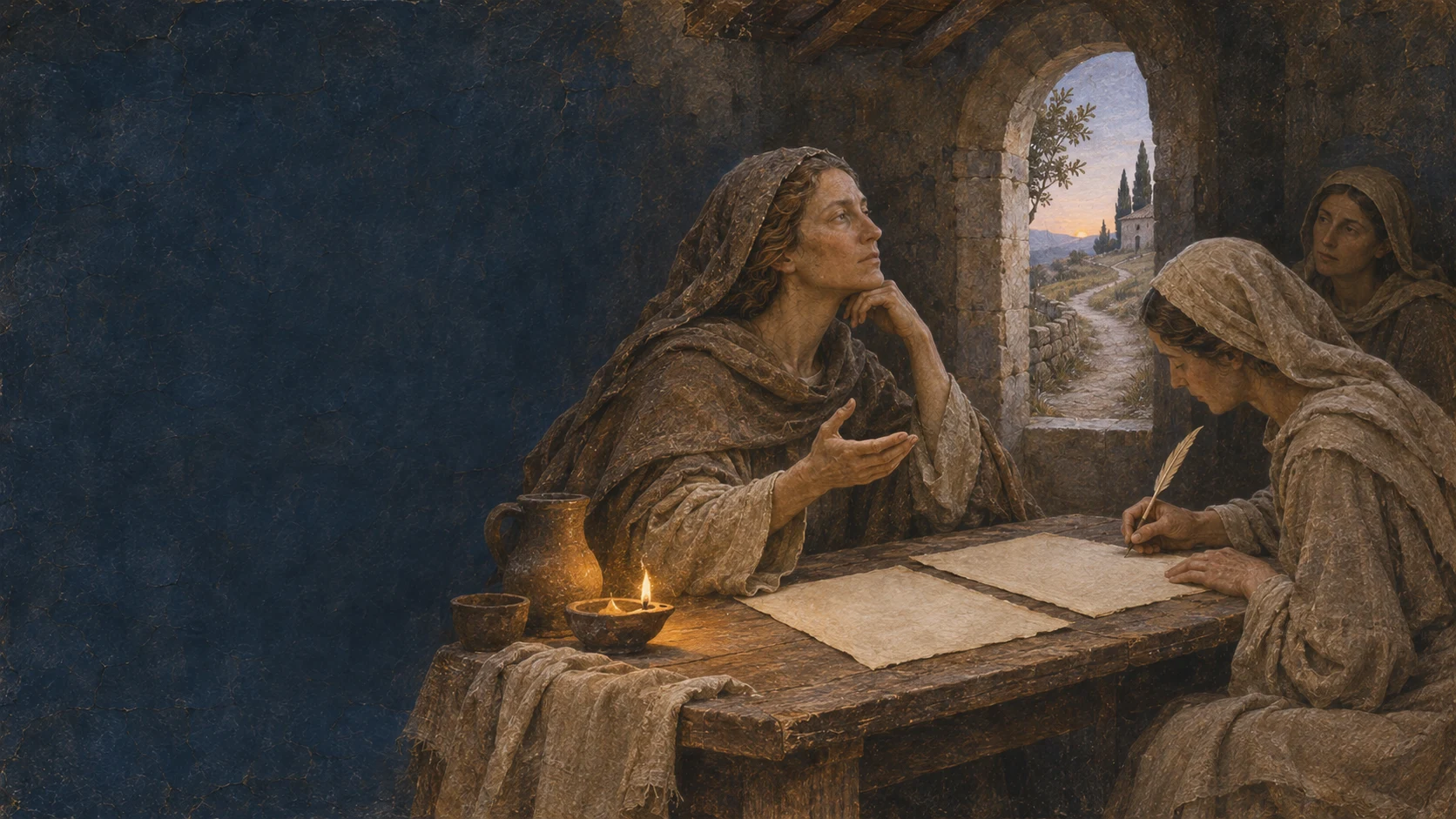
Some time after entering religious life, she received guidance that could alter the path of poverty she and her sisters desired. Clare replied with the letter we now call the Second Letter to Agnes. She did not shout, insult authorities or pretend the decision was simple. She offered a small method of faithfulness: consider the beginning, examine the calling, grasp it firmly and do not abandon it.
A letter without a perfect date
Scholars usually place the Second Letter between 1235 and 1238. The absence of a day and year in the manuscript requires combining internal references, papal documents and stages in the Prague community’s development.
This date range is a reasonable historical conclusion, not a certainty engraved in the text. It is a good example of how medieval chronology is built: different pieces come close together, but do not always fit like gears.
The letter mentions Brother Elias, then minister general of the Friars Minor, and advises Agnes to follow his counsel above others on the path of poverty. This detail helps date the text and reveals the network through which the two women acted.
What advice threatened the beginning?
Clare writes that if someone says something different or suggests something that hinders Agnes’s perfection and seems contrary to her divine vocation, she should respect the person but not follow the advice.
The text does not clearly identify this “someone.” The most common interpretation connects the passage to pressure for Prague to adopt a form of life with greater security through property, perhaps linked to papal guidance. Gregory IX was dealing with Agnes’s foundation and was concerned about its assets and stability.
We cannot turn a solid hypothesis into a transcript of an argument. The letter is a document; the actual conversation that prompted it has not reached us. A scene of an envoy bringing demands and Clare replying immediately is a reconstruction.
Respecting without obeying everything
This is one of Clare’s most delicate passages. She does not tell Agnes to despise those who advise her. She recommends reverence, but also freedom.
In the medieval world, a religious woman was surrounded by authorities: pope, cardinal protector, bishop, Franciscan ministers, confessors and family. Obedience was a central value. Clare does not remove it. Her own Rule begins with a promise of obedience.
Yet obedience did not mean accepting every instruction as God’s voice. If advice contradicted the recognized vocation, Agnes should remain on the path.
This requires discernment harder than automatic rebellion. The person may be sincerely concerned about food and protection. May hold a legitimate office. Even so, their advice may miss the heart of the lived experience.
Brother Elias on the horizon
Clare recommends that Agnes follow Brother Elias’s advice. Today, readers who know the controversies surrounding him may be surprised. Elias was close to Francis, became minister general and later faced strong opposition within the Order. His political career and relationship with Emperor Frederick II deepened the conflicts.
But the letter belongs to a specific moment. Clare was not writing an assessment of Elias’s entire future life. She saw in him an authority capable of supporting Agnes’s Franciscan faithfulness.
This detail prevents us from turning the characters into motionless statues. Alliances changed. People could serve well in one period and be questioned in another. A document needs to be read at the date it was produced, not in light of everything still to come.
“Look, consider, contemplate”
In the letter’s best-known part, Clare invites Agnes to look at, consider and contemplate Christ. The verbs form a movement.
Looking is not glancing. It means letting attention rest. Considering means examining the meaning. Contemplating means staying until what we see transforms the way we desire.
Clare directs the gaze toward the poor Christ, placed in a manger and hanging on the cross. Her spirituality does not separate beauty from vulnerability. The most worthy chooses humility; the king accepts the exposure of a wounded body.
Contemplation is not a way to escape the institutional decision. It is precisely where the firmness to decide comes from. Agnes must see what kind of Christ she wants to follow before assessing which economic form fits that following.
The mirror begins to appear
In her letters to Agnes, Clare would develop the image of the mirror. Christ is the mirror in which a woman contemplates poverty, humility and charity. In the Second Letter, this theme appears connected to attentive looking and transformation.
A medieval mirror did not offer the clarity of a modern one. Polished metal reflected light and outlines. The metaphor therefore does not speak of admiring a perfect image of oneself. It speaks of receiving another way of seeing.
By contemplating Christ, Agnes sees what she wishes to imitate. She does not lose her identity; she allows her values to be corrected.
Do not abandon the beginning
Clare tells her to remember her first resolution, like someone returning to a spring’s source. This could seem like nostalgia: everything was pure at the beginning and later went wrong. But the letter does not order her to repeat old emotions.
The beginning contains a direction. Agnes had chosen poverty out of love for Christ and to live with her sisters. New circumstances required prudence, but should not quietly replace the goal.
Remaining faithful can include adaptations. San Damiano had a vegetable garden, received alms and organized outside service. Clare was not defending an impossible performance. The limit lay in accepting a property base that would change the community’s identity.
Thus, “not abandoning” does not mean never changing anything. It means recognizing which changes help us walk and which lead us onto another road.
The tightrope of discernment
A community without property could suffer need. A community with large possessions could lose simplicity and depend on managers. Neither choice removed every danger.
Clare does not offer a universal formula for every religious house. She speaks to Agnes about a concrete vocation, formed by decisions already examined. This particularity matters. Using the letter to force others into a poverty they did not choose would contradict the freedom it defends.
Nor is this individualism. Agnes does not decide alone against everyone. She talks with Clare, the sisters and Franciscan advisers. Personal discernment happens within relationships, but is not dissolved by them.
The voice of a sick woman
Clare probably already knew health limitations when she wrote. Even without traveling, she followed debates in Prague. Her authority did not come from an office at court or physical strength. It came from experience, consistency and the ability to name the problem.
The letter shows tenderness — she calls Agnes her sister and dear daughter — and legal firmness. This overturns a common stereotype: that medieval women’s holiness was only passive sweetness. Clare knows how to argue, choose allies and set limits.
We do not need to turn her into a modern activist ahead of her time. Her concepts were Christian and medieval, and she accepted structures we would question today. Even so, she exercised real agency within them.
What the letter is not
The Second Letter is not a private diary. It was composed according to conventions, probably with a scribe’s work, and could be read by others. It does not reveal every emotion.
Nor is it neutral reporting. Clare wants to encourage and persuade. Her description of the path presents a spiritual choice, not a financial statement for the Prague monastery.
And it is not a legend. Unlike the miraculous scenes of hagiography, here we have words transmitted as Clare’s correspondence. Textual criticism still asks about manuscripts, variants and translation, but the documentary genre is clear.
Later stories of perfect harmony between Assisi and Prague belong to tradition. The letters reveal closeness, but also distance, delay and problems that could not be solved in a single message.
A friendship that does not take the other’s place
Clare could have demanded that Agnes simply imitate her. Instead, she points to Christ and to the decision Agnes herself recognized. This is a demanding form of friendship.
Bad friends choose for us or abandon us when conflict comes. Clare does something else: recalls the beginning, offers criteria, points to a trusted person and returns the decision to the recipient.
Perhaps this is why her words have crossed centuries. Every serious path reaches a moment when enthusiasm ends and pressure seems sensible. The question then is not “how can I feel the first day again?” but “what was true in that beginning and still calls for faithfulness?”
Clare answers quietly: look attentively, consider intelligently, contemplate lovingly — and hold on to what you have recognized.
Sources and paths for further reading
- Clare of Assisi — Second Letter to AgnesPrimary document. Text and metadata of the letter, generally dated between 1235 and 1238.
- Epistolae — Agnes of PragueDocumentary dossier. Places the recipient and the Church contacts connected to her community in context.
- Epistolae — Clare of AssisiPrimary corpus. Allows readers to follow the development of themes across the four letters.
- Writings of Saint ClareClarean source. Brings together letters, Rule and Testament for comparative reading.
- Oxford Academic — poverty and Clarean identityAcademic research. Examines the legal and spiritual conflicts shared by Clare and Agnes.
- Cambridge Companion — Francis and ClareAcademic research. Provides context for the authority of the friars and sisters.
- University of St Andrews — Franciscan womenUniversity research. Helps readers understand women’s agency and institutions without anachronism.
How we read the advice: Clare’s words are a document. The exact identity of all the advisers and the conversation that prompted the letter are reconstructed from context. Later portrayals of conflict or total harmony belong to tradition.