
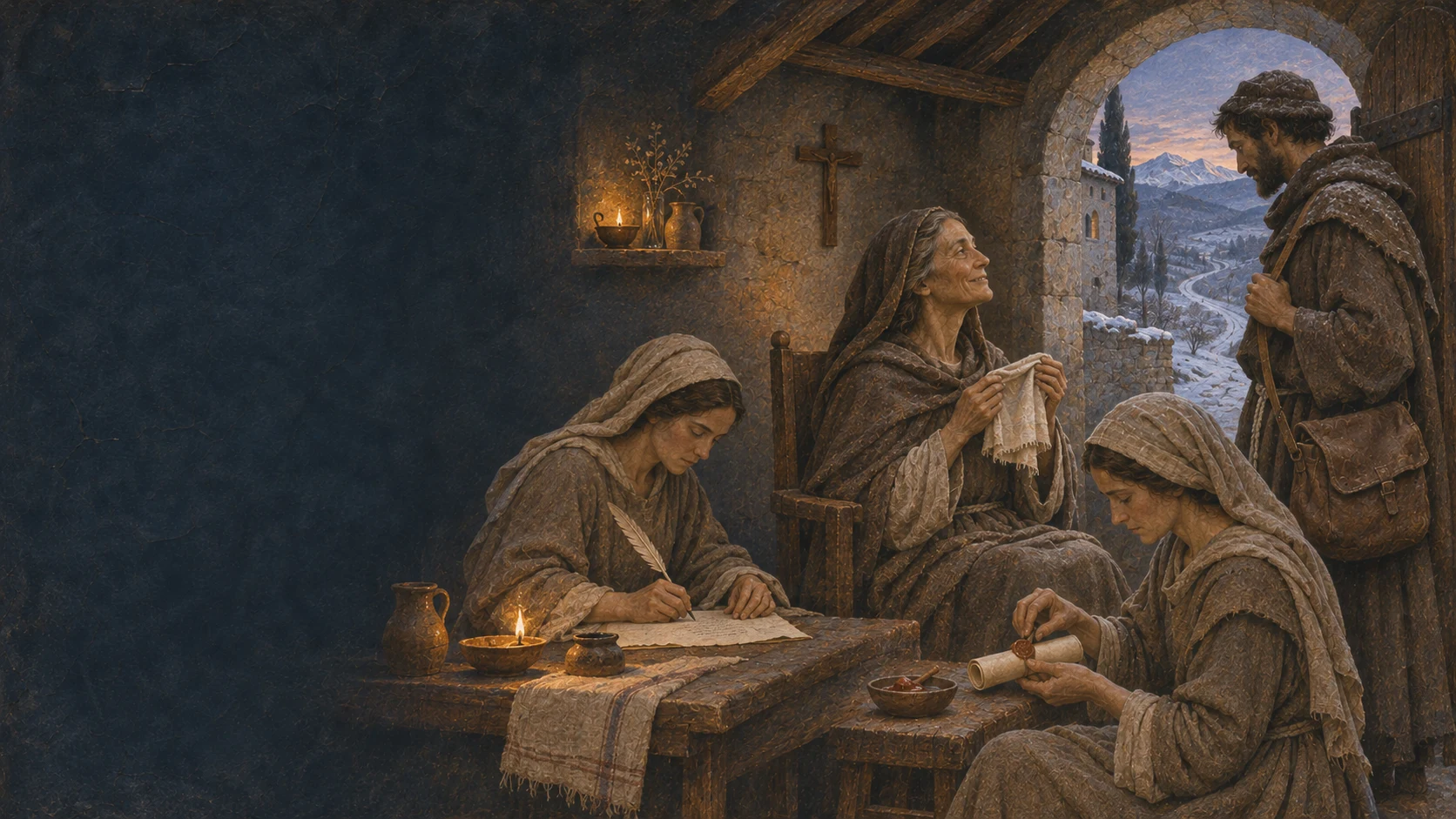
Clare begins her last surviving letter to Agnes of Prague with a closeness that reaches across the distance. She calls her friend half of her soul. The sick woman at San Damiano and the former princess of Bohemia had never met in person, as far as the sources allow us to know. Even so, they built a relationship that could be expressed in such intense words.
The letter is usually dated to 1253, the year of Clare’s death. It carries no clock allowing us to follow the day it was composed. We can read it in the light of the approaching farewell, but it would be wrong to fix the hour, invent a final candle, or describe the gestures of an unknown scribe.
What survives is already enough to bring us close: an affectionate greeting, an explanation for the delay, an invitation to contemplation, and the names of people entrusted with keeping the route between two houses open.
An acknowledged delay
Clare knows she has written less than either woman would have wished. She does not try to disguise the distance with a cheerful phrase. She explains that messengers were lacking and the roads were dangerous. The absence of letters did not mean her affection had diminished.
This explanation seems simple, but it changes how we imagine the Middle Ages. A message did not reach its destination because someone pressed a button. It needed a bearer who would cross regions, find a way through, receive shelter, and know whom to hand the parchment to.
We do not know this letter’s exact route. Identifying every inn, crossing, or threat would be a reconstruction without enough support. The document records the difficulty of transport; it offers no travel diary. Nor does it allow us to count how many messages disappeared before reaching us.
Four survivors are not the whole conversation
We have four letters from Clare to Agnes. Many years separate the third, usually dated to 1238, from the fourth. That gap belongs to the available documentation. It does not prove that the friends spent all that time without hearing from each other.
Agnes’s replies have not survived in the same way. Sometimes we glimpse her questions through Clare’s answers. At other times, we can only see that a wider exchange existed, also carried on through intermediaries. The archive has preserved an uneven part of the relationship.
It is important not to fill that gap with imaginary meetings. A friendship can be deep without our knowing how each stage began. It can also endure silence and incomplete information. Clare’s explanation preserves that very difficulty, without presenting the correspondence as a thread that never broke.
Mother, daughter, sister
In her greeting, Clare brings different roles together. Agnes is cherished as a daughter and honored as a mother. The exchange may surprise anyone expecting a fixed hierarchy: the older Clare would teach; the younger Agnes would learn. The text refuses such a narrow relationship.
These words belong to medieval spiritual language. Motherhood could mean guiding, sustaining, or bringing a form of life into being. Being a daughter could express gratitude and trust. The same person could occupy more than one of these places, because both women also drew strength from each other.
The expression about half a soul need not be hidden or turned into romance. It has a history in the language of friendship and appears in a religious work full of biblical references. Its context is communion in Christ. Reading its intensity requires respecting that context, without reducing all affection to a single kind of relationship.
Joy does not erase weariness
Clare rejoices in Agnes’s perseverance. She does not write as someone who has finally found a life without illness, conflict, or worry. Joy lives alongside her sickness and the memory of difficulties along the way.
This matters. Some accounts of holiness seem to suggest that a faithful person stops missing others. The letter shows the opposite: both women wanted to write more often. The wish for closeness appears as part of the bond, rather than a fault to be corrected.
Nor do we have access to Clare’s entire inner life. A letter chooses what to say. Her written joy is real as a surviving expression, but it does not allow us to declare that she never felt sad, frightened, or tired. Restraint begins when we respect what a document can reveal.
The mirror takes center stage
At the heart of the letter, Clare presents Christ as a mirror. She invites Agnes to look into it every day and recognize poverty, humility, and charity there. Looking is not a way to admire a beautiful face. It should transform the life of the person contemplating it.
The journey begins with Jesus’s birth, passes through the way he lived, and reaches the cross. In the manger, greatness appears in smallness. During his life, humility takes shape in actions. In the Passion, love is presented as the utmost self-giving. This sequence organizes the letter’s meditation.
Clare does not offer a summary of all Christian history. She chooses scenes that illuminate the calling shared by the two communities. Christ’s poverty helps them think about their own poverty; the love they receive asks how the sisters will treat one another. The mirror gives back a task, rather than a certificate of perfection.
Words that sing
The text grows more intense when it uses the language of the Song of Songs. Christian tradition read this biblical poem as an expression of the encounter between God and his people, between Christ and the soul. Clare writes within this long history of interpretation.
Perfume, desire, running, and embracing belong to this world of images. They are not codes for a secret relationship between people in the community. Nor are they mere decoration. They allow her to say that faith involves desire and joy, as well as rules and duties.
A careful reading notices the difference between biblical quotation, liturgical adaptation, and personal voice. Clare’s originality does not require her to have invented every image. Her way of choosing and gathering inherited words is part of her authorship. A shared language can serve a unique friendship.
The future cannot fit into a ready-made farewell
We know that Clare would die in August 1253. That knowledge weighs on our reading. To us, the letter seems a farewell. But we must not credit its author with knowing everything that would follow, or claim she was calculating how many days she had left.
The document speaks of communion and asks for prayers. The prospect of eternal life is explicit, as in other religious writings. That does not turn every sentence into a prediction of approaching death. Clare’s final circumstances help us interpret the letter without replacing the text with a farewell scene we do not possess.
Her concern also reaches people who would go on living. The communities would not disappear with her. New sisters would be welcomed, decisions made, and news would need to circulate. The bond with Prague had a future that its author would no longer be able to follow in the same way.
Names at the edge of distance
Near the end, Agnes, Clare’s sister, appears, sending her greeting. This is Agnes of Assisi, not the recipient in Prague. Two women with the same name occupy different places in the letter, and distinguishing them keeps the story from becoming a confusion of saints.
Clare also commends the bearers, Brother Amato and Brother Bonagura. These names give communication a human presence again. The friendship depended on people who carried messages, found routes, and represented one community before the other. We do not know enough to reconstruct each man’s full biography.
The Latin text helps us check these details and notice the work of translation. A word can be rendered in different ways in Portuguese. For that reason, the emotion of an expression should not be separated from attention to how it was handed down.
The request fits into a few words
Asking her friend for prayer also means admitting need. The author does not take her leave as someone who already offers everything and receives nothing. Her name and her sisters’ names are entrusted to the memory of distant women.
This gesture helps us recognize a mature friendship. At the beginning, Clare had celebrated an admirable choice. Now there is room to lean on the woman she had once encouraged. The exchange does not require them to have the same age, experience, or resources. It requires one life to matter to the other even when there is no meeting arranged, no date for a reply, and no guarantee of another message.
What remains of a voice
The Fourth Letter is a written document. Clare’s illness and final days also reach us through testimony collected in the Process. The Legend reorganizes memories into a narrative of holiness and belongs to hagiography. Later tradition brought these layers together in images of a final letter dictated close to death.
A reconstruction can help readers imagine the distance, provided it presents itself as a reconstruction. We do not know the room’s light, the sisters’ positions, or the expression of the person who received the parchment in Prague. We do not need those details to recognize affection.
The letter ends by leaving people in one another’s care. There is a distant friend, sisters gathered in two houses, and messengers who should be welcomed. Written love does not remove the road: it entrusts someone with the task of traveling it.
Sources and paths for further reading
- Clare — Fourth Letter to Agnes of PraguePrimary document. Greeting, explanation for the delay, meditation on the mirror, and commendation of the bearers.
- ALIM — Fourth Letter in the Latin textLatin text. Allows the language of affection, biblical references, and names at the close to be checked.
- Clare — Third Letter to Agnes of PragueDocument for comparison. Shows earlier themes; the gap between surviving letters does not measure the whole exchange.
- Regis J. Armstrong — Clare of Assisi: The LadySource edition. Offers introductions and translations of the writings and accounts of the final days.
- Catherine M. Mooney — Clare of Assisi and the Thirteenth-Century ChurchAcademic research. Places the final writing in the context of Clare’s relationships and institutional choices.
- Studying the Life of Saint Clare of Assisi — source guideAcademic guide. Presents critical editions and explains why the transmission of the writings needs examination.
Distinction: the words and names come from the letter; its date within 1253 and the scene of its preparation are not established with the same precision.