
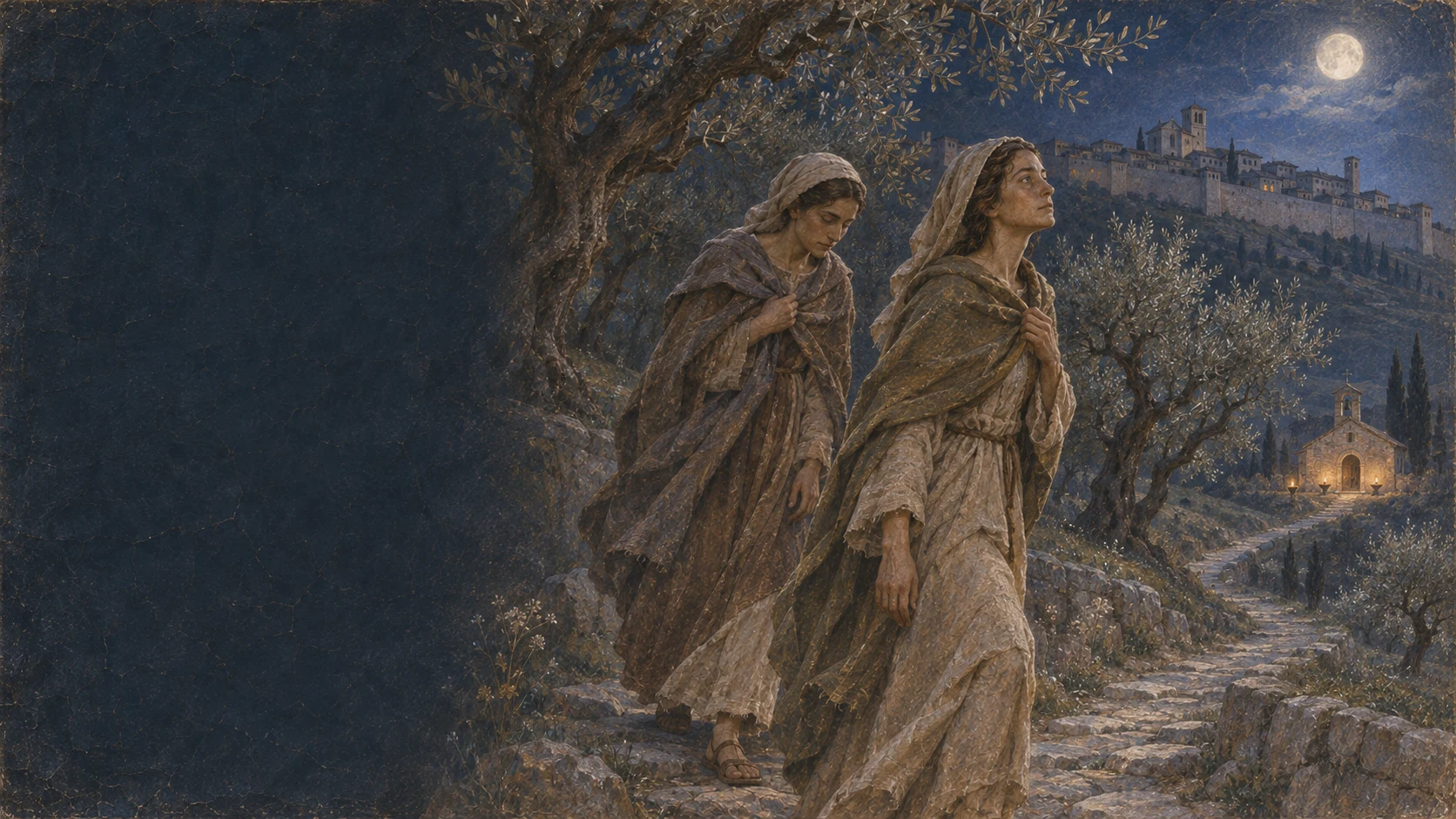
From the high city to Porziuncola, the terrain descends. Today roads, signs, and lights facilitate the journey. On Clare’s night there was uneven stone, fields, trees, animals and darkness.
The old narrative takes us quickly from the door of the house to the small church. A verb suffices: she was. But every moving verb contains a body. Clare had to plant her feet, choose direction, breathe and continue.
Get out of the walls
Medieval Assisi concentrated on the hillside and was protected by walls. Porziuncola was in the valley, a few kilometers below. We do not know which gate Clare passed through or whether she met any obstacle. A night exit required knowing gate times, paths, and watchmen.
It is also possible that parts of the route followed paths that have since changed. The Umbrian landscape preserves hills and olive trees, but eight centuries have changed buildings, crops, and roads. A current map measures line and altitude; it does not restore the sensation of the night.
The distance is not huge for an experienced traveler. For a young woman in a festive dress, at risk of being followed and without constant lighting, the distance carried another weight.
Who walked with her
The Legend states that Clare left the house accompanied. Some traditions name a companion; modern authors connect Bona de Guelfuccio. The Process confirms that Bona accompanied meetings with Francis, but does not clearly record every step of the escape.
This is why our image preserves a nameless woman. It represents a sure truth — Clare does not just appear alone — and respects the uncertainty about identity.
This presence changes history. It does not diminish Clare’s courage; it shows that courage can accept companionship. The other woman took a risk, knew at least part of the plan and helped to prevent the path from becoming isolation.
The Porziuncola before the basilica
Today the small chapel is sheltered within the great Basilica of Saint Mary of the Angels. In Clare’s time, it was a modest church in a rural place. Francis and his brothers had repaired it and adopted it as the center of their fraternity.
The contrast matters. Clare came from a noble house and from a crowded cathedral. She walked to a small building surrounded by the countryside. The strength of the place was not in monumentality, but in the life that began around it.
“Porziuncola” means small portion. The name suits a vocation that would choose little space and refuse large properties. It is not necessary to imagine that Clare formulated this symbol while walking. Later memory perceived the correspondence.
The way wasn’t a procession
Paintings sometimes show angels, stars arranged in order and effortless steps. A real crossing would have dust or moisture, cold, rocks and unfamiliar sounds. Clare could feel fear of relatives, robbers or simply not arriving.
We have no record of her feelings. Saying “could” protects the difference between human possibility and testimony. Courage is not absence of fear; however, applying this phrase to Clare is interpretation, not citation.
We also do not know whether she carried anything: perhaps the branch, perhaps nothing beyond her clothing. The artwork gives her nearly empty hands. This visual choice expresses renunciation but does not claim to document her baggage.
The city behind her
During the descent, Assisi remained visible on the hillside. Clare did not walk to a distant country. She remained under the shadow of the city and within the reach of relatives. The next day, her absence would be known.
This gives the way a particular tension. Going far away can delay the confrontation. Clare stopped first in nearby communities. Her new life would be born close enough to be challenged.
Years later, San Damiano would also be outside the walls and connected to the city. She did not choose to disappear. She chose a position on the threshold: near and outside, dependent and resistant.
Francis waited, Clare walked
At the Porziuncola, Francis and the brothers prepared the rite. This wait should not make him the hero who rescues a girl. He offered support, place and religious form. The decisive movement was Clare.
There is a beautiful asymmetry in the scene: men wait inside; women pass through the night. The nascent Franciscan movement would need to learn that the female vocation was not a simple appendage of male brotherhood.
After the tonsure, Clare would be led to a female monastery, because Porziuncola could not become her dwelling. The walk led to a rite, not yet to a definitive house.
Rebuild without pretending
To narrate this chapter, we used geography, architecture, customs, and ancient sources. This allows us to say that the path went down, that the night was dark and that the chapel was small. It does not allow us to describe the phase of the moon, a phrase spoken by the companion or the tree under which they stopped.
Responsible reconstruction does not mean leaving everything empty. It is to fill only what is necessary and keep the label visible. Art can offer a moon because it needs to illuminate the scene; the text must say that we do not know if the moon lit that night.
This method preserves the true mystery. The unknown does not need to be covered in false details to move.
The rhythm of the feet
Clare had been educated for a future in which trips would be authorized by family and position. That night, every step withdrew authority from that script. Still, she did not walk towards absolute modern autonomy. She entered into a life of obedience, prayer and ecclesial relations.
Her freedom was to choose to whom and to what she would give herself. To current readers, this may seem like a paradox. In Clare’s world, religious promise could make room to refuse marriage and property, while creating new rules.
The physical path helps us not to turn the choice into an idea. Freedom cost cold, distance and consequences. Faith crossed muscles.
Women who pass through the night
The episode belongs to a larger history of women on the move. Ortolana pilgrimed. Bona accompanied meetings. Catherine would leave the house shortly after. Sisters would travel between communities, although the cloister became progressively stronger.
Each displacement had different conditions. Clare’s became foundational because it opened up a way of life that others recognized as possible.
But no crowd followed behind that first night. There were few steps, perhaps two breaths and a point of light in the valley.
Arriving begins another uncertainty
When the chapel appeared nearby, Clare did not receive a complete vision of the future. She did not know in detail how she would face the family, where she would end up living, how many sisters would arrive or how she would argue with popes.
Reaching the Porziuncola did not settle her life. She made public before a small fraternity the decision that had matured in secret.
In the image, Clare looks forward as her companion lowers her eyes to the stones. One keeps the direction; the other watches the next step. Perhaps the spiritual life needs both movements.
The city was still shining behind. The chapel was shining ahead. Between two lights, Clare walked without any. That interval was her first free home.
The night measured by sound
Without urban lighting, the ear also guided. Bells could mark hours; dogs announced movement; water and wind guided those who knew the valley. None of this was recorded for that night. These are elements of the historical environment, not personal memories of Clare.
Thinking about the sounds prevents the walk from turning into still landscape. Two women needed to listen as they advanced. A distant light could disappear behind the trees; the city behind could still draw attention.
The way after the way
Porziuncola has become one of the most beloved places of Franciscan memory. Centuries of pilgrimage have covered the surroundings with constructions and devotions. Visiting today can bring the reader closer to the chapel’s scale, but does not automatically return the night of 1211 or 1212.
The historical place is valuable when we do not confuse it with a time machine. Restored stone, liturgical tradition and research speak together; none eliminates the gaps. Clare continues walking precisely in this interval between what the memory has kept and what we have lost.
The possible path
Sources for this chapter
- Legend of Saint ClareNarrative source. Leads Clare from home to Porziuncola and records that she did not leave entirely alone.
- Process of CanonizationTestimonies. Confirms relationships and decisions without providing path diary.
- Guide to St. ClareCorpus. Offers text and chronology for comparison.
- Basilica of Saint Clare — historical profileLocal context. Summarizes the passage from the city to the valley.
- Writings of St. FrancisPrimary context. Helps understand the brotherhood connected to Porziuncola.
- A Companion to Clare of AssisiAcademic research. Discusses chronology, companionship, and the meaning of the departure.
Level of certainty: Porziuncola, night and companionship are ancient memory; route, climate, moon, duration, luggage and certain identity of the companion have not been preserved.