
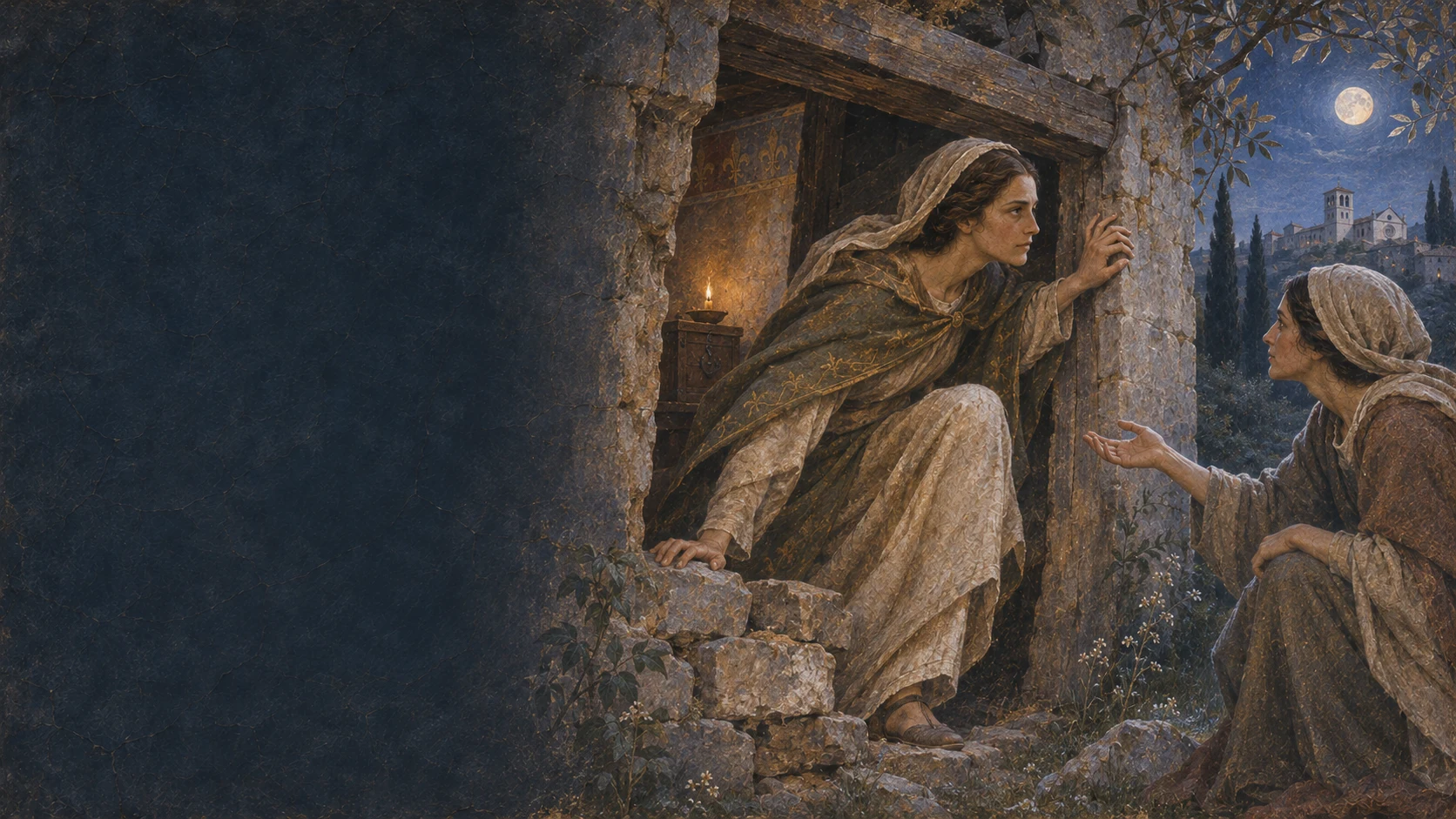
When the night came, Clare didn’t use the main door.
The old Legend says that she left through a secondary opening, blocked with wood and stones, and that she managed to remove the obstacle with surprising force. The image is too perfect to pass without questions: a young woman opens what seemed closed and leaves behind the house of her name.
Later, tradition called this passage “the door of the dead.” The expression is powerful. It is not, however, in the oldest source of the episode.
Why not the main entrance
Noble houses were spaces of protection and control. Main doors could be guarded; servants and relatives knew who came in and out. Clare needed to avoid interruption before reaching the friars.
The Legend also says that she was accompanied. Sources and interpretations differ about who was with her and for which parts of the journey. Bona is a witness of previous encounters, but we should not automatically place her in every scene. The female companion in art is deliberately anonymous.
Choosing another passage shows planning. It was not about walking down the street in broad light and announcing an argument. Clare knew that her family would consider the exit a threat to honor and property.
Wood, stone and a young body
The hagiographic text emphasizes that the opening was closed by weight that several people could barely move, but Clare opened it alone with divine help. This intensification reveals the way the Legend reads the act: God strengthens an apparently fragile young woman.
We can accept that there was real effort without trying to calculate an impossible weight. Hagiography uses contrast to manifest virtue. Spiritual truth — a decision overcomes an obstacle — is presented by means of extraordinary force.
In medieval life, women worked, carried water, moved utensils and endured journeys. “Frail” was also a cultural expectation. Clare did not need to possess superhuman strength to surprise those who underestimated her.
The so-called door of the dead
In many modern narratives, the passage receives the name “door of the dead” and is explained as an opening used to remove corpses, avoiding the ordinary entrance. Symbolism is immediate: Clare dies to the old life and is born to another.
The problem is that this identification does not appear clearly in the ancient Legend. It may reflect local architectural tradition or devotional development. Without a contemporary document establishing use and name, it must be counted as tradition, not as indisputable fact.
This does not make the image useless. Traditions show how generations understood an event. The door of the dead is a later reading of the rupture. The mistake would be to assign the name to Clare herself.
Escape or exit?
“Flight” describes discretion and urgency. It can also suggest someone with no plan, running just to escape. Clare was walking toward an agreed destination: the Porziuncola, where Francis and the brothers were waiting for her.
“Exit” better preserves her agency. She was not just fleeing from marriage; she was going to a way of life. The two words can be used, as long as none erases the other dimension.
In the family, the gesture was probably seen as disobedience and loss. For Clare, it was a religious response. The same door separated incompatible interpretations.
The house wasn’t just prison
It would be easy to paint the home as a totally dark place and the exterior as pure freedom. Clare received care, training, relationships and resources there. Ortolana, Catherine and Beatrice were not just obstacles. Later, they would all connect in different ways to the community.
Leaving can hurt just because there is love. Sources don’t register farewell. We don’t know if Clare looked at a room one last time, if she took her palm or if she thought about her mother. Inventing specific tears is not necessary to recognize the cost.
The decision questioned family authority but did not require hating the family. In the following years, relationships would be remade in unexpected ways.
The legal and social risk
A noblewoman was bound up in marriage agreements, dowry, and inheritance. Her choice affected more than feelings: it could alter alliances and the circulation of property. That is why relatives would react forcefully at the first refuges.
Clare also could not simply rent a house and live alone. She needed recognizable religious protection. The haircut and penitential clothing would make her decision visible; the shelter in a monastery would give her institutional space, albeit precarious.
The night opened a freedom, but did not eliminate dependencies. She exchanged one set of relationships for another and would spend decades negotiating autonomy within the Church.
What was outside
Assisi at night was not illuminated like a modern city. There was moonlight, rare lanterns, domestic fire and darkness. Stone paths could be dangerous. The walls had guarded gates, and the Porziuncola was below the city.
We do not know the exact path. Modern maps can measure distance; they cannot recover each deviation or stop. Visual narrative uses olive trees and Assisi’s view to situate, not to provide topographic reconstruction.
Clare might still wear the costume of the feast. The Legend creates a strong contrast between the abandoned adornments and the poverty received. In the image, the mantle shows restrained wealth and already touches the stone and the earth.
A night without spectators
Unlike the palm in the cathedral, the exit took place far from the assembly. There was no crowd to applaud. Clare’s decisive gesture began hidden.
This contrast is important. Medieval holiness had a public dimension, but many choices were born without audience. Only later did the community tell the night as a beginning. Memory organized signs: palm, door, path, hair.
Each sign has a basis and elaboration. Together, they do not form a fairy tale, but a narrative of passage. The task of the portal is to allow the reader to feel its force without erasing the historical seams.
The door inside the memory
The Legend was composed after Clare’s death, using the Process and other information. When writing about youth, the author knew who she had become. The door appears illuminated by the future: that young woman would found a community and have a confirmed Rule.
Clare did not possess that complete certainty on the night itself. She knew the next destination, not every decade. Real courage does not require knowing the end; it requires taking the possible step.
In art, a companion extends her hand, but does not pull. Clare supports her own weight on the stone. The moon does not open the door. Francis does not even appear. Her body makes the choice.
What’s left behind
Clare left property, possibility of marriage, position and family protection. She did not abandon memory, intelligence or ability to love. She took with her everything that a life had already taught her and subjected it to a new direction.
The main door represented the planned path: going out as a daughter to become a wife in another noble house. The secondary passage led to something that society still did not know how to name completely.
Then other women would cross. Catherine would follow her sister. San Damiano would become home. The solitary gesture would produce a community.
Tradition called that opening the door of the dead because it saw a symbolic death. Perhaps we can add carefully: for Clare, it was above all a door of the living. The night did not close her story. It opened it.
An opening is not complete freedom
After crossing the wall, Clare remained vulnerable. The family could reach her, and the institutions that would receive her had their own rules. The door did not separate prison from perfect freedom; it separated an unchosen obedience from a path in which she would accept new obediences.
This difference avoids a modern simplistic reading. Clare did not want to live without ties. She wanted to choose bonds capable of serving the Gospel. The night opened this negotiation, which would last her whole life.
What the door holds
Sources for this chapter
- Legend of Saint ClareMain source. Narrates obstruction, exit and providential interpretation.
- Process of CanonizationTestimonies. Offers the oldest control over youth and family reaction.
- Guide to St. ClareCorpus. Facilitates the comparison between Process, Legend and the writings.
- Basilica of Saint Clare — historical profileMemory of the place. Summarizes the departure and distinguishes traditional elements.
- A Companion to Clare of AssisiResearch. Analyzes gender, family, agency and narrative construction.
- Letter for the Year of ClareOfficial reception. interprets the departure as a vocational and ecclesial decision.
Level of certainty: the blocked passage comes from the Legend; “door of the dead”, exact architectural function and details of the escape belong to tradition or reconstruction.