
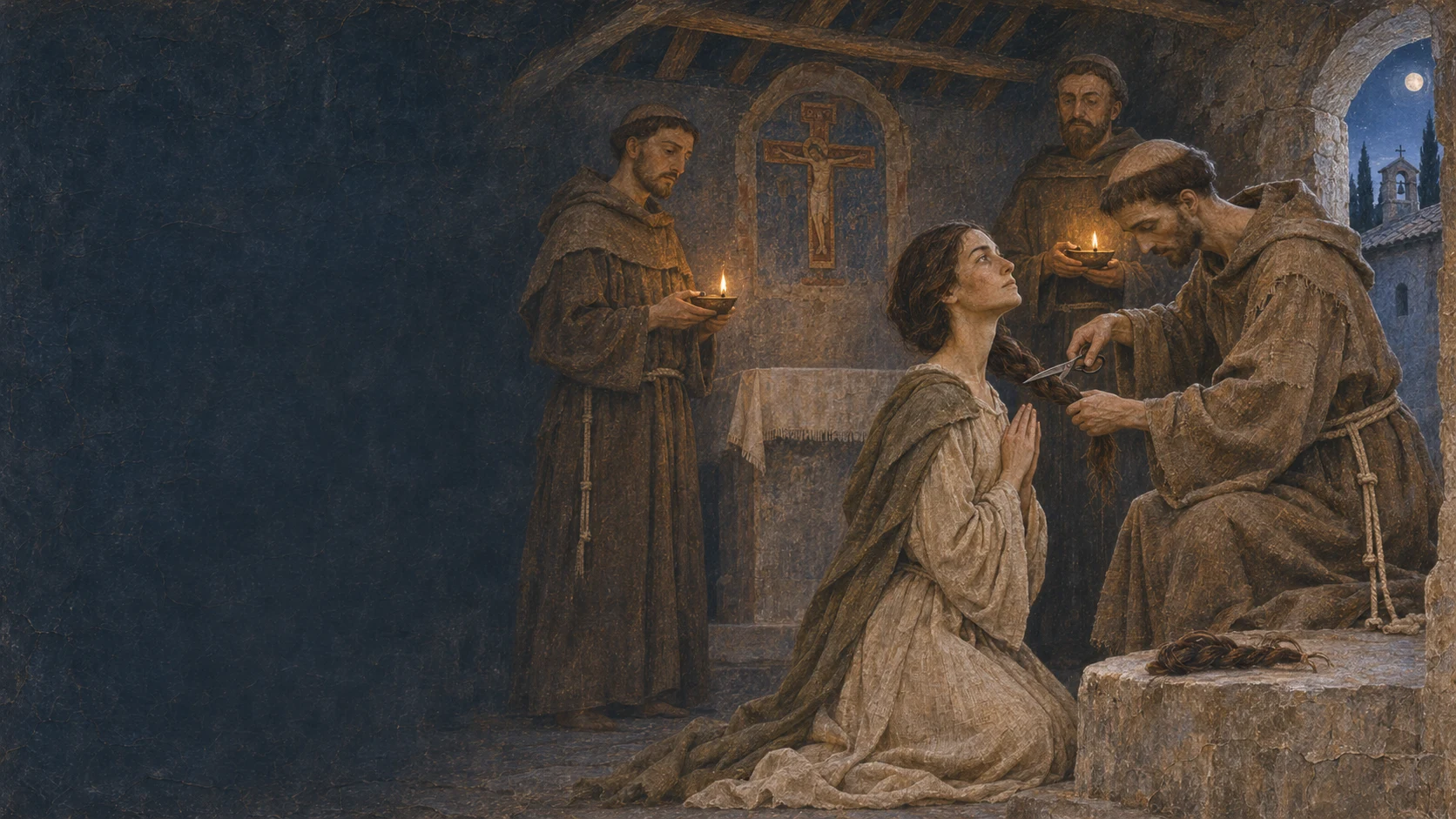
At the Porziuncola, by the light of oil lamps, Clare let them cut her hair.
Today a cut can mean taste, fashion or personal renewal. At the beginning of the 13th century, a young noblewoman’s hair formed part of her social identity, expected beauty and future marriage. Cutting it in a religious rite declared before witnesses: this body will not follow the path prepared for her.
The old Legend attributes the gesture to Francis. The brothers were present. Clare received a poor garment. The inner decision gained visible form.
The little church full of witnesses
The Porziuncola was modest. Francis and the brothers had made it a center of prayer and departure. That night, the male space welcomed for a few hours a woman whose vocation had not yet had a home.
The Legend speaks of brothers with torches, creating an almost liturgical scene. This can preserve memory and also organize the episode as spiritual wedding procession.
There was no photographer, written record, or catalogued object. When a current image chooses four people, stone and scissors, it is interpreting. The historical center remains: Clare arrived, had her hair cut and changed clothes before being taken to the first refuge.
What the tonsure meant
Tonsure was the religious cut that marked clerical or monastic belonging in different forms. For men, patterns could be defined. For women, cutting hair accompanied entry into religious life and renouncing the appearance expected of a future wife.
Clare was not yet in an established female community. Her rite was performed by Francis, the leader of a penitential brotherhood, and then she was led to a Benedictine monastery. The sequence shows creativity and precariousness.
The cut should not be read as contempt for the female body. Clare would later care for sick sisters, write about the incarnated Christ and use language of motherhood. Renunciing a social sign of beauty is not declaring beauty to be a sin.
Who acts on the scene
Paintings can make Francis look like the agent and Clare, passive matter. The verb “cut” favors this impression. But the context shows that the rite responded to the desire Clare had matured and for which she left home.
Francis did not steal her hair. Clare offered it as part of a choice. Still, there was gender inequality and authority. He already had community and recognition; she depended on his support to pass through the first moment.
A mature reading preserves the two things: Clare’s agency and Francis’ real mediation. We do not have to turn one into a villain or the other into an absolute savior.
In art, Clare looks up and keeps her hands together. Francis leans to serve the rite. Her gaze does not ask for romance; it expresses decision before God.
The hair and the family
When relatives found Clare in San Paolo delle Abbadesse, they would immediately see that something had happened. Clothes and hair served as visible evidence. The choice could not be hidden or treated as a walk.
This helps to understand the strong reaction. A marriage could still be negotiated while the young woman remained socially available. The tonsure signaled consecration and placed the family before a religious fact, not just a domestic discussion.
Relatives would try to take her back. Clare would cling to the altar cloths and show her shorn head, according to the Legend. This next episode also uses gesture and body as an argument.
The change of clothes
The Legend contrasts noble adornments and humble clothing. In medieval societies, clothing declared status. A simple tunic brought Clare closer to penitents and poor people, although she still carried her education and the networks of her origin.
We do not know the exact cut, the color or who sewed the piece. Representing it with a clarissa habit of later centuries would be anachronistic. The first outfit probably looked more like simple penitential dress than a fully defined monastic uniform.
So art uses wool and linen in natural tones. There is no perfectly arranged modern veil. The history of female religious clothing would be long, linked to rules, cloister and community identity.
Christ’s Bride: language and risk
Medieval texts describe consecrated women as brides of Christ. The Legend uses nuptial images for Clare’s night. In her letters to Agnes of Prague, Clare herself employs nuptial language, love and union with Christ.
This language should not be reduced to disguised human romance. It comes from the Bible, liturgy, and monastic tradition. It allowed women to say that their main relationship was not defined by an earthly husband.
It may also sound strange or excessive to the current reader. The way is to explain it, not erase it. For Clare, belonging to Christ grounded freedom, poverty and community.
A rite without a final home
After the haircut, Clare did not remain in Porziuncola. She was taken to San Paolo delle Abbadesse, a protected and recognized monastery. This shows that the rite did not resolve the institutional question.
Where would poor women live? Under what rule? Who would give them food and protection? What authority would they have? The answers would arise over years.
The hair on the stone marks a beginning, not a conclusion. The force of the scene can hide the long daily administration that came after. A community cannot live on beautiful moments alone; it needs bread, care, decision and documents.
Document, hagiography and relic
Our main narrative is hagiographic. The Process confirms Clare’s choice and firmness through witnesses, but does not transcribe the ceremony minute by minute.
Later traditions have identified objects and places, and hair strands attributed to Clare are venerated. Relics belong to the history of devotion; their material authenticity requires another type of analysis and cannot be proved only by tradition.
The portal does not need to ridicule devotion or convert every tradition into a historical report. It can say clearly: this is ancient text; this is testimony; this is tradition; this is artistic reconstruction.
The price of the gesture
Hair grows. The family might think it would be enough to wait. But the haircut was joined to a promise and religious shelter. Reversing the gesture would require publicly denying a decision made before witnesses.
Clare would bear pressure not because her hair possessed magic, but because her will had acquired form. The body helped to sustain the word when relatives tried to treat her decision as a whim.
Many years later, already ill, she would write a Rule approved for her community. Between the scissors of that night and the papal seal of 1253 lie four decades of perseverance. The brief gesture is only understood by the duration.
What the stone kept
The title of this chapter speaks of hair on the stone. We do not know if the braid fell exactly on a step, was gathered up or preserved. The stone is a visual resource: something alive and soft finds an ancient and firm surface.
This contrast tells what does not fit into an official record. Clare lost a visible sign of noble future and gained a path without guarantees. Francis cut; the brothers lit up; then each witness left. Clare needed to remain the person who had said yes.
Art avoids a halo. Light comes from small flames. Holiness, that night, was no effect on the air. It was a young woman kneeling, men trying to receive what they did not yet fully understand and a door open to other women.
Not the end of the young girl, but the beginning of the author
Sometimes the tonsure is told as if Clare disappeared to give way to “the saint.” That is unfair. The young woman with family, intelligence and desires was not erased. She became founder, leader, correspondent and author.
Her hair was cut; her voice grew. Her clothing lost signs of nobility; her ability to negotiate with cardinals and popes did not diminish. The rite made her no less a person. It gave her body a language for a project that would still need to be built.
The next morning, the world was unresolved, the relatives would come, the first shelter would be temporary, the community still did not exist, but one thing could no longer be ignored: Clare had chosen.
Scissors, clothing, and memory
Sources for this chapter
- Legend of Saint ClareMain source. Narrates Clare's reception, the cutting of her hair, and the change of clothing.
- Process of CanonizationTestimonies. Confirms Clare's choice and allows comparing what was not narrated in detail.
- Guide to St. ClareCorpus. Gathers old sources, writings and references.
- Basilica of Saint Clare — historical profileLocal memory. Situates the tonsure in the chronology and geography of Assisi.
- A Companion to Clare of AssisiAcademic research. Discusses rite, genre, agency and sources.
- Writings of St. FrancisFranciscan primary voice. Contextualizes the fraternity that welcomed Clare.
- Letter for the Year of ClareOfficial reception. Interprets consecration and collaboration with Francis.
Level of certainty: shades, poor garment and welcome belong to the ancient narrative; instrument, speeches, position of those present and hair on the stone are visual reconstruction.